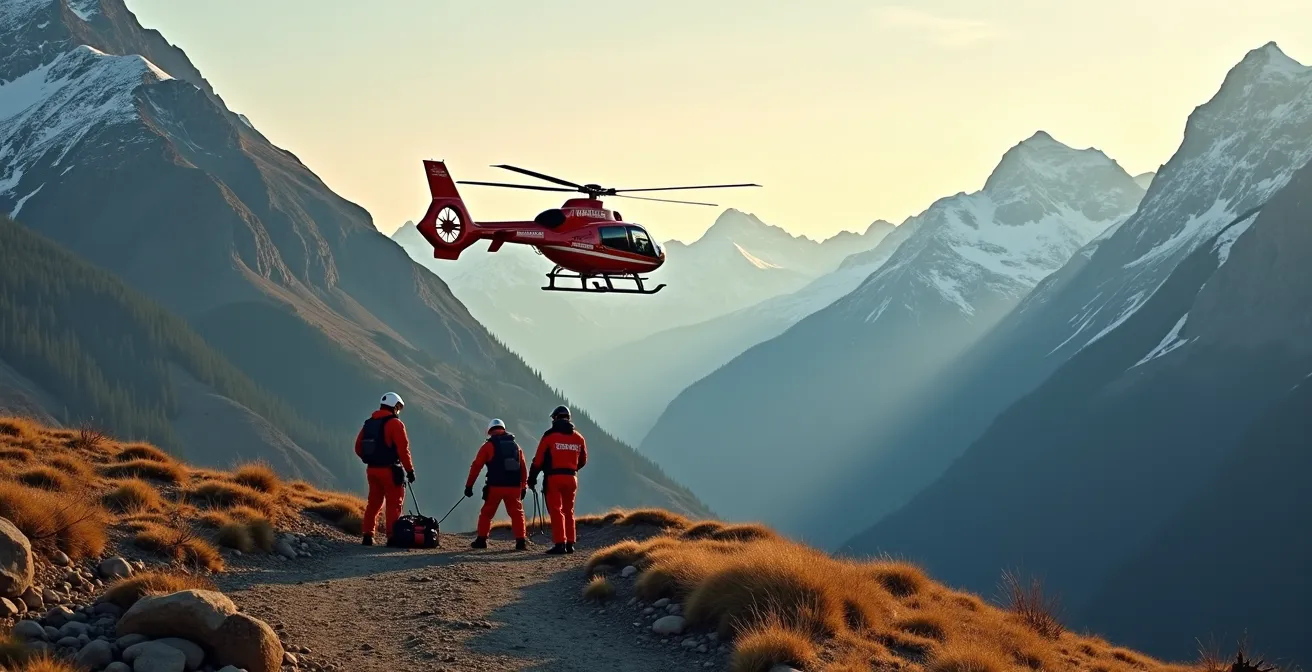
Contrary to popular belief, backcountry rescue in Canada is not universally free, and your standard travel insurance likely won’t cover the helicopter ride.
- Rescue costs are a ‘jurisdictional roulette’—free in National Parks but potentially thousands of dollars in certain provincial parks like those in Quebec.
- Satellite device insurance often has critical fine print, such as 100-mile radius rules, creating major ‘coverage gaps’ for the actual evacuation.
Recommendation: Purchase a dedicated adventure or evacuation insurance policy *before* your trip that explicitly lists “search and rescue” as a covered expense.
The vast, untamed wilderness of Canada is a siren call for adventurers worldwide. You’ve meticulously planned your route, packed the right gear, and perhaps even invested in a satellite messenger for emergencies. There’s a common, comforting assumption among many international travelers: if something goes wrong, a helicopter will appear, and the rescue will be free, or at least covered by your standard travel medical plan. This assumption is not just wrong; it can be a five-figure financial catastrophe.
As an adventure insurance broker, I see the devastating aftermath of this misunderstanding. The real risk is often not the broken leg, but the bill for the evacuation that your policy refuses to pay. The Canadian rescue system is a complex patchwork of federal, provincial, and volunteer organizations, each with different rules on who foots the bill. This creates a high-stakes ‘jurisdictional roulette’ where your financial fate depends entirely on where your accident occurs. Standard insurance is designed to pay for the hospital, not the ride to get there.
This guide will serve as your insider briefing. We will move beyond the platitudes of “be prepared” and dive into the fine print. We’ll dissect who really pays for a helicopter rescue, expose the dangerous coverage gaps in common safety nets, and outline the practical steps—from gear choices to legal requirements—that constitute true preparedness for a Canadian wilderness expedition. It’s time to understand the difference between being equipped and being truly insured.
This article provides a comprehensive overview of the essential considerations for any adventurer heading into the Canadian backcountry. From the financial implications of a rescue to specific gear requirements and local regulations, we’ll cover the critical details you need to know.
Summary: Navigating the Realities of Canadian Backcountry Adventure
- Who Pays for the Helicopter: Parks Canada vs. Provincial Rescue Policies
- Satellite Messenger vs. PLB: Which Device is Best for Solo Hikers in Canada?
- Beaver Fever: Why You Must Filter Canadian Stream Water Despite It Looking Clear?
- The Bear Canister Rule: Where is Hanging Food No Longer Allowed?
- Crown Land Camping: How for Non-Residents to Camp for Free Legally?
- GPS or Topo Maps: What to Trust When You Are 50 km into the Bush?
- The PCOC Requirement: Do You Need a License to Drive a Rental Jet Ski?
- How to Book Alpine Club of Canada Huts Before They Sell Out in Minutes?
Who Pays for the Helicopter: Parks Canada vs. Provincial Rescue Policies
There’s a pervasive myth, often repeated in outdoor forums, that backcountry rescue in the U.S. and Canada is nearly always free. This oversimplification is dangerously misleading for international travelers in Canada. The reality is a complex ‘jurisdictional roulette’ where the cost of your rescue depends entirely on your location. Getting this wrong can mean the difference between a sigh of relief and a $10,000 bill.
The good news is that for trips within Canada’s National Parks—such as Banff, Jasper, Yoho, Kootenay, or Glacier—search and rescue (SAR) operations are generally covered if you have paid your park admission fee. Similarly, adventures on Alberta’s provincial lands, including the popular Kananaskis Country and Canmore areas, typically do not result in a rescue bill. This is the foundation of the “rescue is free” myth.
However, the moment you step outside these specific jurisdictions, the rules change dramatically. In British Columbia, whether a rescue in a provincial park is free can be situational. A critical factor is who initiates the call. If your guide or a bystander calls 911 and a volunteer SAR team is dispatched, the costs are usually covered by the provincial government. But if private resources like a helicopter company are called directly, you are on the hook for the full cost. The most clear-cut user-pay model is in Quebec, where SEPAQ, the provincial park authority, states explicitly that all rescue operations are at the expense of the person rescued. This includes the ambulance ride from the park entrance to the hospital, which alone can cost thousands.
Satellite Messenger vs. PLB: Which Device is Best for Solo Hikers in Canada?
Carrying a satellite communication device is non-negotiable for serious backcountry travel in Canada. The choice between a Satellite Messenger (like a Garmin inReach or Zoleo) and a Personal Locator Beacon (PLB) often comes down to communication needs. Messengers offer two-way texting, which is invaluable for non-emergencies, while PLBs are one-way, single-use distress signals that connect directly to the international Cospas-Sarsat satellite system. For a solo hiker, the ability to communicate changing plans or minor issues often makes a messenger the superior choice.
However, relying on the insurance offered with your messenger subscription is a classic ‘coverage gap’ trap. Many international travelers purchase the add-on rescue insurance, assuming it’s a complete safety net. A user in an online forum discovered a critical piece of fine print in their inReach policy: for the rescue insurance to be valid, you must be over 100 miles away from your home (as the crow flies, not road miles) and the rescue must be initiated from your device. This makes the policy effectively useless for Canadian residents exploring their local mountains and potentially problematic for international visitors on trips near their Canadian ‘home base’ city.
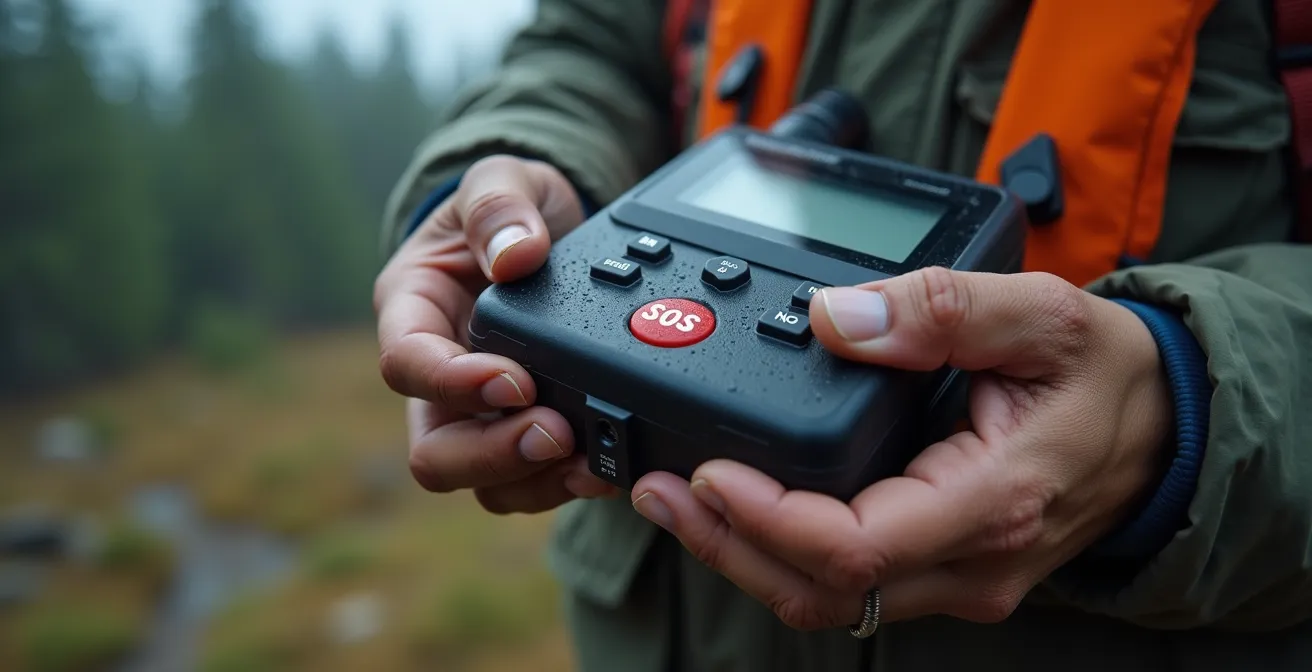
As this case study shows, these policies are not a substitute for proper adventure travel insurance. They are a supplementary benefit with major exclusions. Your primary insurance must be a standalone policy that explicitly covers search and rescue, regardless of how the call was initiated or your distance from home. The device gets the message out; a proper policy pays the bill.
Beaver Fever: Why You Must Filter Canadian Stream Water Despite It Looking Clear?
That crystal-clear, ice-cold stream running through the alpine meadow looks like the most refreshing drink in the world. It’s a tempting, iconic image of the Canadian wilderness. Unfortunately, drinking it unfiltered is one of the quickest ways to end your adventure. Canadian water bodies, no matter how pristine they appear, can be contaminated with microscopic parasites, with the most notorious being Giardia lamblia.
This parasite causes giardiasis, commonly known as “Beaver Fever.” The name comes from beavers and other mammals acting as hosts, shedding Giardia cysts into the water through their feces. The symptoms—including severe diarrhea, gas, stomach cramps, and dehydration—can take one to two weeks to appear, often hitting you long after you’ve left the trail. A severe case can lead to hospitalization and completely derail your travel plans, an entirely preventable medical situation.
This is where the ‘self-sufficiency mandate’ comes into play. It’s a philosophy that underpins much of Canadian park management. As CAA-Quebec aptly puts it in their guide, “Parks Canada encourages visitors to be self-sufficient and prepared to deal with emergencies in the woods or elsewhere.” An emergency isn’t just a broken bone; it’s also a debilitating gastrointestinal illness. Being self-sufficient means not assuming water is safe. It means carrying and consistently using a reliable water filter, purifier, or chemical treatment. It’s a fundamental aspect of risk management that protects your health and your trip.
The Bear Canister Rule: Where is Hanging Food No Longer Allowed?
For decades, the “bear hang” was the gold standard for protecting food in the backcountry. However, in many of Canada’s most popular and densely populated bear habitats, this method is no longer sufficient or even allowed. Bears, particularly in areas like the Rockies, have become highly adept at defeating even the most elaborate rope systems. This has led park authorities to implement mandatory hard-sided bear canister rules in an increasing number of zones.
This rule change is not about making life difficult for hikers; it’s a critical component of wildlife management. When a bear gets a “food reward” from a campsite, it becomes conditioned to associate humans with food, leading to more aggressive behavior. This often results in the bear having to be relocated or, in the worst cases, destroyed. To protect both wildlife and visitors, Parks Canada has been making significant investments in conservation. In fact, in a recent plan, $23 million was allocated to 56 conservation projects, many of which focus on reducing human-wildlife conflict. Requiring canisters is a direct result of this evidence-based strategy.
For the international traveler, this means you must check the specific regulations for your intended route *before* you go. Areas like the Lake O’Hara region in Yoho National Park and many core areas in Banff and Jasper now require approved, hard-sided containers. Assuming you can just hang your food could lead to being turned away by a ranger or, worse, contributing to a dangerous bear encounter.
Action Plan: Complying with Bear Canister Regulations
- Identify Zone Requirements: Before your trip, consult the official Parks Canada website to check the specific backcountry zones you’ll enter for mandatory hard-sided container rules.
- Inventory Your Options: List rental locations in gateway towns like Canmore, Banff, or Jasper (expect $5-10/day) versus the cost of purchasing an approved model ($70-150).
- Verify Model Approval: Cross-reference your chosen canister—whether rented or owned—with the park’s official list of approved models to ensure full compliance.
- Assess Practicality: Evaluate if the canister’s volume is sufficient for your food and if its bulk and weight are manageable within your pack. This is a critical trip-planning calculation.
- Integrate into Your Plan: As confirmed by various outfitter guides, you should reserve a rental or purchase your canister well in advance, especially during peak season, to avoid shortages.
Crown Land Camping: How for Non-Residents to Camp for Free Legally?
For many adventurers, the idea of “Crown Land” in Canada evokes a romantic image of limitless, free camping. Crown Land makes up about 89% of Canada’s land mass, and in principle, it offers incredible opportunities for dispersed, no-trace camping. However, for non-residents, the rules are not as simple as just pitching a tent anywhere.
The regulations vary by province. In Ontario, for example, non-Canadian residents who wish to camp on Crown Land must purchase a Crown Land Camping Permit. This is a crucial detail many international visitors miss. Without this permit, you are technically trespassing. In British Columbia, the rules are generally more lenient, and non-residents can often camp on Crown Land for up to 14 days in one spot without a permit, provided the area is not otherwise restricted. The key is research.
Finding legal Crown Land camping spots requires using tools like the BC Backroad Mapbooks or Ontario’s Crown Land Use Policy Atlas. These resources show you the boundaries of Crown Land and highlight any specific restrictions. It is illegal to camp on private land, in provincial or national parks outside of designated campgrounds (without a backcountry permit), or on land leased for other purposes like logging or mining. Assuming a logging road leads to “free” camping is a risky gamble. Legally camping on Crown Land as a non-resident is absolutely possible, but it requires due diligence, adherence to provincial laws, and a commitment to leaving no trace.
GPS or Topo Maps: What to Trust When You Are 50 km into the Bush?
The debate between digital and analog navigation is a classic one in the outdoor community. A GPS device or a smartphone app offers unparalleled convenience and precise real-time location. However, placing 100% of your trust in electronics when you are deep in the Canadian wilderness is a critical error. Batteries die, screens break, and devices can fail in extreme cold. A physical topographic map and a compass are your ultimate, failure-proof backup.
The professional standard is not to choose one over the other, but to use both in a redundant system. Use the GPS for quick, precise checks of your current location. Use the topo map for “big picture” planning—understanding the overall terrain, identifying escape routes, and orienting yourself within the larger landscape. Your map doesn’t have a battery, and it won’t fail if you drop it in a creek (if it’s waterproofed).
Knowing how to read a topo map and use a compass is not an archaic skill; it’s a fundamental component of the ‘self-sufficiency mandate.’ If your electronics fail 50 kilometers from the trailhead, you are entirely dependent on this knowledge to get yourself out safely. Relying solely on a digital track is not navigating; it’s just following. True navigation is the art of knowing where you are, where you are going, and what lies between—a skill only a map and compass can guarantee.
To help adventurers understand these trade-offs, Parks Canada provides guidance on trip planning. The following comparison breaks down the strengths and weaknesses of each tool, reinforcing the need for redundancy.
| Navigation Tool | Best Use Case | Critical Limitation |
|---|---|---|
| GPS Device | Precise current location | Battery dependent, can fail |
| Smartphone App | Easy trail following | Screen hard to read in sun |
| Physical Topo Map | Big picture planning | Requires compass skills |
| Both Combined | Professional redundancy | Weight and preparation time |
Key Takeaways
- Rescue costs vary dramatically by location; National Parks are generally covered if you’ve paid your entry fee, but many provincial parks are user-pay.
- Standard travel medical insurance and satellite device policies often contain ‘coverage gaps’ and will not pay for the search and rescue operation itself.
- True preparedness includes securing a dedicated adventure insurance policy that explicitly lists search and rescue evacuation as a covered benefit.
The PCOC Requirement: Do You Need a License to Drive a Rental Jet Ski?
Enjoying Canada’s countless lakes on a personal watercraft (PWC), or jet ski, is a popular summer activity for tourists. This raises a common question: do you need a Canadian boating license to operate a rental? The answer is nuanced. In Canada, all operators of motorized pleasure craft must have proof of competency, which is most commonly the Pleasure Craft Operator Card (PCOC).
However, Transport Canada provides an exception specifically for rental companies. Most reputable rental agencies will have you complete a “rental boat safety checklist.” This involves a safety briefing on the specific vessel and the local waterways. Upon successful completion, this checklist acts as a temporary proof of competency, valid only for the duration of your rental. So, while you don’t need a full PCOC to rent a jet ski for an afternoon, you cannot simply hop on and go. You must complete the mandated safety briefing.
For American tourists, there’s another ‘reciprocity blindspot.’ A common assumption is that a US state-issued boating license is automatically valid in Canada. This is only true if the license is NASBLA-approved (National Association of State Boating Law Administrators). You must check if your specific state’s course meets this requirement for it to be recognized as equivalent to a PCOC. Finally, be aware of a strict, non-negotiable rule: no person under the age of 16 is permitted to operate a PWC in Canada, regardless of supervision or licensing.
How to Book Alpine Club of Canada Huts Before They Sell Out in Minutes?
The Alpine Club of Canada (ACC) operates a legendary network of backcountry huts, offering priceless shelter in some of the country’s most spectacular mountain terrain. Accessing these huts, especially iconic ones like the ones at Lake O’Hara, is a trip-defining experience. Unfortunately, securing a reservation can be as challenging as the approach hike. The most popular huts and dates sell out literally minutes after the booking window opens online.
Success requires a strategic, coordinated effort. This is not a casual booking process; it’s a competitive event. Experienced users treat it like a mission, preparing well in advance to maximize their chances. Simply showing up on the website at the designated time is a recipe for disappointment. You need a plan that involves pre-loading information, coordinating with your partners, and having multiple backup options ready to go.
Here is a strategy guide based on tactics from seasoned ACC hut users:
- Create your ACC account and profile at least one week before the booking day.
- Pre-load your personal details and payment information into your account to save precious seconds during checkout.
- If booking as a group, coordinate with your partners to have multiple people trying for different huts or different dates simultaneously.
- Join the official ACC forum and unofficial Facebook groups where members post cancellations or transfers.
- Be flexible: consider mid-week dates, which often have better availability than weekends.
- Have a list of backup huts and dates ready in case your first choice is gone instantly.
This level of preparation is the difference between securing a spot and missing out. It’s another form of ‘self-sufficiency’—taking proactive steps to ensure the logistics of your adventure are as solid as your gear.
Frequently Asked Questions about Canadian Backcountry Regulations
Do I need a PCOC to rent a jet ski as a tourist?
Not necessarily. Most rental companies in Canada offer a Transport Canada-approved rental boat safety briefing and checklist, which acts as a temporary proof of competency for the duration of your rental.
Is my US boating license valid in Canada?
Only if it is from a state with a NASBLA-approved boating safety course. You must verify your specific state’s license has this reciprocity agreement to be considered equivalent to a Canadian PCOC.
What age restrictions apply to PWC operation?
In Canada, there is a strict federal law that no person under the age of 16 is permitted to operate a personal watercraft (like a jet ski), regardless of any licensing or supervision.
Ultimately, a successful Canadian wilderness adventure hinges on a modern definition of preparedness. It’s about more than just maps and gear; it’s about anticipating the financial and legal fine print. By understanding the ‘jurisdictional roulette’ of rescue costs and closing the ‘coverage gaps’ in your insurance, you aren’t just planning a trip—you are underwriting your own safety and financial well-being. The next logical step is to audit your existing policies and seek out coverage that explicitly names “search and rescue” as a benefit. Don’t gamble on the biggest risk of all.