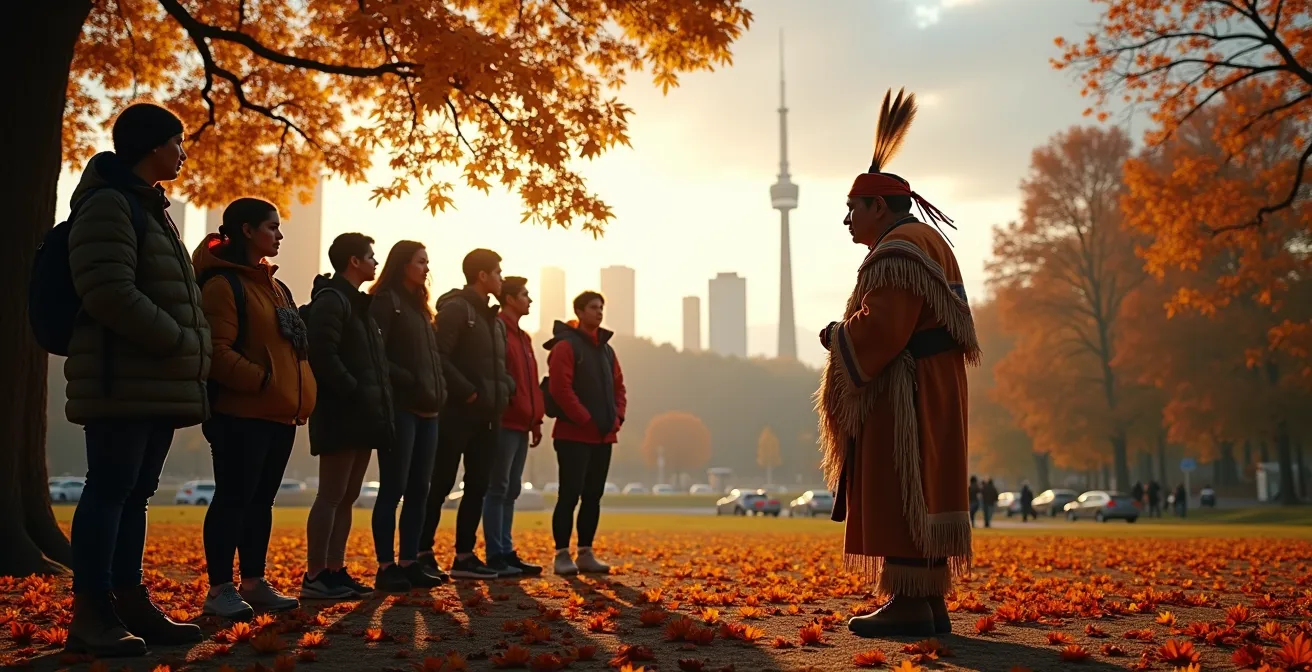
True cultural exploration in Canada goes beyond sightseeing; it requires understanding the unwritten rules and rich histories that define each community.
- Respect involves active learning, from the meaning of land acknowledgments to the story behind your poutine.
- Authenticity is proven through community benefit and official marks like The Original Original or the Igloo Tag.
Recommendation: Shift your mindset from a passive spectator to an active, informed guest committed to meaningful engagement.
You’re standing at the edge of Vancouver’s Chinatown or Toronto’s Kensington Market, phone in hand, eager to capture the vibrant sights and sounds. Yet, a nagging feeling holds you back. You want to connect, to understand, to experience this place authentically, but you’re terrified of being just another intrusive “zoo tourist”—someone who consumes a culture’s surface without engaging with its substance. You’ve heard the usual advice: “buy local,” “be respectful,” “try the food.” But what do those platitudes actually mean in practice?
This generic advice fails to equip you for the complex social fabric of Canada’s urban centres. It doesn’t explain the political weight of saying “Bonjour-Hi” in Montreal, the difference between witnessing and spectating at a Residential School memorial, or how to tell if a beautiful carving truly benefits the Indigenous artist who made it. These places are not theme parks; they are living communities, homes, and sites of profound historical significance. Navigating them with grace requires more than good intentions.
But what if the key wasn’t a checklist of dos and don’ts, but a deeper understanding of the hidden curriculum of a place? This guide is built on that premise. We will move beyond superficial sightseeing to explore the unspoken rules, historical contexts, and power dynamics that transform a visitor into a respectful participant. By learning to see the narratives embedded in a land acknowledgment, a plate of food, or a handmade craft, you can move from passive consumption to active, reciprocal engagement. This is your path to becoming the conscientious traveller you want to be.
This article provides a framework for navigating these rich cultural landscapes with awareness and respect. The following sections will equip you with specific knowledge and tools to engage meaningfully with the diverse communities that shape the Canadian experience.
Summary: Beyond the “Zoo”: A Guide to Respectfully Exploring Canada’s Cultural Enclaves
- Why You Hear Land Acknowledgments Before Events in Vancouver and Toronto
- Poutine Variations: When Does Innovation Become Cultural Appropriation?
- Bonjour-Hi: How to Greet Shopkeepers in Montreal Without Causing Offense
- Caribana vs. Pride: How to Prepare for the Crowds at Toronto’s Massive Street Festivals?
- Made in Canada vs. Souvenir Shop Junk: How to Spot Authentic Cultural Crafts?
- Residential School Memorials: How to Visit with Respect and Somberness?
- Indian-Chinese Fusion: Why Toronto is the Global Capital of Hakka Cuisine?
- How to distinguish Authentic Indigenous Tourism from Cultural Appropriation?
Why You Hear Land Acknowledgments Before Events in Vancouver and Toronto
Before a concert in Toronto or a conference in Vancouver, you’ll likely hear a speaker begin by acknowledging the traditional territories of the Indigenous Nations on which the event is taking place. For a visitor, this may seem like a formal, even perfunctory, ritual. However, it is one of the most significant entry points into the hidden curriculum of modern Canada. A land acknowledgment is not just a polite preamble; it is a political statement, an act of reconciliation, and a direct rejection of the colonial myth of terra nullius (nobody’s land). It explicitly recognizes that cities like Toronto and Vancouver are built on lands that were never surrendered by the Mississaugas of the Credit, the Squamish, or the Tsleil-Waututh Nations, among others.
Understanding this practice is the first step in shifting from a tourist to an informed guest. It requires recognizing the fundamental difference between various regions, such as the Treaty Lands common in Ontario, where historical agreements (often contested) were made, and the vast Unceded Territories of British Columbia, where no such treaties exist. This distinction is crucial; it frames the ongoing relationship between Indigenous peoples and the Canadian state. By actively listening and identifying the specific Nations named, you begin to see the land not as a generic backdrop but as a place with a deep, layered, and often painful history.
To engage meaningfully is to move beyond passive listening. It means using this moment as a prompt for your own education. A quick search on resources like native-land.ca can reveal the specific history of the ground beneath your feet. This simple act transforms the acknowledgment from an abstract statement into a concrete connection to place, setting a foundation of respect for all your explorations.
Your Action Plan: How to Meaningfully Engage with Land Acknowledgments
- Listen actively to identify the specific Nations being acknowledged (e.g., Mississaugas of the Credit, Squamish, Tsleil-Waututh).
- Use resources like native-land.ca or the Whose Land app to research the traditional territory you’re on and its history.
- Learn the crucial difference between Treaty Lands (common in Ontario) and Unceded Territories (prevalent in British Columbia) to understand local context.
- Move beyond passive listening by researching local Indigenous organizations, cultural centres, and community initiatives in the area you are visiting.
- Translate knowledge into action by seeking out and supporting Indigenous-owned businesses, artists, and cultural events during your stay.
Poutine Variations: When Does Innovation Become Cultural Appropriation?
From its humble origins in rural Quebec, poutine has become a national icon. You’ll find it everywhere, from greasy spoons to high-end restaurants, topped with everything from foie gras to butter chicken. But as this dish travels, a critical question emerges for the conscientious eater: where is the line between creative culinary homage and careless cultural appropriation? The answer lies in the “3 Cs”: Context, Credit, and Commerce. A chef who innovates respectfully does so with an understanding of what they are changing.
First, Context. Authentic poutine isn’t just fries, cheese, and gravy. It’s hand-cut, double-fried potatoes, fresh cheese curds that “squeak,” and a specific beef-and-chicken-based gravy. It represents a particular working-class, Québécois cultural heritage. When a restaurant presents a version with shredded mozzarella or a generic brown sauce as “poutine” without acknowledging the deviation, it strips the dish of its cultural significance. Second, Credit. Respectful innovation gives credit where it’s due. A menu might describe a dish as “Quebec-style poutine” or “our twist on a classic poutine.” This simple act acknowledges the origin and positions the new creation as a respectful dialogue with the original, rather than an outright replacement. Third, Commerce. Who benefits? While not always transparent, a truly engaged approach often involves sourcing ingredients from Quebec or ensuring a portion of profits supports cultural initiatives.
This framework is your tool for reading a menu like a cultural text. Is the restaurant telling a story that honors the dish’s roots, or is it simply cashing in on a trend? Choosing the former is a delicious way to practice respectful tourism.

The “3 Cs” framework provides a clear guide for evaluating how a dish is presented, distinguishing a thoughtful tribute from a thoughtless copy.
| Criterion | Respectful Innovation | Potential Appropriation |
|---|---|---|
| Context | Acknowledges poutine’s Québécois origins and cultural significance | Presents as generic ‘Canadian’ dish without Quebec attribution |
| Credit | Clearly states ‘Quebec-style’ or ‘inspired by traditional poutine’ | No mention of origins, marketed as own creation |
| Commerce | Portion of profits support Quebec suppliers or cultural initiatives | Profits entirely extracted without acknowledgment of source |
Bonjour-Hi: How to Greet Shopkeepers in Montreal Without Causing Offense
Walking into a shop in Montreal, you’re faced with a seemingly simple choice: how to say hello? The hybrid greeting “Bonjour-Hi” might seem like the perfect, bilingual solution—a welcoming gesture to all. However, this two-word phrase is one of the most politically charged expressions in Canada, sitting at the heart of Quebec’s long struggle to protect the French language. For the conscientious traveller, understanding the hidden curriculum behind this greeting is essential to navigating Montreal with grace.
To some, “Bonjour-Hi” is a symbol of friendly bilingualism and an open, cosmopolitan city. It’s a practical way for a shopkeeper to welcome a customer without knowing their linguistic preference. However, to many French-language advocates and proud Québécois, it represents the slow erosion of French as the primary language of public life. For them, the automatic inclusion of “Hi” signals an assumption that French is not enough, and that English is the default or required alternative. The greeting has been the subject of political motions in the National Assembly and endless public debate, making it a microcosm of Quebec’s linguistic anxieties.
So, what should you do? There is no single correct answer, but an informed one is always best. The most respectful approach is to lead with “Bonjour.” This simple act acknowledges that you are in a predominantly French-speaking province and shows respect for that reality. It places the choice of which language to continue in with the shopkeeper, who will almost certainly switch to English if they are able and see that you are more comfortable in it. By starting with “Bonjour,” you are not just saying hello; you are participating in a subtle but meaningful cultural act that recognizes the unique linguistic identity of Quebec, moving beyond the simple transaction to a moment of genuine cultural awareness.
Caribana vs. Pride: How to Prepare for the Crowds at Toronto’s Massive Street Festivals?
Toronto’s summer streets explode with two of North America’s largest festivals: the Toronto Caribbean Carnival (Caribana) and Pride Toronto. Both are vibrant, joyous celebrations of identity, but they are not interchangeable parties. For the visitor, preparing for the crowds means more than just finding a good vantage point; it means understanding the distinct histories and cultural protocols of each event. Attending respectfully requires recognizing that these are not just parades, but powerful expressions of community resilience and political history.
Caribana, for example, is a celebration of Caribbean culture rooted in the history of emancipation from slavery. The spectacular costumes seen in the Grand Parade are not just “party wear”; they are part of a tradition called “playing mas” (masquerade), where each costume tells a story and represents deep cultural expression. A respectful attendee understands the difference between being a spectator and attempting to join the parade without being part of a registered “mas band.” Similarly, Pride is more than a rainbow-hued street party; it commemorates the Stonewall Riots and the ongoing fight for LGBTQ+ rights. Within the larger festival, events like the Dyke March and the Trans March have their own distinct, often more political, atmospheres compared to the main parade, which has a larger corporate presence. Understanding the critique of “pinkwashing”—where corporations use Pride for marketing without meaningful support for the community—can help you choose to support community-led events and LGBTQ+-owned businesses in the Church-Wellesley Village instead.
Navigating these events means being an ally. It involves researching their significance, respecting designated spaces (like family-friendly or sober zones), and supporting authentic community vendors. By doing so, you contribute to the celebration rather than just consuming it.

For those wishing to attend as respectful allies, understanding the specific cultural context of each celebration is paramount. The following points offer a guide to responsible festival attendance:
- For Caribana: Learn the difference between being a spectator and ‘playing mas’—costumes are cultural expressions, not just party wear.
- For Pride: Understand the concept of ‘pinkwashing’ and seek out community-led events rather than only corporate-sponsored activities.
- Research the historical significance: Caribana celebrates Caribbean emancipation, while Pride commemorates Stonewall and the fight for LGBTQ+ rights.
- Support authentic community vendors and LGBTQ+-owned businesses in the Church-Wellesley Village.
- Respect designated spaces: some areas are alcohol-free or family-friendly zones.
- Navigate different event vibes: Pride includes the main parade, Dyke March, and Trans March—each with distinct atmospheres.
Made in Canada vs. Souvenir Shop Junk: How to Spot Authentic Cultural Crafts?
You’re in a souvenir shop, faced with a wall of art: beautiful moccasins, intricate carvings, and colourful prints. Some are labelled “Made in Canada,” but does that mean they are authentic Indigenous-made items? Not necessarily. This is a critical distinction for the conscientious traveller who wants their purchase to support Indigenous artists and communities, not a factory producing appropriated designs. Distinguishing authentic work from “souvenir shop junk” requires moving beyond simplistic labels and learning to ask the right questions.
Your most powerful tool is curiosity. An authentic vendor or gallery will be proud to tell you the story behind a piece. When you express interest, don’t just ask about the price; ask about the person who made it. An informed seller should be able to tell you the artist’s name and the community or Nation they belong to. They should be able to explain the cultural meaning behind the design—is that a Thunderbird, a Bear, or a specific figure from a Haida or Anishinaabe story? This narrative is part of the artwork’s value. A seller who cannot provide this information is a major red flag.
For certain types of art, there are also formal systems of verification. The best-known is the Igloo Tag Trademark, which offers a concrete way to verify authenticity.
Case Study: The Igloo Tag Trademark: Canada’s Authentication System
To combat the flood of mass-produced fakes in the souvenir market, a crucial tool is the Canadian government’s Igloo Tag Trademark. As detailed in an official government announcement on Indigenous tourism, this tag serves as a certificate that a piece of art was genuinely made by an Inuk artist. The tag provides traceability by including the artist’s name and home community, ensuring that the economic benefits flow directly back to Indigenous creators and their families. Asking a vendor if their Inuit art is registered with this program is a direct and effective way to distinguish authentic, community-supported art from appropriated designs.
Asking informed questions not only protects you from buying a fake but also sends a powerful message to the market: that consumers value and demand authentic, respectfully sourced Indigenous art.
To help guide your purchase, here are some key questions to ask, based on best practices from sources like educational guides on Indigenous tourism:
- Can you tell me about the artist who made this piece?
- Which community or Nation is the artist from?
- What is the story or cultural meaning behind this design?
- Is this artist registered with the Igloo Tag Trademark program (for Inuit art)?
- Can you provide documentation of authenticity or an artist biography?
- How does purchasing this piece support the Indigenous community?
Residential School Memorials: How to Visit with Respect and Somberness?
Across Canada, you may encounter memorials dedicated to the victims and survivors of the Indian Residential School system—often marked by rows of children’s shoes, teddy bears, and orange flowers. It is fundamentally important to understand that these are not tourist attractions. They are active sites of mourning, remembrance, and community grief. Your role here is not that of a tourist but of a witness. Approaching these sacred spaces requires a profound shift in mindset, from sightseeing to somber observation.
The first step is preparation. Before you visit, take the time to understand the history you are about to confront. Reading the 94 Calls to Action from the Truth and Reconciliation Commission (TRC) provides essential context about the system’s devastating legacy and the path toward reconciliation. This knowledge transforms your visit from a passive glance into an act of informed solidarity. When you arrive, your conduct should reflect the gravity of the site. This means dressing modestly, maintaining silence, and, crucially, refraining from photography. Selfies are completely inappropriate. These are places of trauma, and the urge to document your presence must be secondary to respecting the memory of the children who never came home.
The items left at these memorials—shoes, toys, tobacco ties—are offerings. They are deeply personal and sacred. Never touch, move, or add to them. If you feel compelled to contribute, the most meaningful action is to make a donation to an organization like the Indian Residential School Survivors Society. As Alison Norman, a research adviser for the Ontario Ministry of Indigenous Affairs, stated powerfully in a report by CBC News:
These are not tourist attractions; they are sites of trauma and remembrance. It needs to be the beginning of a learning process.
– Alison Norman, Research Adviser for the Ontario Ministry of Indigenous Affairs
By embracing the role of a respectful witness, you honor the lives and experiences of the survivors and victims, making your visit a meaningful part of your own and the nation’s journey of reconciliation.
Indian-Chinese Fusion: Why Toronto is the Global Capital of Hakka Cuisine?
In the suburbs of Scarborough and Markham in the Greater Toronto Area, you’ll find a culinary phenomenon that tells a powerful story of migration, adaptation, and community: Hakka cuisine. This unique Indian-Chinese fusion, famous for fiery dishes like Chilli Chicken and Manchurian Gobi, is not something you’ll find in most of China. Its global capital is, improbably, Toronto. For the food-loving traveller, understanding why reveals a fascinating multi-generational journey and a perfect example of how food can build a new home.
The story of Hakka food is a story of a community’s resilience and creativity, a narrative that stretches across continents and generations.
Case Study: The Hakka Migration Journey: From China to Kolkata to Toronto
The origins of Hakka cuisine lie in a double migration. The Hakka people, originally from southern China, first migrated to Calcutta (now Kolkata), India. There, they adapted their traditional cooking techniques to the local palate, fusing Chinese staples like soy sauce, ginger, and garlic with the bold flavours of Indian spices like cumin and chili. This created an entirely new culinary genre. Then, in the latter half of the 20th century, many of these Hakka families immigrated to Canada, settling primarily in the Greater Toronto Area. Their restaurants became more than just places to eat; they were crucial community hubs for new immigrants, serving as points of cultural connection and preservation for a community that had twice remade its home.
The result is a menu of dishes that are a testament to this fusion. Dishes like “Manchurian,” for example, were famously invented in Mumbai and are entirely unknown in China, despite their name. Toronto, in turn, has added its own innovations, such as Crispy Ginger Beef, building upon the foundations laid in Kolkata. For the visitor, eating at a Hakka restaurant in Toronto is not just about trying a spicy meal; it’s about tasting a living history of migration and identity.
The signature dishes of Hakka cuisine each tell a part of this fusion story, combining techniques and ingredients from two distinct cultures.
| Dish | Key Ingredients | Cultural Fusion Story |
|---|---|---|
| Chilli Chicken | Soy sauce, ginger, garlic, green chilies | Created in Kolkata’s Chinatown, combining Chinese cooking techniques with Indian heat preferences |
| Manchurian (Gobi/Chicken) | Cornflour batter, Indo-Chinese sauce | Named after Manchuria but invented in Mumbai, entirely unknown in China |
| Hakka Noodles | Wheat noodles, julienned vegetables, soy-garlic sauce | Traditional Hakka stir-fry technique adapted with Indian vegetable cuts and spicing |
| Crispy Ginger Beef | Beef strips, fresh ginger, sweet-savory glaze | A Toronto innovation building on traditional Hakka beef preparations |
Key Takeaways
- True respect in cultural travel goes beyond politeness; it demands active learning about the history, politics, and protocols of a place.
- Authenticity is not a vibe; it’s verified through community benefit, narrative sovereignty, and official marks like the Igloo Tag or The Original Original.
- Every interaction, from a greeting in Montreal to a meal in Toronto, is an opportunity to engage with a deeper cultural story if you know what to look for.
How to distinguish Authentic Indigenous Tourism from Cultural Appropriation?
You’ve learned to look for authentic crafts and to visit memorials with respect. But how do you apply this lens to experiences—a guided walk, a lodge stay, or a cultural workshop? The Indigenous tourism sector is growing, but so is the risk of “Indigenizing”—superficial experiences that use Indigenous culture as a decorative theme without genuine community leadership or benefit. Distinguishing truly authentic Indigenous tourism from appropriation requires a clear framework and knowing what signs to look for.
The most reliable sign of authenticity is the “Original Original” mark from the Indigenous Tourism Association of Canada (ITAC). This accreditation is a guarantee of quality and authenticity. According to ITAC’s official accreditation program requirements, businesses displaying The Original Original mark must be at least 51% Indigenous-owned and controlled. This simple rule ensures that the people whose culture is being shared are the ones leading the narrative and receiving the economic benefits. When you see this logo, you can be confident that you are supporting a business that is accountable to its community.
Beyond this mark, you can use the “4 Rs” framework, a concept widely promoted by groups like Indigenous Tourism BC, to evaluate any experience: Respect, Relevance, Reciprocity, and Responsibility. Does the tour operator respect cultural protocols, including what stories they can and cannot share? Is the information they provide relevant and shared with the community’s consent, or is it just a historical exhibit without a living context? Is there a clear reciprocal benefit to the community through employment or profit-sharing? And does the operator act responsibly by having community consent? An authentic operator will be transparent about these relationships.
This framework empowers you to be an informed and ethical traveller. It moves you from a passive consumer of experiences to an active partner in supporting Indigenous self-determination and cultural revitalization. By choosing authentic experiences, your travel becomes a force for good.
- RESPECT: Does the tour respect Indigenous knowledge and sacred sites? Are there places or stories they explicitly don’t share out of cultural protocol?
- RELEVANCE: Is the content relevant and actively shared by the community, not just historical artifacts presented without context?
- RECIPROCITY: Is there clear reciprocal benefit to the Indigenous community through employment, profit-sharing, or capacity building?
- RESPONSIBILITY: Does the operator act responsibly by having community consent and following cultural protocols?
Your journey as a conscientious traveller is a continuous process of learning and unlearning. By applying these frameworks—from understanding land acknowledgments to seeking out the Original Original mark—you move beyond the fear of intrusion and into a space of meaningful, respectful connection. This is how you explore Canada’s vibrant cultural enclaves not as a spectator, but as a welcome and informed guest.