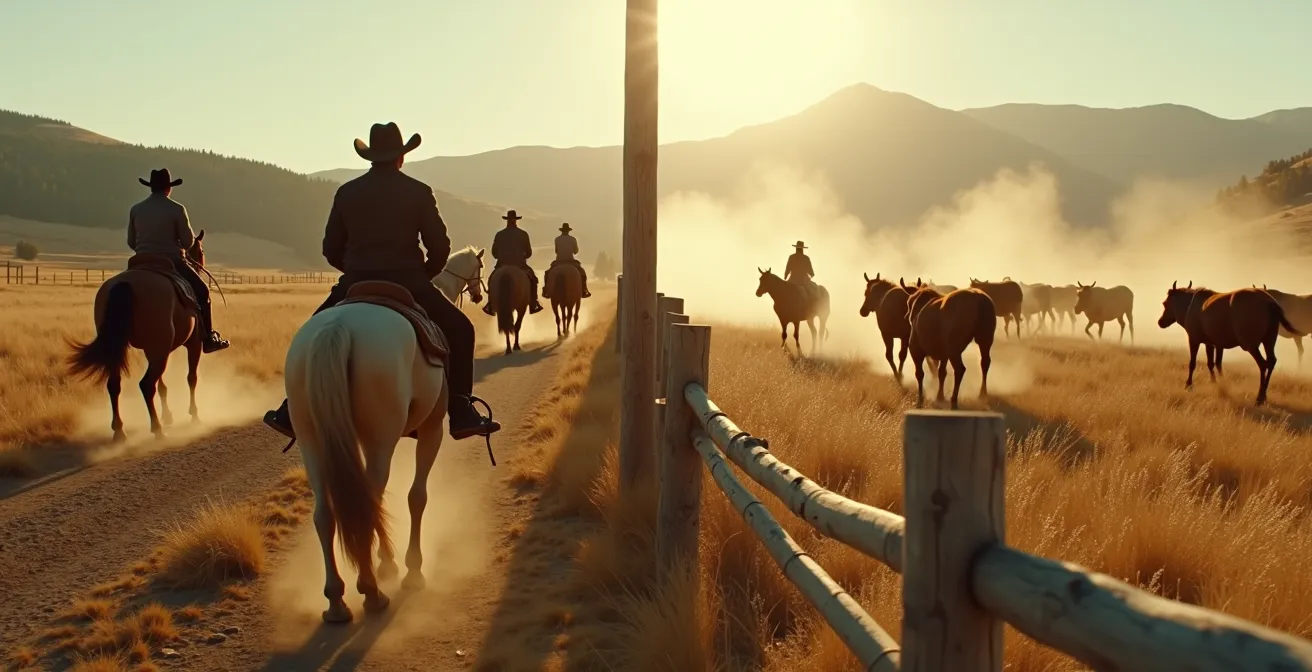
The key to an authentic Alberta ranch experience isn’t finding the prettiest view, but honestly matching your riding ability to the operational reality of the ranch.
- A dude ranch sells a comfortable, controlled version of the cowboy life, perfect for novice riders seeking scenic trail rides.
- A working ranch requires competent, fit riders who can contribute to actual cattle operations, from mending fences to long hours in the saddle.
Recommendation: Before you book, use this guide to perform an honest self-assessment of your skills, fitness, and gear. Choosing the right “saddle-fit” ensures you’re an asset, not a liability.
The image is powerful: you, on a horse, silhouetted against the vast backdrop of the Alberta Rockies, a modern-day cowboy. It’s a dream sold in travel brochures and on Instagram feeds. But here’s the unvarnished truth from someone who’s spent more time in the saddle than on the ground: there’s a world of difference between a “dude ranch,” which is essentially a resort with horses, and a “working ranch,” which is a farm with a payroll that might include you. The first is a vacation; the second is a job. Confusing the two is the fastest way to find yourself either bored out of your mind or dangerously out of your depth.
Many aspiring riders think “some experience” is enough. They imagine leisurely trail rides and campfire songs. The operational reality of a working ranch, however, involves long, demanding days, unpredictable livestock, and challenging terrain. It requires not just the ability to sit on a horse, but the skill to make that horse an effective partner in a complex agricultural operation. Your gear isn’t a costume; it’s functional equipment designed for safety and endurance. Your fitness isn’t about looking good in jeans; it’s about whether you can handle eight hours in the saddle without becoming a burden to the crew.
This guide is your honest pre-vetting process. We’re going to move past the romance and get real about what it takes to have a genuine Western experience in Canada. We’ll break down the skills you actually need, the gear that matters, the physical demands of the job, and what life is really like when the trail ride ends and the work begins. By the end, you’ll be able to make an informed choice, ensuring your Alberta ranch adventure matches your capabilities and gives you the authentic experience you’re truly looking for.
To guide you through this decision, this article breaks down the critical differences and requirements for each type of ranch experience. From assessing your riding skills to understanding bunkhouse etiquette, you’ll find everything you need to choose wisely.
Summary: A Realistic Look at Alberta’s Dude and Working Ranch Experiences
- Nose to Tail: Why You Will Be Bored on a Trail Ride if You Are an Experienced Rider?
- Jeans and Boots: Why Yoga Pants are a Terrible Idea for Horseback Riding?
- The Cattle Drive: Are You Fit Enough for 8 Hours in the Saddle?
- Barrel Racing vs. Bull Riding: What are the Rules of the Rodeo?
- Shared Quarters: What to Expect from Accommodation on a Real Working Ranch?
- Highway 22 vs. Highway 2:How to Prepare Your Vehicle for the 7,800 km Trans-Canada Highway Crossing?
- The Pancake Breakfast: How to Find Free Stampede Breakfasts in July?
- Why You Should Visit the Alberta Badlands Instead of Just Staying in the Rockies?
Nose to Tail: Why You Will Be Bored on a Trail Ride if You Are an Experienced Rider?
There’s a fundamental misunderstanding about what “experienced rider” means. If your experience is limited to ring work or guided trail rides where your horse’s nose is glued to the tail of the horse in front, you are not prepared for a working ranch. A dude ranch trail ride is designed for safety and scenery; the horses are often trained to follow a path on autopilot. For a true horse person, this is mind-numbingly dull. On a working ranch, your horse is a tool, and you are its operator. You need to be able to ride with one hand while opening a gate with the other, read a cow’s intention, and move your horse precisely to head it off.
The communication required is subtle and immediate. An experienced rider on a working ranch understands neck reining, can tack up their own horse without a second thought, and can navigate unpredictable terrain like river crossings or steep foothills. This is an active, thinking-rider’s game. As an example, the vetting process for authentic cattle drives demands more than just saddle time. At operations like Home on the Range Adventure Tours, a guest’s ability to handle a horse at various paces is crucial; cantering or galloping isn’t for fun, it’s done only when necessary to bring cattle back into line. If your primary skill is holding on while the horse follows a leader, you belong on a dude ranch—and there’s no shame in that. A working ranch requires a partner, not a passenger.
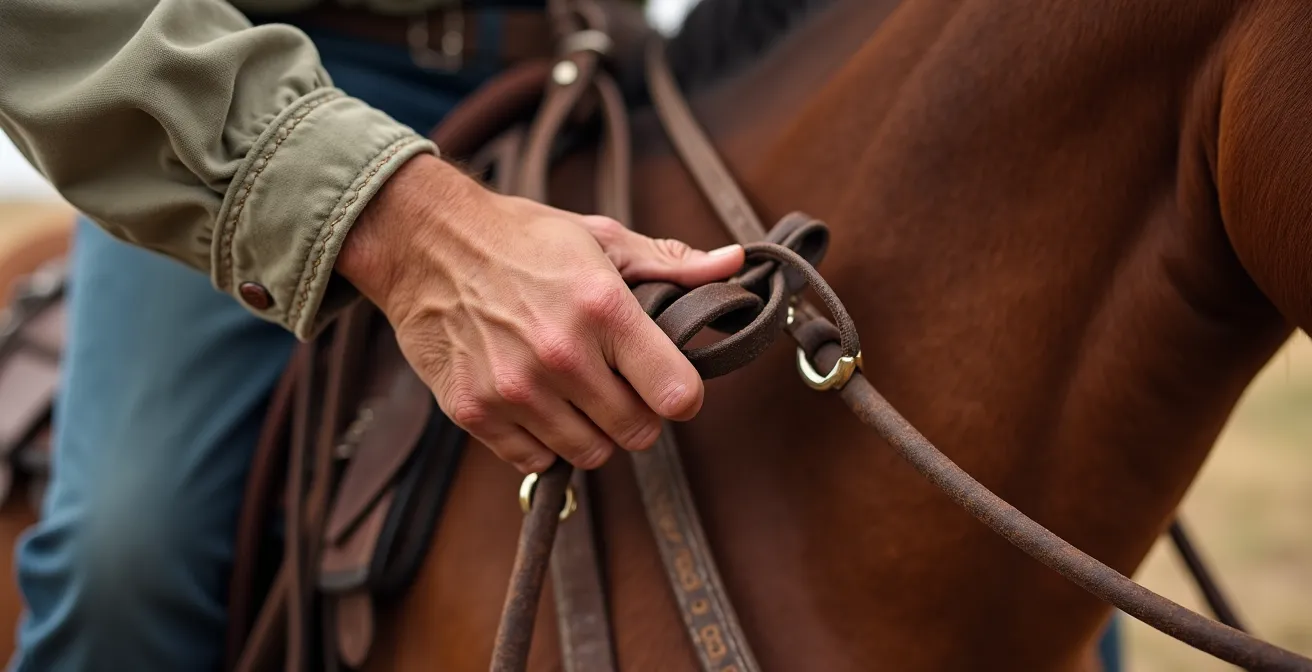
This image captures the essence of that partnership: the subtle pressure on the reins, the horse’s listening ear, the focused connection between rider and animal. This level of responsiveness is what separates a trail horse from a working cow horse. To be a real asset on a drive, you must master this dialogue, building the endurance for 6-8 hours of daily riding to move herds across vast distances. It’s about a deep, functional understanding of horsemanship, not just a passive appreciation of the landscape from a saddle.
Jeans and Boots: Why Yoga Pants are a Terrible Idea for Horseback Riding?
The fantasy of a ranch vacation often involves a shopping trip for the perfect “cowboy” outfit. As travel blogger Luis noted during a visit with the Canadian Cattle Association, the desire to “channel my inner cowboy” is a powerful motivator. He mentions an exclusive shopping experience at Lammle’s Western Wear, which is a fun part of the preparation. However, on a working ranch, your clothing is not a costume; it is functional safety equipment.
We kicked off the day with an exclusive shopping experience at Lammle’s Western Wear. I’ve always wanted to channel my inner cowboy, and today was my chance!
– Luis, Travel Blogger, Lost with Luis – Canadian Cattle Association Ranch Visit
The most common mistake city-dwellers make is choosing fashion over function. Yoga pants or leggings are the prime offenders. While comfortable for a walk, they offer zero protection. After a few hours in a leather saddle, the friction will cause painful chafing and sores. Sturdy denim jeans are non-negotiable; their thick, durable fabric and flat inner seams are designed to prevent this. Similarly, running shoes or hiking boots are a liability. A proper riding boot has a significant heel to prevent your foot from slipping through the stirrup—a potentially fatal mistake if you fall and get dragged. It also needs a sturdy sole and ankle support. What you wear directly impacts your safety and ability to do the job.
This table breaks down the essentials, clarifying what you need to bring versus what a typical Alberta ranch might provide. Pay close attention to the Alberta-specific notes, which account for the region’s unique conditions, like sudden Chinook winds.
| Item | Ranch Typically Provides | You Must Bring | Alberta-Specific Notes |
|---|---|---|---|
| Helmet | Riding helmets provided | Personal helmet accepted if ASTM/SEI approved | No law in Alberta requires helmets, but strongly recommended |
| Boots | Never provided | Good sturdy footwear required, sandals not permitted | Boulet or Canada West boots recommended (1.5cm heel minimum) |
| Pants | Never provided | Long pants for safety and comfort | Jeans essential for protection against saddle sores |
| Outerwear | Limited rain gear supply | Jacket required, weather changes quickly | Layers critical for sudden Chinook winds |
| Gloves | Rarely provided | Quality leather gloves essential | Protection from rope burns and cold |
The Cattle Drive: Are You Fit Enough for 8 Hours in the Saddle?
The phrase “a long day in the saddle” is often romanticized, but the physical reality is a serious test of endurance. A one-hour trail ride at a dude ranch is a gentle introduction; a cattle drive on a working ranch is a full-body athletic event that can last eight hours or more, day after day. This isn’t just about sitting. It’s about active riding: constantly adjusting your balance, using your legs and core to cue the horse, and staying alert over long distances. The muscles you use for riding are specific, and if they aren’t conditioned, you will be in a world of pain by day two.
The terrain itself is a major factor. You won’t be on a graded path. Working ranches in Alberta often operate in the foothills, like the Porcupine Hills, where you’re navigating steep inclines, crossing rivers, and dealing with unpredictable footing. This requires a level of physical fitness and riding confidence far beyond what a casual rider possesses. Your cardiovascular health matters, as does your core strength and joint stability. Being saddle-sore is one thing; being too exhausted or injured to continue makes you a liability to the entire operation.
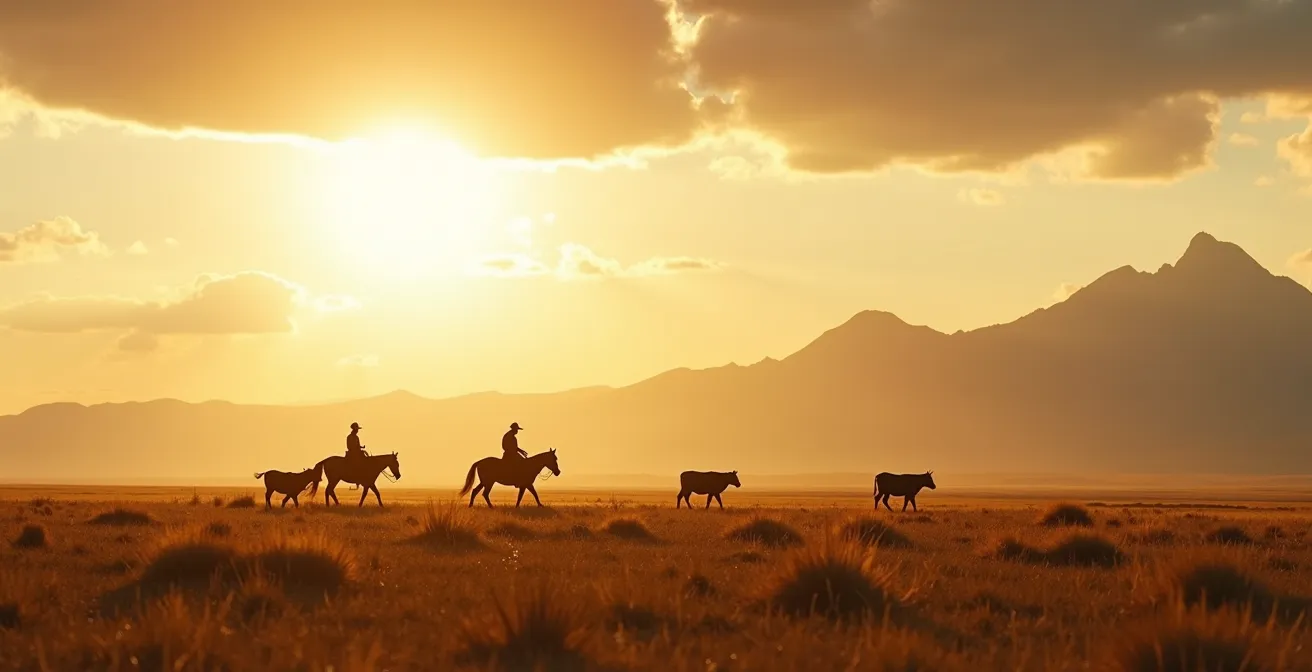
Look at the scale of this landscape. The riders and cattle are tiny specks against the vastness of the hills. This is the environment you must be prepared to cross. Before you commit to a working cattle drive, be honest with yourself. Can you ride for a full workday? Do you have the physical resilience to handle varied terrain and weather? If the answer is anything but a confident “yes,” a guest ranch with shorter, more controlled rides is a much better fit. The goal is to return with great memories, not a back injury.
Barrel Racing vs. Bull Riding: What are the Rules of the Rodeo?
For many, the Calgary Stampede is their only image of rodeo: a spectacular, high-stakes sport. But rodeo’s roots are firmly planted in the daily tasks of a working cowboy. The events you see in the ring are stylized, high-speed versions of skills needed on the open range. Team roping and tie-down roping directly evolved from the need to catch and doctor sick cattle. The incredible agility of a barrel racing horse is the same agility needed to separate a single cow from a tightly packed herd. Understanding this connection is key to appreciating Alberta’s deep-rooted ranching culture.
A visit to a working ranch offers a unique opportunity to see these skills in their original context. While you won’t be riding bucking broncs, the daily activities are a living demonstration of rodeo’s origins. A working ranch vacation isn’t just about riding; it’s about participating in the full scope of ranch life. As one guest experience highlights, this can include everything from checking cattle and rounding them up to mending fences. It’s this variety of tasks that defines the authentic experience and separates it from a simple riding holiday. It’s about contributing to the operation in a meaningful way.
While a working ranch is focused on business, the spirit of rodeo is never far away. Some guest-friendly ranches even offer “amateur rodeo” nights, where visitors can safely try events like barrel racing on experienced, quiet horses under close supervision. This is more than just an activity; it’s a direct link to the heritage of the West. It’s a chance to feel the adrenaline and appreciate the incredible skill of both horse and rider, reinforcing the practical application of what might otherwise seem like just a sport. The culture is built on these skills, celebrated in small-town rodeos from Ponoka to High River, where local ranching families compete and sustain their way of life.
Shared Quarters: What to Expect from Accommodation on a Real Working Ranch?
The word “ranch” can conjure images of sprawling, luxurious log homes. While some high-end guest ranches offer that, the accommodation on a true working ranch is built for function, not fantasy. Take the Bar Diamond Guest Ranch, for example. It’s a genuine, 121-year-old working cattle operation on 34,000 acres. While they offer comfortable, modernized rooms in their historic log ranch house, the experience is grounded in the reality of sharing space on a functioning farm. You are a guest, but you are also stepping into a workplace and a home.
The key difference lies in the social contract. On a working ranch, especially one you might find through a program like Workaway, you aren’t a tourist in a hotel; you are a temporary co-worker. This means living in shared quarters, often a “bunkhouse,” alongside full-time ranch hands. Your privacy will be limited, and your willingness to be a team player is paramount. You are expected to pull your weight, not just in the fields but in the house as well. This includes cleaning up after meals without being asked and respecting the schedules and space of those who live there year-round.
The mindset is crucial. As one host puts it, “If all you want is riding and relaxing, pay for a vacation on a guest ranch.” This is a place of work. Food may be provided, but you’ll likely be preparing most of it yourself. Internet and cell service are often unreliable, and you can’t just pop into town. You must be self-sufficient, adaptable, and, above all, respectful of the fact that you are a visitor in a tight-knit community. This is the authentic experience, and it demands a certain kind of person.
Your Bunkhouse Readiness Audit: 5 Points to Consider
- Communal Living: Are you prepared to respect the space and privacy of full-time ranch hands and contribute to communal chores like cleaning without being asked?
- Self-Sufficiency: Can you prepare most of your own meals from provided food and manage your time effectively?
- Shared Facilities: Can you adapt to a shared bathroom schedule and coordinate with others, especially during busy mornings?
- Digital Detox: Are you ready to accept limited or non-existent cell service and public transport, embracing a more isolated lifestyle?
- Work Ethic: Do you have a genuine desire to contribute to all aspects of ranch work, including the less glamorous jobs, rather than just seeking to ride?
Highway 22 vs. Highway 2:How to Prepare Your Vehicle for the 7,800 km Trans-Canada Highway Crossing?
Getting to your Alberta ranch adventure is the first step of the journey, and choosing the right road can define the start of your experience. Your route depends entirely on your priority: speed or scenery. The main artery from Calgary southward is Highway 2, a major four-lane divided highway. It’s fast, efficient, and will get you into ranch country quickly. However, it offers prairie views and requires you to exit onto secondary roads to reach most of the historic ranches.
The alternative is Highway 22, famously known as the Cowboy Trail. This two-lane highway runs parallel to the Rocky Mountains, offering panoramic views of the eastern slopes. It winds through historic towns like Black Diamond and Longview and provides direct access to iconic locations like the Bar U Ranch National Historic Site. Travel planning shows that reaching this historic site is about an hour’s drive south of Calgary via Highway 22. This route is not just a means of transport; it’s an immersion into the ranching heritage of the area. However, the trade-off for scenery is practicality. Access roads off the Cowboy Trail are often gravel, and your vehicle should be prepared for it.
Your choice of vehicle and preparation should align with your route. While a standard car is perfectly adequate for Highway 2, taking the Cowboy Trail demands more. A vehicle with good clearance and, ideally, all-terrain tires is recommended. A full-size spare tire and the knowledge to change it are not optional—they are essential. Cell service can be spotty, and you need to be self-reliant. The following table compares the two main routes to help you decide.
| Aspect | Highway 22 (Cowboy Trail) | Highway 2 |
|---|---|---|
| Route Character | Alberta’s Cowboy Trail lies southwest of Calgary | Major divided highway, fastest route |
| Ranch Access | Direct access to Bar U Ranch National Historic Site and historic ranches | Requires secondary roads to reach most ranches |
| Scenic Value | Panoramic views of eastern slopes of Rockies through Longview, Black Diamond | Prairie views, less mountain visibility |
| Historical Sites | Learn about mythical cowboys who established successful ranching operations | Limited ranching heritage sites |
| Road Conditions | Two-lane highway, gravel access roads common | Four-lane divided, paved throughout |
| Vehicle Prep Needs | All-terrain tires, full-size spare essential | Standard highway vehicle adequate |
The Pancake Breakfast: How to Find Free Stampede Breakfasts in July?
Before you commit to the mud and grit of a working ranch, you can get a powerful taste of Alberta’s famous Western hospitality at a free pancake breakfast. Every July, during the Calgary Stampede, the entire city embraces its cowboy roots. Community associations, businesses, and radio stations host daily events where anyone and everyone is welcome to line up for free flapjacks, sausages, and coffee. It’s a tradition that embodies the open, friendly spirit of the West.
These breakfasts are more than just a free meal; they are the social gateway to ranch culture. It’s where city folk and country folk mingle, where you can strike up a conversation with a local who might just give you an insider tip on a small-town rodeo or a hidden gem of a ranch. The genuine community spirit you’ll find in a breakfast line is a direct reflection of the neighbourly welcome you can expect in rural Alberta. It’s a low-stakes, high-reward way to immerse yourself in the culture before you’re knee-deep in it.
Finding these breakfasts is part of the fun. While some are massive, well-publicized events, others are smaller community gatherings. Being savvy can help you avoid the longest lines and find the best experiences. The key is to plan ahead but also be open to spontaneous tips from locals.
Insider’s Guide to Finding Stampede Breakfasts
- Check Calgary community association websites for daily breakfast schedules starting in late June.
- Listen to country radio stations (especially CJAY 92 and Country 105) for live announcements of pop-up events.
- Download the ‘Flapjack Finder’ app or visit the official Calgary Stampede website for comprehensive listings.
- Arrive early (before 8 AM) for shorter queues and fresher pancakes.
- Bring cash for optional donations, as most breakfasts support local charities.
- Strike up conversations with locals in line—they’re your best source for tips on other authentic Western experiences.
Key takeaways
- The fundamental choice is between a dude ranch (a resort experience for any skill level) and a working ranch (a job requiring competent, fit riders).
- Your gear is functional equipment, not a costume. Sturdy jeans and boots with a heel are non-negotiable for safety and comfort.
- A working ranch demands significant physical fitness for long hours in the saddle over challenging terrain. Honestly assess your endurance.
Why You Should Visit the Alberta Badlands Instead of Just Staying in the Rockies?
When people think of Alberta, they picture the majestic, pine-covered slopes of the Rocky Mountains. Most ranch vacations are marketed with this backdrop. But for the rider seeking a truly unique and unconventional landscape, the Alberta Badlands offer a starkly beautiful and equally authentic alternative. Located in the eastern part of the province, this region of coulees, hoodoos, and vast, arid landscapes presents a completely different kind of Western experience.
A working ranch in the Badlands, such as the Bar Diamond Ranch near the Red Deer River, operates differently than its foothills counterparts. Cattle management techniques are adapted to the drier conditions, and the riding terrain is spectacular in its own right. Instead of forests, you’ll be navigating ancient geological formations and exploring lands rich with dinosaur fossils. As RanchSeeker highlights, Alberta is home to 5 of Canada’s 13 UNESCO World Heritage Sites, and the Badlands allow for a unique combination of experiences.
Imagine visiting Dinosaur digs in the Alberta Badlands in the morning, working on the ranch with cowboys in the afternoon, and relaxing in the hot tub in the evening.
– RanchSeeker, Alberta Dude Ranches Guide
Choosing the Badlands is a choice to step off the beaten path. It’s for the traveller who is intrigued by paleontology as much as horsemanship, who appreciates the silent beauty of an arid landscape, and who wants to experience the warm, neighbourly welcome of small prairie towns. This region proves that Alberta’s ranching heritage is not confined to the shadow of the Rockies. It is a diverse and resilient culture that has adapted to every corner of this vast province.
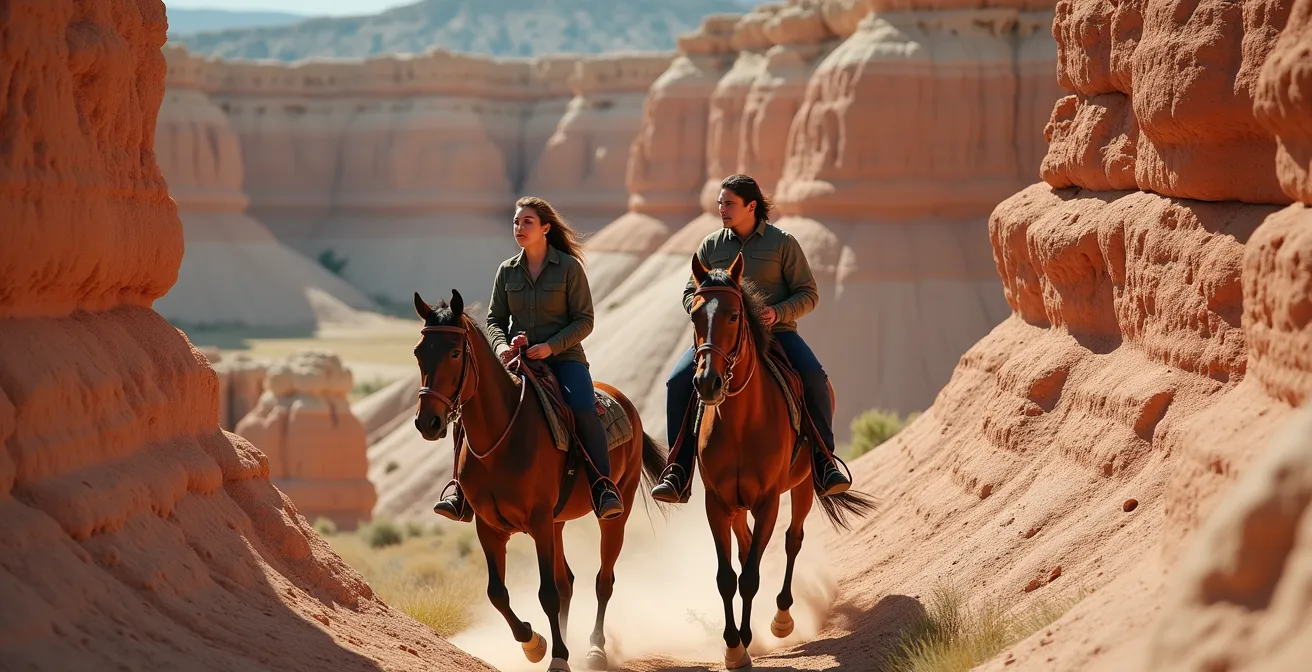
Your perfect Alberta adventure is out there. By honestly assessing your skills and considering all the incredible landscapes the province has to offer, you can move beyond the cliché and create a truly memorable experience. The next step is to start researching the specific ranches that align with your honest self-assessment.
Frequently Asked Questions About Alberta’s Rodeo and Ranch Culture
How do rodeo skills translate to actual ranch work?
Team roping and tie-down roping are directly applicable to doctoring cattle on the range, while barrel racing develops the horse agility needed for sorting and cutting cattle from the herd.
What rodeo events can guests safely try on Alberta working ranches?
Some guest-friendly working ranches offer ‘amateur rodeo’ nights where visitors can try barrel racing or pole bending on quiet, experienced horses under supervision.
Beyond Calgary Stampede, what defines Alberta’s rodeo culture?
The Canadian Finals Rodeo (CFR) and the circuit of small-town rodeos like Ponoka and High River form the heart of rural Alberta life, where local ranching families compete and celebrate their western heritage.