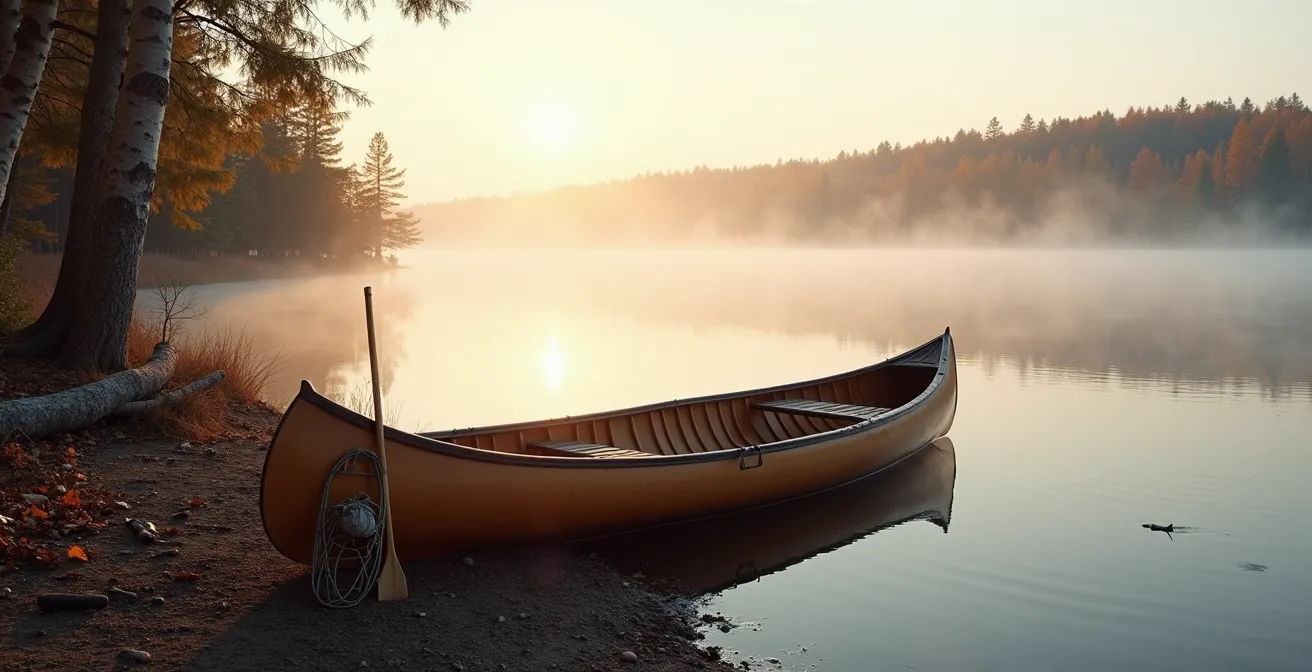
Canada’s most iconic symbols aren’t just historical artifacts; they are living expressions of sophisticated Indigenous ecological and spiritual wisdom.
- The enduring success of items like the canoe and snowshoe comes from a design philosophy perfectly adapted to the Canadian landscape.
- Their meaning transcends mere function, embedding concepts of community, spirituality, and governance directly into their form.
Recommendation: To truly appreciate these symbols, engage with them by seeking out the Indigenous stories, communities, and businesses that keep their traditions alive and thriving today.
The sight of a canoe slicing through the still water of a misty lake, the taste of maple syrup on a fresh stack of pancakes, the satisfying crunch of snowshoes on a winter trail—these are quintessentially Canadian experiences. As a cultural historian, I often observe how these elements are presented as the shared heritage of all Canadians. We know, on some level, that these symbols have Indigenous origins, often framed as helpful secrets shared with early European settlers.
But have we ever truly asked why these specific innovations, and not others, became so deeply woven into the Canadian fabric? The answer lies beyond the object itself. It resides in a holistic design philosophy—an intimate, reciprocal relationship with the land that produced technologies of unparalleled efficiency and elegance. These were not just tools; they were, and are, expressions of ecological intelligence, spiritual practice, and community survival. Their adoption by settlers was a testament to their undeniable superiority in the challenging Canadian environment.
This article journeys beyond the surface of these national symbols. We will explore the sophisticated knowledge systems behind maple syrup harvesting and the hydrodynamic genius of the birchbark canoe. We will unpack the spiritual technology of lacrosse and the climate-specific science of mukluks and snowshoes. Finally, we will consider the vital, contemporary questions of cultural appropriation and how the very names of our cities speak to a history that is still present, right under our feet. This is the story of how Indigenous wisdom became the foundation of Canadian identity.
To fully appreciate the depth of these contributions, this guide will explore the specific stories and principles behind each of these iconic symbols. The following sections break down the ingenuity, cultural context, and enduring legacy of these foundational innovations.
Table of Contents: How Indigenous Wisdom Shaped Canadian Identity
- The Sweet Water Origin: How Indigenous Peoples Taught Settlers to Make Maple Syrup?
- Birch Bark vs. Kevlar: How the Indigenous Design Shape Defines Modern Canoeing?
- The Creator’s Game: What is the Spiritual Significance of Lacrosse Beyond the Sport?
- Bear Paw vs. Ojibwe Style: Why Different Snowshoes Were Designed for Different Snow?
- Form and Function: Why Traditional Mukluks are Warmer than Synthetic Boots?
- Poutine Variations: When Does Innovation Become Cultural Appropriation?
- Rappie Pie: Why You Might Hate the Texture but Love the History
- What Do the Indigenous Names of Canadian Cities Actually Mean?
The Sweet Water Origin: How Indigenous Peoples Taught Settlers to Make Maple Syrup?
Long before “maple syrup” became a pantry staple, it was known to the Anishinaabe as sinzibuckwud, or “sweet water.” The discovery wasn’t an accident but a product of deep ecological observation. The process of tapping maple trees, boiling the sap, and creating sugar was a sophisticated food science developed and perfected over centuries. As Bronwyn Johns, a guide from the Mohawk Nation, explains, this knowledge often came from watching the natural world.
In our story, maple syrup was discovered because a man saw a squirrel drinking from a tree. We always follow what the animals do, because they lead us to good medicines.
– Bronwyn Johns, Member of Mohawk Nation, Kahnawà:ke Tourism guide
Indigenous communities taught early settlers this vital survival skill, which not only provided a crucial source of sugar but also laid the groundwork for a massive industry. Today, Canada’s maple syrup industry represents nearly 75% of global production, with Québec alone accounting for the vast majority. This economic powerhouse is built directly upon a foundation of Traditional Ecological Knowledge.
This tradition is not a historical relic; it is a vibrant, living culture. Modern Indigenous-owned businesses are reclaiming this heritage and innovating upon it.
Wabanaki Maple: A Modern Expression of an Ancient Tradition
Wabanaki Maple, a 100% Indigenous female-owned company on Neqotkuk (Tobique First Nation), exemplifies this continuity. They use barrel-aging techniques passed down through generations to create unique maple syrup flavours that represent the cultural fabric of the land. By proudly sharing the traditions of the Wabanaki Confederacy peoples, they are not just selling a product; they are sharing a story and revitalizing a cornerstone of their culture for a new generation.
Birch Bark vs. Kevlar: How the Indigenous Design Shape Defines Modern Canoeing?
The canoe is perhaps the most romanticized symbol of Canadian wilderness, but its enduring presence is due to its unparalleled design. Far from being a primitive vessel, the birchbark canoe was a masterpiece of engineering, perfectly adapted to the network of lakes and rivers that form Canada’s natural highways. Its lightweight, durable, and easily repairable construction was a triumph of ecological intelligence, using materials readily available in the boreal forest: birchbark for the skin, cedar for the frame, and spruce root for lashing.
This design was so effective that it remains the blueprint for modern recreational canoes, even those made from Kevlar and carbon fibre. The distinctive raised ends, the shallow arch of the hull, and the efficient hydrodynamics were not improved upon, merely replicated in new materials. The genius was in the shape, not just the substance. The efficiency of this original design is quantifiable; historical analysis shows that the lightweight efficiency of traditional canoes inspired modern counterparts, with some original birchbark models weighing as little as 23kg, a benchmark that modern materials strive to beat.
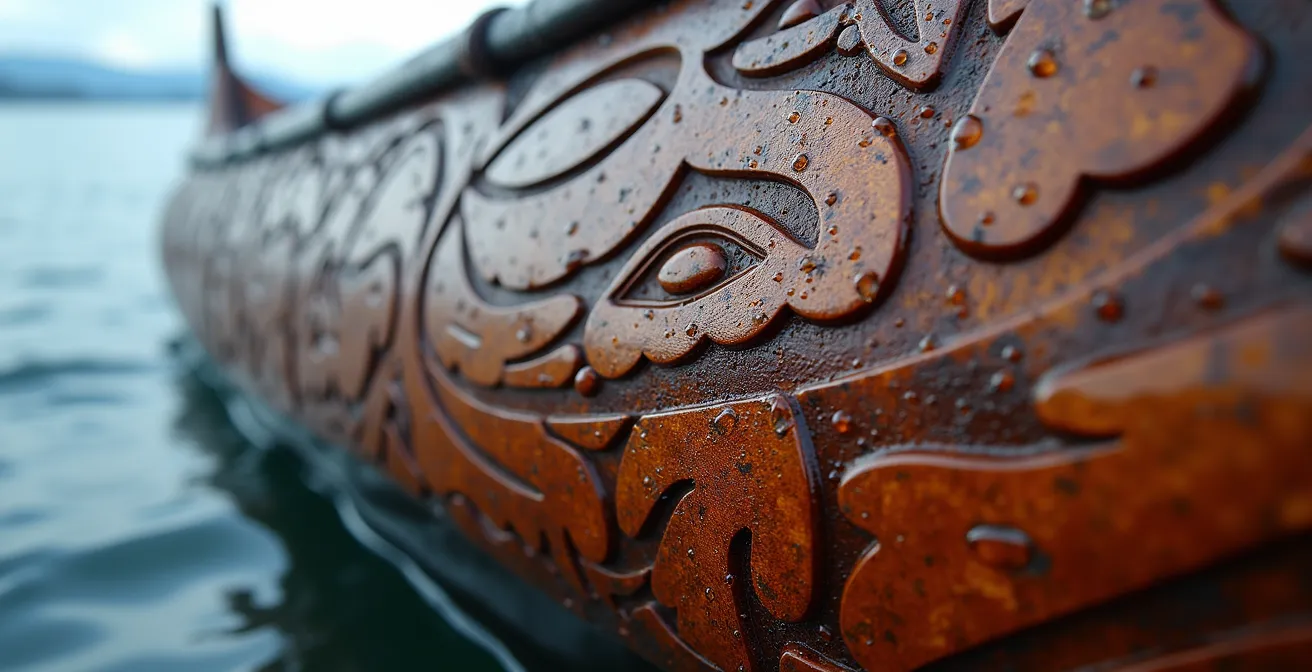
While the birchbark canoe dominated the waterways of the East, different environments demanded different designs. On the Pacific coast, nations like the Haida developed massive dugout canoes from single red cedar logs. These were not just for transport but were powerful vessels for whaling, trade, and ceremony, often intricately carved with designs that told stories and signified lineage. Each canoe, whether birchbark or cedar, was a perfect response to a specific environment, a piece of technology born from thousands of years of observation and refinement.
The Creator’s Game: What is the Spiritual Significance of Lacrosse Beyond the Sport?
Declared Canada’s national summer sport in 1994, lacrosse is often seen today through the lens of modern competition. However, its origins as Tewaarathon (Haudenosaunee) or Baggataway (Algonquin) reveal a practice far more profound than a simple game. It was, and is, a form of spiritual technology. Games could involve hundreds of players on fields several miles long, played not for a trophy, but for the Creator. It served as a way to heal individuals, resolve conflicts between nations, and prepare young men for life.
The spiritual dimension is not just a historical footnote; it is the essence of the game. The Canadian government itself acknowledges this deep meaning in its official documentation on national symbols.
In ancient times, as today, the game is considered by many Indigenous peoples as a medicine game, played in the Sky World and on Mother Earth, and a gift of the Creator that is still played to honor and respect the way of life and ceremonies of First Nations.
– Government of Canada, Official Symbols of Canada
The transformation from a ceremonial practice to a modern, commercialized sport highlights a significant cultural shift. The following table illustrates just how different the original “Creator’s Game” is from the box lacrosse played in arenas today.
| Aspect | Traditional Indigenous Game | Modern Box Lacrosse |
|---|---|---|
| Field Size | No fixed boundaries, up to several miles | Hockey rink-sized arena |
| Number of Players | Up to hundreds per team | 6 players per team |
| Game Duration | Days-long ceremonies | 60-minute matches |
| Purpose | Healing, conflict resolution, spiritual ceremony | Competition and entertainment |
Your Guide to Respectfully Witnessing the Creator’s Game
- Identify a Goal: Determine if you wish to see a historical reenactment, a modern competitive game, or a cultural exhibition. Each offers a different perspective.
- Locate Venues: Research places like the Six Nations of the Grand River in Ontario for summer tournaments or the Kahnawake Cultural Center in Quebec for historical exhibits.
- Review Etiquette: Before attending an event on First Nations territory, check for any specific protocols regarding photography, seating, or interaction. Approach the experience as a guest.
- Learn the Context: Take time to read about the specific nation hosting the event. Understanding their history with the game enriches the viewing experience and shows respect.
- Engage and Support: If opportunities arise, attend cultural workshops, support local Indigenous artisans, and listen to the stories shared by community members.
Bear Paw vs. Ojibwe Style: Why Different Snowshoes Were Designed for Different Snow?
The snowshoe is a brilliant solution to a fundamental Canadian problem: mobility in deep snow. Like the canoe, it’s an innovation born of necessity and perfected through deep environmental knowledge. However, there was never just one “snowshoe.” Different Indigenous nations developed a wide variety of styles, each tailored to a specific type of terrain and snow condition. This demonstrates a sophisticated understanding of physics and material science, a core tenet of ecological intelligence.
The two most recognized styles are the “Bear Paw” and the “Ojibwe” (or “Algonquin”). The Bear Paw style is short, rounded, and without a tail, offering excellent maneuverability in dense, brush-filled forests. The Ojibwe style, by contrast, is long and narrow with an upturned toe and a distinct tail, designed for tracking straight and “floating” over the deep, powdery snow of open country. One was for agility, the other for efficiency.
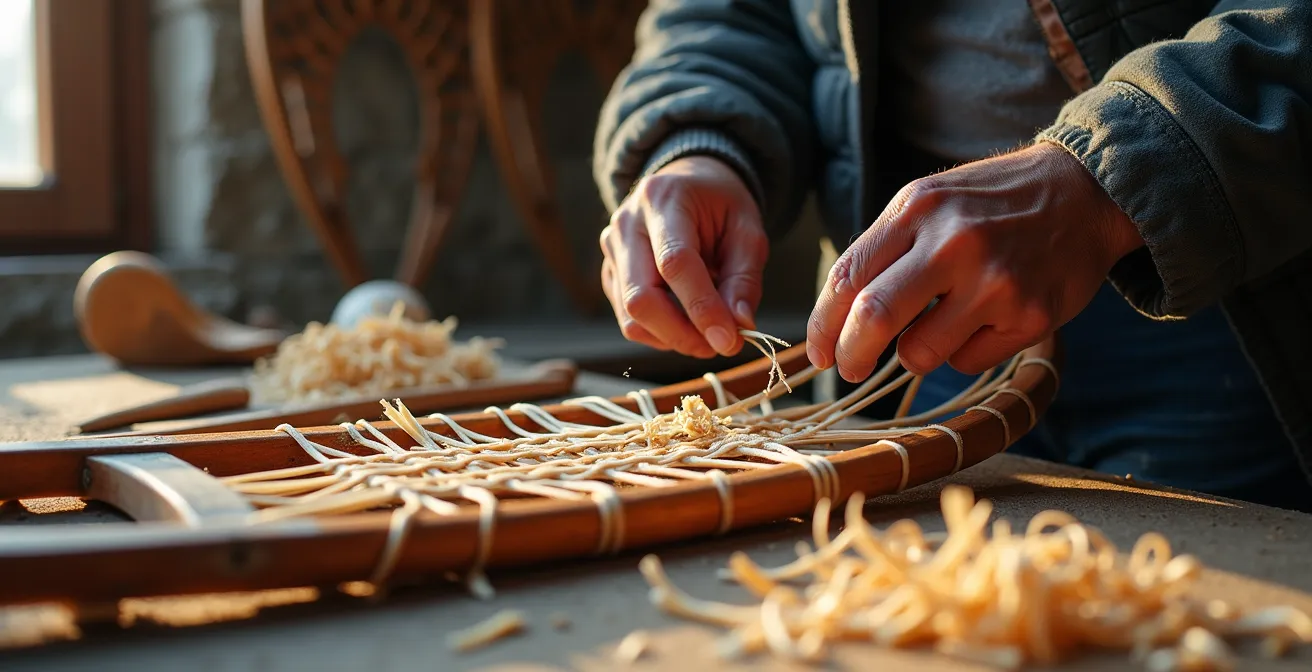
The construction itself was a living tradition, passed down through generations and deeply connected to place. Materials were sourced locally and used with purpose and respect.
The Huron-Wendat Nation’s Living Snowshoe Craft
In Wendake, Quebec, the Huron-Wendat Nation actively maintains the traditional craft of snowshoe making. Artisans use ash wood for the frames due to its strength and flexibility, and babiche (rawhide lacing) for the webbing. The intricate weaving patterns are not just decorative; they are designed to distribute weight perfectly and prevent snow from sticking. This continuation of craft, using materials from their specific territory, is a powerful act of cultural preservation and a testament to the enduring genius of the original designs.
Form and Function: Why Traditional Mukluks are Warmer than Synthetic Boots?
In the extreme cold of the Canadian North, keeping feet warm is not a matter of comfort, but of survival. While modern hikers often turn to insulated, waterproof synthetic boots, traditional Indigenous footwear like mukluks and kamiks offer superior performance based on a counterintuitive principle: breathability is the key to warmth. This insight is a cornerstone of Inuit and First Nations knowledge about Arctic and subarctic living.
The problem with most synthetic “winter” boots is that they are waterproof. While this keeps external moisture out, it also traps internal moisture—sweat. When that sweat cools and freezes, it draws heat away from the foot, leading to cold and even frostbite. Traditional mukluks, made from animal hides like sealskin or caribou and often lined with fur, are designed to do the opposite. They are highly breathable.
The natural materials in traditional mukluks are breathable, wicking away moisture to keep feet dry, which is the true key to warmth in Arctic conditions.
– Indigenous Knowledge Keepers, Traditional Ecological Knowledge Archives
This system acts like a natural Gore-Tex. The soft, flexible soles also allow the foot to move naturally, promoting blood circulation, which generates more heat. Furthermore, the wearer could feel the texture of the snow and ice beneath their feet, providing crucial feedback for safe travel. This combination of moisture management, circulation, and sensory feedback makes traditional mukluks a form of high-performance technology far more sophisticated than a simple insulated boot. It is a system designed not just to block the cold, but to work with the body’s own heating system in the harshest of environments.
Poutine Variations: When Does Innovation Become Cultural Appropriation?
While poutine’s origins are rooted in rural Québecois culture of the 1950s rather than ancient Indigenous tradition, its journey into a national icon and a canvas for endless “gourmet” variations provides a powerful modern lens through which to understand a critical issue: cultural appropriation. When does celebrating and adapting a food become extracting and erasing its origins? This question is central to the conversation around reconciliation and respect in Canada today.
Cultural appropriation is not the same as cultural exchange, which is often reciprocal and respectful. Appropriation typically involves a dominant culture taking elements from a marginalized culture without permission, understanding, or credit. Often, this involves stripping the element of its original context and meaning, and frequently, profiting from it in a way the originating community cannot. The distinction is crucial, especially when it comes to food, which is so deeply tied to identity and history.
The following framework helps differentiate between respectful innovation and harmful appropriation, a vital tool for chefs, travellers, and consumers alike.
| Aspect | Respectful Innovation | Cultural Appropriation |
|---|---|---|
| Credit | Acknowledges Indigenous or cultural origins | Erases or ignores original creators |
| Profit | Benefits flow back to the source community | External extraction of value and profit |
| Permission | Collaboration or consent from elders/community | Taken without asking or permission |
| Context | Preserves or honors cultural meaning | Strips spiritual or historical significance |
The Indigenous Food Sovereignty Movement as a Response
The growing Indigenous food sovereignty movement in Canada is a direct response to centuries of cultural disruption and appropriation. As outlined in reconciliation efforts, this movement is about much more than food; it’s about reclaiming control over traditional food systems, revitalizing language and culture tied to harvesting, and educating others on the proper context of Indigenous cuisine. By supporting Indigenous-owned restaurants, businesses like Wabanaki Maple, and educational programs, non-Indigenous Canadians can participate in a respectful exchange that empowers the source communities, representing a fundamental shift in the relationship between peoples.
Rappie Pie: Why You Might Hate the Texture but Love the History
Further east, in the Acadian communities of Southwest Nova Scotia, another dish tells a powerful story of resilience and cultural identity: rappie pie (râpure). For the uninitiated, the texture can be challenging—a gelatinous mass of grated potatoes with a small amount of meat or seafood. But to dismiss it on texture is to miss the point entirely. This dish is a direct link to one of the most traumatic events in Canadian history.
Rappie pie is a food of survival. It was developed by Acadians who, after returning from exile following the Great Upheaval (Le Grand Dérangement) of 1755, had to make do with limited resources in a new and often hostile environment. Potatoes were one of the few crops they could reliably grow. The complex process of grating the potatoes and extracting the water was a way to preserve them and create a hearty, sustaining meal from the humblest of ingredients.
The dish represents making do with limited resources and preserving culture against all odds during Le Grand Dérangement.
– Acadian Historical Society, Cultural Heritage Documentation
Like Indigenous innovations, rappie pie is a technology born from a specific historical and environmental context. It embodies a story of perseverance, community, and the refusal to let a culture be erased. To eat rappie pie in a church hall in Clare or a family kitchen in Pubnico is to partake in a living history. For those wishing to experience it authentically, there is a well-trodden path:
- Start at Church Point (Pointe-de-l’Église) for authentic Acadian church hall dinners.
- Visit local restaurants in the Clare municipality, especially during the Festival Acadien de Clare.
- Stop at family-run establishments in the Pubnico area for famously traditional preparation methods.
- Join cooking workshops at sites like the Village Historique Acadien to learn the technique firsthand.
Key Takeaways
- Canada’s most iconic national symbols are sophisticated Indigenous technologies, born from a deep, scientific understanding of the environment.
- Their value transcends mere function, often embedding spiritual significance, community principles, and governance into their very design.
- Engaging with these symbols today requires moving beyond romanticism to actively recognize, credit, and support the living Indigenous communities and traditions that are their source.
What Do the Indigenous Names of Canadian Cities Actually Mean?
The final, and perhaps most pervasive, evidence of Indigenous innovation is written across the map of Canada itself. We travel daily through cities and across provinces whose names are derived from Indigenous languages, often without a second thought to their original meaning. This linguistic landscape is a constant, subtle reminder that the history of this land did not begin with the arrival of Europeans. The names themselves are a form of navigational and ecological technology, describing the very function or feature of the land.
These are not just poetic names; they are descriptive and practical. They speak to a time when the land was understood in terms of its function—for trade, for resources, for gathering. Tkaronto wasn’t just a place; it was *the* place “where trees stand in water,” a crucial fishing weir. Adawe wasn’t just a settlement; it was the hub “to trade.” This toponymy is the oldest layer of Canadian history, hiding in plain sight.
Understanding the original meanings of these place names is a powerful act of recognition. It re-frames our understanding of the urban spaces we inhabit, connecting them back to their Indigenous roots and the function they served for millennia.
| Current Name | Indigenous Name | Nation/Language | Literal Meaning |
|---|---|---|---|
| Toronto | Tkaronto | Mohawk | Where trees stand in water |
| Ottawa | Adawe | Algonquin | To trade |
| Winnipeg | Win-nipi | Cree | Muddy waters |
| Quebec | Kébec | Algonquin | Where the river narrows |
To truly understand Canada, the next logical step is to learn the story of the land you are on. We encourage you to research the traditional territory you inhabit, learn a greeting in the local Indigenous language, and support the artists, storytellers, and businesses who are the living keepers of these powerful traditions.