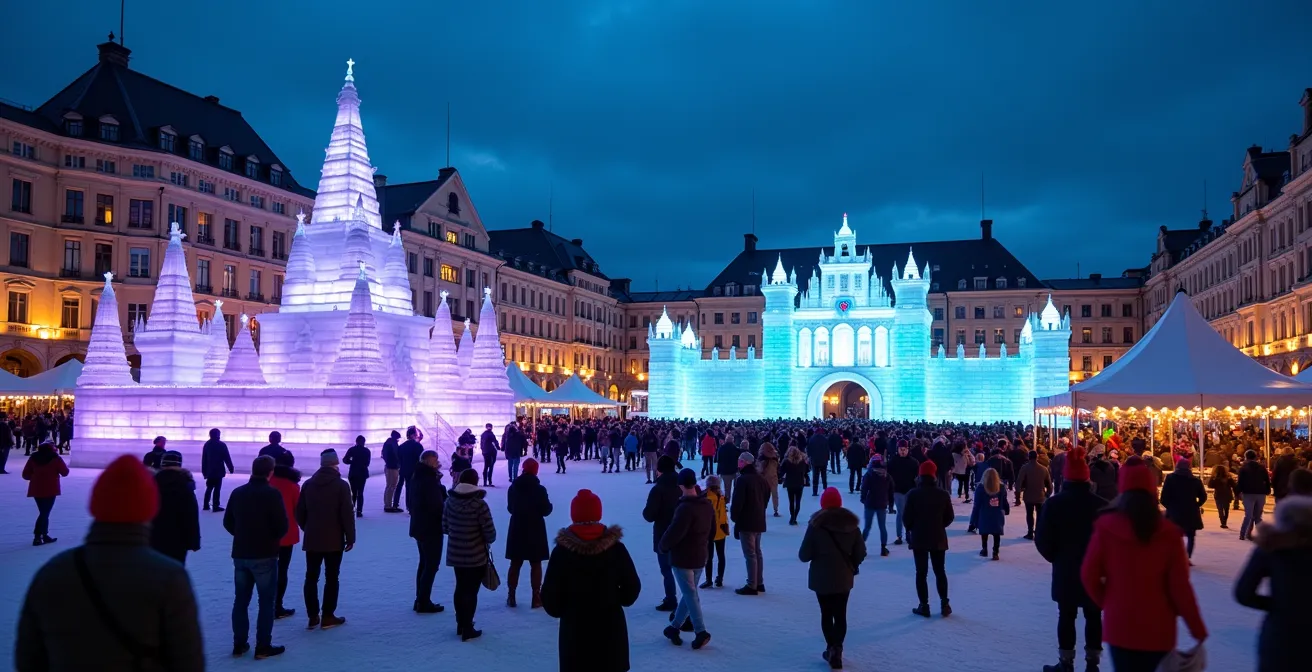
Contrary to popular belief, staying warm at the Carnival isn’t about piling on clothes; it’s about mastering a system of strategic warmth that locals have perfected.
- Defeat “static cold” by choosing boots based on insulation grams, not just temperature ratings, and by insulating your feet from the ground.
- Use high-calorie local foods like BeaverTails and tourtière as strategic fuel to power your body’s internal furnace.
Recommendation: Adopt the local Quebecois mindset: treat warmth as an active skill you can learn, not a passive test of your cold tolerance.
The image of Bonhomme’s Ice Palace, the vibrant night parades, and the joyful crowds is what draws thousands to the Quebec Winter Carnival. But for many, another image looms larger: a digital thermometer showing -20°C, accompanied by a paralyzing fear of spending hours as a human popsicle. The standard advice you’ll hear is to “wear layers” and “drink hot chocolate.” While not wrong, this advice is dangerously incomplete. It’s the reason so many visitors tap out early, retreating to their hotels and missing the true magic of the festival.
As a festival planner based right here in Quebec City, I’ve seen this happen year after year. Visitors arrive with expensive ski jackets, ready for an active day on the slopes, only to discover that standing still to watch a parade is a completely different kind of cold. The secret to not just surviving, but truly loving the Carnival, isn’t about having a higher pain threshold. It’s about understanding the local art of strategic warmth—a proactive system of heat management that Quebecers have turned into second nature. It involves defeating ground conduction, mastering caloric fuelling, and using indoor spaces as tactical “warmth pockets.”
Forget simply enduring the cold. This guide will teach you how to outsmart it. We’ll deconstruct the science of staying warm when you’re standing still, reveal the specific gear that makes a real difference, and explore the local foods that act as delicious, high-performance fuel. By the end, you won’t just be prepared; you’ll be armed with the insider knowledge to experience the Carnival with the cozy confidence of a local.
Summary: How to Enjoy the Quebec Winter Carnival at -20°C Without Freezing?
- The Cane Strategy: How to Carry Your Caribou Drink Safely at the Carnival?
- The Layering System: What Boots are Essential for Standing on Snow for 3 Hours?
- Rideau Canal Skateway: How to Check Ice Conditions Before You Travel?
- Cinnamon and Sugar: Why a BeaverTail is the Essential Fuel for Skating?
- Snow Sculptures: How to Vote for Your Favorite International Carving Team?
- Standing Still at -30°C: Why Ski Gear is Not Enough for Aurora Watching?
- The House of Commons Tour: How to Secure Tickets During Renovation Periods?
- How to Experience Montreal and Toronto’s Fine Dining for Under $100 CAD?
The Cane Strategy: How to Carry Your Caribou Drink Safely at the Carnival?
One of the most iconic adult traditions at the Carnival is the Caribou, a potent and warming concoction of red wine, whisky, and maple syrup. The classic way to enjoy it is by filling a hollow, plastic walking cane, turning a festive accessory into a personal flask. But this cherished ritual comes with its own set of challenges: spills, sticky gloves, and the risk of a frozen beverage. Mastering the cane strategy is a rite of passage that separates the rookies from the seasoned festival-goers.
The secret isn’t just to fill it and hope for the best. It’s a small system. Locals often craft their own custom cane holders using materials like leather straps and carabiners, a testament to Quebec’s resourceful maker culture. During the Carnival, some local hardware stores even set up “Carnival DIY” sections to cater to this tradition. The goal is to keep your hands free and your Caribou secure, allowing you to cheer, clap, and navigate crowds without sacrificing a drop of your liquid warmth. It’s about integrating the drink into your experience, not letting it become a clumsy burden.
Your Action Plan: Mastering the Caribou Cane Tradition
- Purchase an official cane holder at carnival kiosks near the main gates; they’re designed to prevent spills while walking through crowds.
- Fill your cane only two-thirds full to avoid overflow when walking—the Caribou mix can stain expensive winter gear.
- Hold the cane at a 45-degree angle when navigating crowds, using your free hand as a protective barrier.
- Master the “Quebec cheers” by gently tapping canes together at the neck, not the bulb, to avoid breakage.
- Keep your cane in an inside coat pocket between drinks to prevent the Caribou from freezing in extreme cold.
The Layering System: What Boots are Essential for Standing on Snow for 3 Hours?
Here is the single biggest mistake visitors make: they underestimate the cold that comes from the ground. You can wear the most expensive down jacket in the world, but if your feet are cold, you will be miserable. This is because of ground conduction—the process of the frozen, compacted snow actively sucking the heat out of your body through the soles of your boots. Ski boots or fashionable winter boots are designed for active use and simply don’t have the insulation needed for standing still. This is the difference between active cold and static cold.
Research confirms this gap between marketing and reality. Many boots are sold with dramatic temperature ratings, but these often assume you’re in constant motion. In fact, contrary to manufacturer claims, temperature ratings assume active movement, meaning a -40°F rated boot might only keep you warm to -10°F when you’re stationary. For standing at a parade, you need a different class of footwear. A recent study by Canadian footwear experts is even more specific, finding that boots with 600-800 grams of insulation are essential for stationary activities in -30°C conditions. Look for boots with thick, non-compressible soles and removable felt liners from trusted Canadian brands like Sorel or Baffin. This isn’t about fashion; it’s about deploying the right technology to defeat the cold.
Rideau Canal Skateway: How to Check Ice Conditions Before You Travel?
While the Rideau Canal Skateway in Ottawa is a world-famous Canadian winter experience, it’s important for visitors to the Quebec Winter Carnival to know that it is in a different city, over 450 kilometers away. Trying to include it in a Carnival trip isn’t practical. However, Quebec City offers its own magical and, crucially, more reliable skating experience right in the heart of the historic district: the rink at Place D’Youville. Surrounded by the city’s 400-year-old fortifications and the stunning Capitole theatre, it provides all the charm with none of the logistical uncertainty.
Unlike the Rideau Canal’s natural ice, which is entirely dependent on weather, Place D’Youville uses a refrigeration system. This guarantees consistent, perfect ice conditions throughout the festival, so you never have to worry about a sudden thaw ruining your plans. It’s the perfect place to practice your skating before indulging in a well-deserved treat.
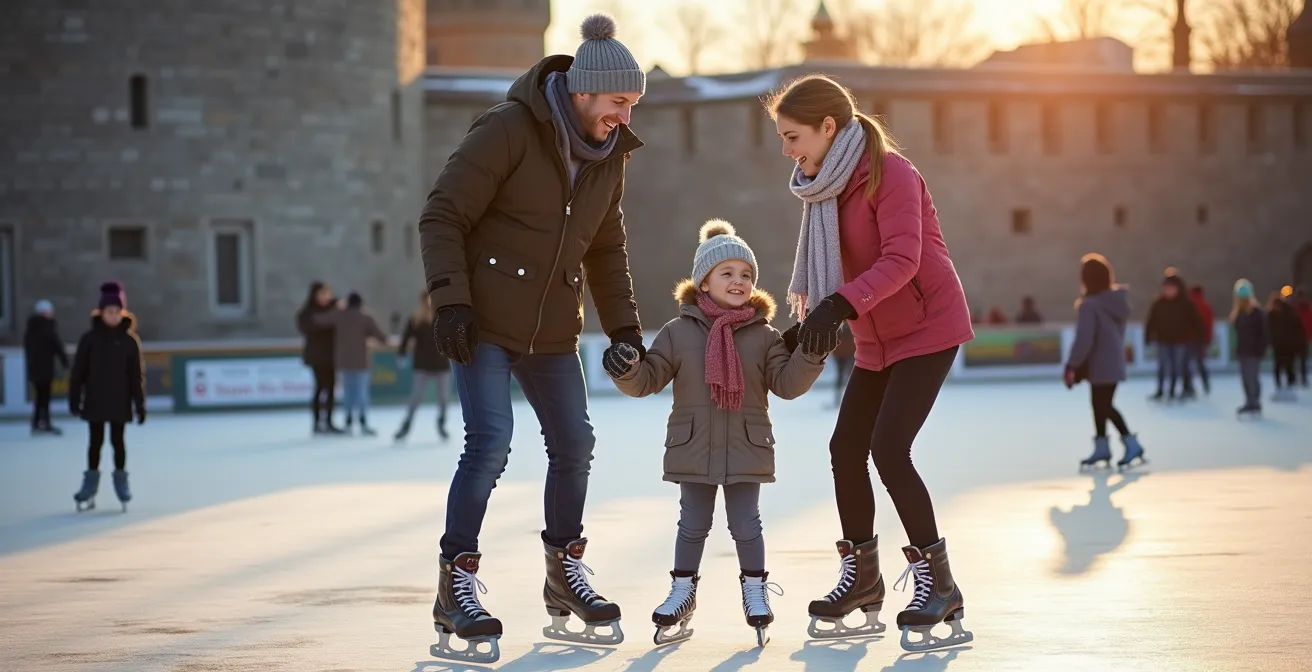
However, one piece of critical safety advice is universal across Quebec: never venture onto the frozen St. Lawrence River. While it may look solid, powerful tidal currents beneath the surface create invisible weak spots that can collapse without warning. Stick to officially managed rinks like Place D’Youville, where safety is the top priority.
Cinnamon and Sugar: Why a BeaverTail is the Essential Fuel for Skating?
In the battle against the cold, your body is a furnace, and calories are the fuel. This is the principle of “caloric fuelling,” and no food at the Carnival embodies it better than the iconic BeaverTail (or *Queue de Castor* in French). This hand-stretched whole wheat pastry, fried and topped with cinnamon and sugar, is far more than a simple treat; it’s a piece of high-performance winter equipment. It’s warm, easy to eat with mittens on, and delivers a powerful, immediate energy boost to keep your internal furnace burning hot.
The effectiveness of the BeaverTail isn’t just folklore; it’s backed by nutrition. A nutritional analysis reveals that a classic cinnamon and sugar BeaverTail contains around 312 calories and 50g of carbohydrates, providing the perfect blend of simple sugars for a quick burst of energy and complex carbs for more sustained warmth. While other treats like maple taffy on snow are a must-try for the experience, they offer a much shorter-lived caloric hit. The BeaverTail is the undisputed champion of festival fuel. As an insider tip, the stand near Bonhomme’s Ice Palace often has shorter lines between 2 and 4 PM when crowds are focused on the parades.
Snow Sculptures: How to Vote for Your Favorite International Carving Team?
The International Snow Sculpture Competition is one of the Carnival’s main events, a breathtaking open-air museum where artists from around the world transform massive blocks of snow into ephemeral masterpieces. The scale of this event is immense; the Quebec Winter Carnival hosts one of the world’s largest snow sculpture events, where international teams work with over 360 tons of specially prepared snow. These sculptures are not just built; they are engineered. Sculptors use everything from chainsaws to cheese graters, constantly adapting their techniques as the temperature fluctuations change the snow’s consistency from hard and brittle to soft and pliable.
Viewing the sculptures at night is a completely different experience. Strategic LED lighting is used to create dramatic shadows and highlight intricate details that are invisible during the day. As a visitor, you are not just a passive observer; you are a judge. The “People’s Choice Award” is a highly coveted prize, and participating in the vote is a fun way to engage with the art. The process is managed through modern technology, making it easy for everyone to cast their ballot and follow the results in real-time.
Your Action Plan: Voting in the Snow Sculpture Competition
- Download the official Carnaval de Québec mobile app before arriving to access the voting portal, even if your data connection is slow.
- Scan the unique QR code displayed at the base of each sculpture site to unlock that specific team’s voting page.
- You can vote once per day per device; the system is designed to ensure a fair tally.
- Access the “People’s Choice Award” section in the app to see the real-time voting standings and cheer on your favorite.
- Submit your final vote before 8 PM on the final Saturday of the competition for it to be counted in the official results.
Standing Still at -30°C: Why Ski Gear is Not Enough for Aurora Watching?
This section title mentions aurora watching, but the principle it addresses is the absolute core of surviving the Carnival’s night parades: the failure of active gear in static situations. Your high-tech ski jacket is designed to breathe, releasing heat and moisture as you exert yourself. When you’re standing still for two hours, you aren’t generating that excess heat. The jacket’s breathability becomes a liability, letting precious warmth escape. This is why Canadian work safety research confirms passive cold requires double the insulation compared to active conditions.
So, how do locals stay warm? They employ a series of ingenious, low-tech strategies. First is the “Quebec Shuffle,” a subtle, continuous shifting of weight from one foot to the other. It looks like a gentle sway, but this simple movement increases blood flow to your extremities by an estimated 40% without losing your prime viewing spot. Second, they bring their own insulation. You’ll see families standing on simple sheets of corrugated cardboard. This creates a critical barrier that prevents heat loss through ground conduction by up to 60%. Finally, there’s the “penguin huddle,” where small groups stand close together and rotate positions every 15 minutes, with those on the inside moving to the outside. This simple social act can reduce individual heat loss by 25%. These aren’t just quirks; they are time-tested survival techniques.
Key Takeaways
- Defeat “Static Cold”: Your gear must be rated for stationary activities. This means prioritizing heavy insulation (600g+ in boots) over the breathability found in activewear like ski gear.
- Insulate from the Ground: The frozen ground is your primary enemy. Use thick-soled boots and stand on a piece of cardboard to create a barrier and stop heat from being leached from your body.
- Food is Functional Fuel: View high-calorie, high-carbohydrate foods like BeaverTails and tourtière not as indulgences, but as essential fuel to keep your internal furnace running hot.
The House of Commons Tour: How to Secure Tickets During Renovation Periods?
Just as with the Rideau Canal, it’s important to clarify geography. The House of Commons is part of Canada’s Parliament in Ottawa and not a feature of Quebec City. For those visiting the Carnival, the more relevant strategy is to plan for “warmth pockets“—strategic indoor breaks to reset your core temperature. As a planner, I see museum visits and indoor attraction attendance triple during the coldest hours of a Carnival day, typically between 2 PM and 4 PM. Thinking of indoor locations not as a retreat, but as part of your daily itinerary, is a game-changer.
Instead of pushing through the cold until you’re shivering, plan a 60-to-90-minute indoor stop. This allows your body to fully warm up before you head back out for the evening’s festivities. Quebec City’s layout is perfect for this, with world-class attractions located just a short walk from the main Carnival sites on the Plains of Abraham and around the Old City. This tactical approach turns a potential ordeal into a pleasant and culturally enriching part of the day.
- Musée de la civilisation: A 15-minute walk from the Ice Palace, offering fascinating exhibits in a beautifully heated building.
- Morrin Centre Library: A historic English library just 5 minutes from the Plains of Abraham, offering free entry to its peaceful reading rooms.
- Château Frontenac Lobby: Open 24/7 with free access, this iconic hotel lobby offers luxurious seating areas and magnificent views.
- Musée national des beaux-arts du Québec: Located right on the Plains of Abraham, its modern wing has heated floors and a café with panoramic views.
How to Experience Montreal and Toronto’s Fine Dining for Under $100 CAD?
While Montreal and Toronto boast incredible fine dining scenes, focusing on that during the Quebec Winter Carnival misses the point entirely. Here, the ultimate culinary experience isn’t found in Michelin-starred establishments, but in the cozy, historic bistros serving authentic Quebecois comfort food. This is food designed for warmth, both for the body and the soul. And the best part? You can enjoy a spectacular, multi-course meal for a fraction of the price of big-city fine dining, often well under $50 per person.
The key is to look for the “Table d’Hôte” lunch menus. Many of Old Quebec’s most revered restaurants, which can be pricey for dinner, offer these fixed-price lunch specials that include an appetizer, a main course, and often dessert or coffee. This allows you to experience legendary dishes like tourtière, pea soup, or pouding chômeur in an authentic setting without breaking the bank. It’s the smartest way to dine, providing both incredible value and a delicious cultural immersion.
| Restaurant | Table d’Hôte Price | Courses Included | Dinner Price Same Meal | Savings |
|---|---|---|---|---|
| Le Continental | $38 | Soup + Main + Dessert | $85 | 55% |
| Aux Anciens Canadiens | $32 | Appetizer + Main + Coffee | $68 | 53% |
| Le Saint-Amour | $45 | Full 3-course + Wine | $95 | 52% |
| Légende | $35 | 2 courses + Bread service | $72 | 51% |
Now that you’re armed with the same strategies and secrets that locals use, you’re no longer just a visitor; you’re a savvy participant. You have the knowledge to choose the right gear, fuel your body effectively, and navigate the festival with confidence. It’s time to plan your trip and experience the magic of the Quebec Winter Carnival warmly, comfortably, and completely.