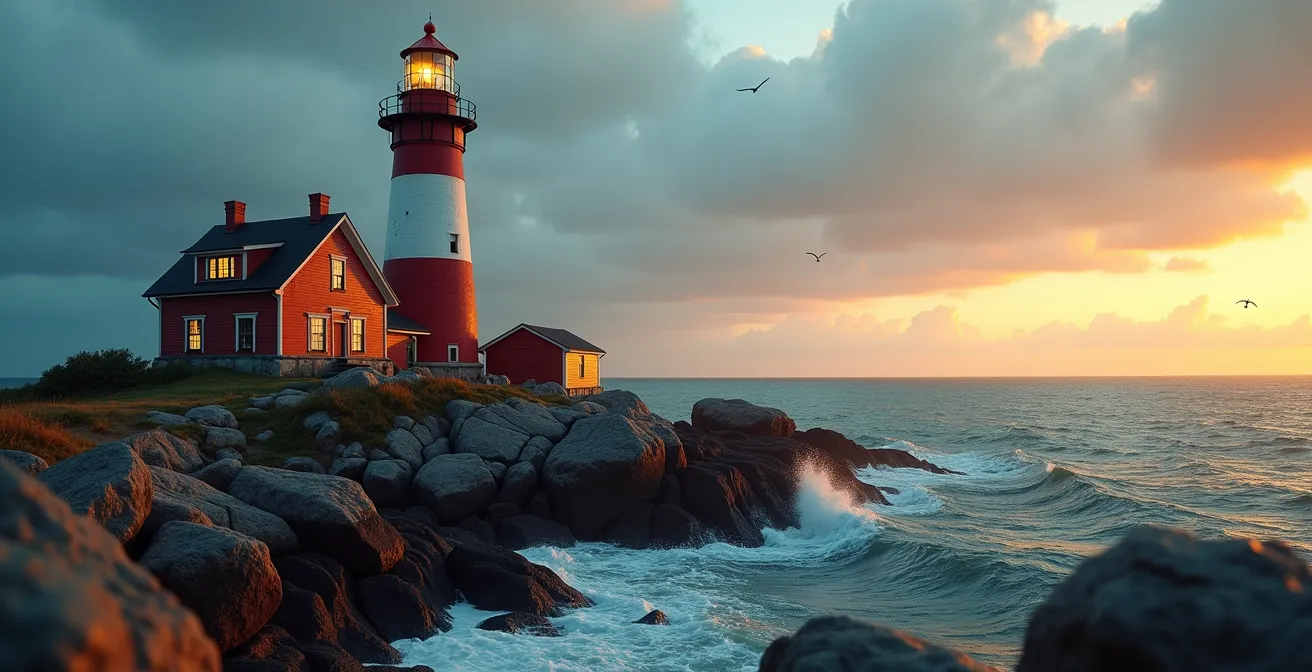
Choosing a Canadian lighthouse stay is about embracing living history, not just booking a room with an ocean view.
- The experience ranges from rustic authenticity, complete with shared quarters and foghorns, to renovated luxury in historic buildings.
- Your stay directly contributes to the preservation of these coastal sentinels, often managed by passionate community groups.
Recommendation: Prioritize the kind of authentic experience you seek—be it solitude, history, or community—and use that as your guide to find the perfect lighthouse accommodation.
The image of a lone lighthouse standing guard against the churning Atlantic is a powerful symbol of Canadian maritime heritage. For the romantic traveler, the idea of sleeping within those historic walls, lulled to sleep by the waves, is the ultimate escape. But this is an experience that goes far deeper than a picturesque seaside rental. It’s a chance to step into a piece of living history, to connect with the rugged soul of Canada’s coastline in a way no hotel ever could.
Many guides will simply list the most famous lighthouses. They’ll talk about the sweeping views and the photo opportunities, which are undeniably spectacular. However, they often miss the very essence of what makes these stays so profound. The real magic isn’t just in seeing the lighthouse; it’s in understanding its story and your role within it. What if the key to the most memorable stay wasn’t finding the most luxurious room, but embracing the authentic “heritage compromise” that comes with it?
This guide is built on that premise. We will explore the spectrum of experiences, from rustic keeper’s cottages to elegantly restored inns. We will uncover how your tourist dollars become a vital lifeline for preservation. We’ll navigate the practicalities, from accessibility for senior travelers to the unwritten safety rules of the coast. Ultimately, this journey will equip you to move beyond the tourist trail and find a truly authentic stay in one of Canada’s incredible coastal sentinels.
To help you plan this unique adventure, we’ve broken down the essential considerations into clear sections. This structure will guide you from understanding the different types of accommodation to finding your own slice of authentic maritime life.
Summary: Your Guide to Staying in a Canadian Heritage Lighthouse
- Luxury vs. Rustic: What Amenities Can You Expect in a Lighthouse Keeper’s Cottage?
- Where Does Your Money Go: How Tourism Funds Lighthouse Restoration?
- Peggy’s Cove vs. Cape Spear: Which Iconic Lighthouse is More Accessible for Seniors?
- The Black Rocks Rule: Why You Must Never Stand on Wet Rocks at Peggy’s Cove?
- The Lighthouse Route: Which 5 Stops Are Essential on Nova Scotia’s South Shore?
- Baddeck or Ingonish: Where Should You Base Yourself for the Trail?
- Shared Quarters: The Realities of Life in a Keeper’s Cottage
- How to Find Authentic Fishing Villages That Are Not Tourist Traps?
Luxury vs. Rustic: What Amenities Can You Expect in a Lighthouse Keeper’s Cottage?
The dream of staying in a lighthouse can conjure images of both spartan solitude and charming seaside luxury. In Canada, both are a reality. The key is to understand what you’re booking: are you seeking a modern inn set in a historic property, or the authentic, rustic experience of a keeper’s quarters? This choice will define everything from your bathroom facilities to your breakfast options. It’s the essential “heritage compromise”: sometimes, true authenticity means forgoing the amenities of a standard hotel.
On one end of the spectrum, you have beautifully restored properties like the West Point Lighthouse Inn on Prince Edward Island. It exemplifies the luxury heritage model, offering newly renovated seaside units with private balconies and king-sized beds. Here, the historic shell of the building houses a modern, comfortable inn experience, often including amenities like complimentary breakfast and Wi-Fi. This is an ideal choice for travelers who want the romance of the location without sacrificing creature comforts.
Conversely, many of the most authentic stays lean towards the rustic. To preserve historical accuracy, locations like the lighthouse on Île aux Perroquets in Quebec feature shared bathrooms. Remote island locations often have strict luggage limits—sometimes just one bag per person—due to transport by boat. Meals can range from fully catered dinners featuring local seafood to self-catering kitchens where you’ll share space with other guests. These trade-offs are not drawbacks; they are an integral part of the authentic living history experience, connecting you more deeply to the reality of life at these remote outposts.
Where Does Your Money Go: How Tourism Funds Lighthouse Restoration?
When you book a stay in a heritage lighthouse, you are doing more than just renting a room; you are becoming a direct patron of preservation. Many of Canada’s most beloved lighthouses are no longer operated by the government. Instead, they have been passed into the hands of passionate local community groups who rely on tourism revenue to fund the immense costs of maintenance and restoration. Your visit is a vote for their survival.
The scale of this movement is significant. According to data from the federal government’s heritage program, over 70 heritage lighthouses have been transferred to community groups and other organizations who commit to their long-term preservation. This model turns historic buildings from relics into living, breathing parts of the local economy. The West Point Lighthouse in PEI is a prime example of this success. Established as an inn in 1987 by the West Point Development Corporation, a volunteer group, the revenue from guests directly supports the ongoing upkeep of the lighthouse and the operation of its museum.
This paragraph introduces the vital role of community in lighthouse preservation. The image below captures the hands-on effort that goes into maintaining these historic structures, often powered by local volunteers.

As you can see, every shingle replaced and every window pane glazed is a testament to community dedication. By choosing to stay at these locations, you provide the essential financial fuel for this work. You are not just a tourist; you are an active participant in the stewardship of these irreplaceable coastal sentinels, ensuring they will continue to stand guard for generations to come.
Peggy’s Cove vs. Cape Spear: Which Iconic Lighthouse is More Accessible for Seniors?
For many travelers, especially seniors, accessibility is a critical factor in planning a coastal adventure. The romantic image of a lighthouse perched on a rugged cliff can sometimes hide practical challenges. While iconic sites like Peggy’s Cove in Nova Scotia and Cape Spear in Newfoundland are must-sees, their natural, untamed landscapes can be difficult to navigate for those with mobility concerns. It’s important to know what to expect before you go.
Peggy’s Cove is famous for its lighthouse sitting atop a massive granite rock formation. While stunning, the path from the visitor center involves walking directly on this uneven, sloping granite, which can be very challenging. Cape Spear, the easternmost point in North America, offers a more structured experience with a paved path, but it includes inclines and exposure to potentially extreme Atlantic winds. For a truly accessible and rewarding alternative, consider the Fisgard Lighthouse National Historic Site in British Columbia. It offers a completely different but equally historic experience with fully paved, flat terrain.
To help you make the best choice for your comfort and safety, the following table compares the key accessibility features of these three famous lighthouse locations. As data from Parks Canada and local observations show, what makes a site iconic doesn’t always make it the most comfortable to visit.
| Accessibility Feature | Peggy’s Cove | Cape Spear | Fisgard (Recommended Alternative) |
|---|---|---|---|
| Parking to Lighthouse Distance | 150m on uneven granite | 200m paved path | 100m flat causeway |
| Terrain Type | Natural rock, very uneven | Paved with some inclines | Fully paved, wheelchair accessible |
| Rest Areas/Benches | Limited | Several along path | Multiple with shade |
| Weather Protection | None – exposed Atlantic winds | Minimal – extreme winds common | Fort buildings provide shelter |
| Accessible Washrooms | Yes at visitor center | Yes at interpretive center | Yes, multiple locations |
| Overall Senior Rating | Challenging (2/5) | Moderate (3/5) | Easy (5/5) |
The Black Rocks Rule: Why You Must Never Stand on Wet Rocks at Peggy’s Cove?
The raw power of the ocean is a huge part of the allure of Canada’s coastlines. However, this power demands immense respect. At Peggy’s Cove, and indeed at any coastal lighthouse location, the most important safety rule is deceptively simple: stay off the black or wet-looking rocks. This isn’t just cautious advice; it’s a critical instruction to prevent a dangerous, and potentially fatal, fall into the turbulent, cold Atlantic.
The “black rocks” are dark because they are constantly coated in sea spray and host a thin, invisible film of slippery algae. They offer zero grip, making them as treacherous as a sheet of ice. Even on a calm day, a sudden “rogue wave” can surge unexpectedly, sweeping over rocks that appeared safe moments before and pulling unsuspecting visitors into the water. The coastline is not a predictable environment, and turning your back on the ocean for even a moment can be a serious mistake. This rule is paramount for the safety of all who visit these beautiful but wild places.
This principle is just one part of a universal code of coastal safety. With over 750 lighthouses protecting Canada’s coastline, the world’s longest, these rules are essential knowledge for any visitor.
Universal Coastal Safety Rules for Canadian Lighthouse Visits
- Never turn your back on the ocean: Rogue waves can appear suddenly even on calm days.
- Stay off black or wet rocks: Algae and sea spray create an invisible slippery film that’s impossible to grip.
- Respect barrier ropes and warning signs: They mark the safe viewing distance based on local wave patterns.
- Check tide tables before exploring: Many lighthouse areas and tidal pools become dangerous or inaccessible at high tide.
- Watch for ‘sneaker waves’ on the Pacific coast: These unusually large waves can surge much further up the beach than expected.
The Lighthouse Route: Which 5 Stops Are Essential on Nova Scotia’s South Shore?
For the ultimate lighthouse pilgrimage, few drives can rival Nova Scotia’s iconic Lighthouse Route. This scenic journey along the South Shore is dotted with historic fishing villages and, of course, a breathtaking array of coastal sentinels. While the entire route is worth exploring, certain stops offer truly unique experiences, especially for a romantic traveler with a love for history and photography. Focusing on five essential locations allows you to savour the journey rather than just ticking boxes.
The key is to seek out a mix of the famous and the hidden. While Peggy’s Cove is an obligatory stop, the real magic is found by arriving at dawn. At this hour, you can capture its raw granite beauty without the crowds, using the rocks as powerful leading lines in your photographs. Further down the coast, the Lunenburg Harbour Light is best photographed not from its base, but from across the water on Bluenose Drive, allowing you to compose a shot that includes the colourful, historic town in the frame.
For a more intimate experience, the lesser-known Port Medway Lighthouse offers a pristine beach in its foreground at low tide, creating a serene and beautiful composition. At the other end of the dramatic spectrum, the Western Head Lighthouse near Liverpool sits on a dramatic cliff edge, making it a perfect spot for capturing the ocean’s power, especially during stormy weather. Finally, Cape Forchu in Yarmouth has transformed into a major attraction, offering a “Climb the Light” experience that provides unparalleled harbour views and, after dark, a spectacular stage for stargazing. It’s a brilliant example of successful community-led tourism.
Baddeck or Ingonish: Where Should You Base Yourself for the Trail?
When tackling another of Nova Scotia’s famed scenic drives, the Cabot Trail, a common question arises for lighthouse enthusiasts: where should you set up base? The two most popular hubs, Baddeck and Ingonish, offer distinctly different atmospheres and access to different coastal experiences. Choosing the right one depends entirely on the type of trip you envision.
Baddeck, situated on the shores of the Bras d’Or Lake, is the social and cultural heart of the region. It’s a bustling town with a wider variety of restaurants, year-round services, and a lively Celtic music scene. From here, your primary lighthouse target is the Kidston Island Light, accessible by a short ferry ride. Baddeck is perfect for those who want a comfortable home base with plenty of evening entertainment after a day of exploring. Its central location also makes it a good starting point for exploring the entire Cabot Trail loop over a few days.
In contrast, Ingonish acts as the gateway to the wild, northern section of Cape Breton Highlands National Park. It has a more isolated, wilderness feel and is the ideal base for those who prioritize hiking, dramatic coastal scenery, and early morning photography. The nearby Neil’s Harbour Lighthouse is an easily accessible, classic fishing village sentinel. Ingonish truly shines in the autumn when the fall colours are at their peak, though services can be more limited outside of the high season. The decision ultimately comes down to a choice between a social hub and a wilderness retreat.
The table below breaks down the key differences for a traveler focused on coastal exploration and photography.
| Factor | Baddeck | Ingonish |
|---|---|---|
| Lighthouse Access | Kidston Island Light (ferry required) | Neil’s Harbour Light (roadside) |
| Atmosphere | Social hub with ceilidhs, museums | Wilderness gateway, isolated feel |
| Best Season | Year-round services available | Peak fall colors (early October) |
| Dining Options | Multiple restaurants | Limited, focus on Keltic Lodge |
| Morning Photography | Sunrise over Bras d’Or Lake | Coastal dawn shots |
Shared Quarters: The Realities of Life in a Keeper’s Cottage
The most authentic lighthouse stays invite you into a world far removed from the sterile quiet of a hotel. They offer a chance to experience the “authentic quarters” of the lightkeepers themselves. This often means embracing shared spaces and adjusting to the unique rhythms of a working heritage site. It’s in these moments—sharing a kitchen with fellow travelers or being woken by the mournful sound of a foghorn—that the truest memories are made.
Life in a keeper’s cottage is a sensory experience. As one guest at the West Point Lighthouse beautifully described it, the experience is deeply memorable:
Sleeping with the sea breeze and the sound of the waves was an experience I will never forget. The staff were amazing, friendly and smiling all the time-working together as a team. Waking up and enjoying a home cooked breakfast with fresh baking and home made bread-what a great way to start our day.
– TripAdvisor Guest, Review of West Point Lighthouse Inn
This testimonial captures the essence of the “heritage compromise.” You might hear the automated light mechanism or foghorn, but you’ll also be treated to home-cooked meals and a unique camaraderie with staff and other guests. Many of these remote locations offer limited or no Wi-Fi, presenting it not as a flaw, but as a welcome opportunity for a “digital detox.” It’s about disconnecting from the modern world to reconnect with your surroundings. To prepare, pack light, especially for island locations, bring cash for small purchases, and come with an open mind, ready to embrace a slower, more communal way of living.
Key takeaways
- A Canadian lighthouse stay is an active participation in living history, not just a rental with a view.
- Your tourism dollars are often the primary funding source for the restoration and maintenance of these community-run heritage sites.
- Authenticity sometimes involves a “heritage compromise,” such as shared facilities or limited amenities, which is part of the unique charm.
How to Find Authentic Fishing Villages That Are Not Tourist Traps?
For the romantic traveler, the allure of a lighthouse is often intertwined with the dream of discovering a quintessential, unspoiled fishing village. The challenge is finding one that hasn’t been polished into a tourist trap, a place that still hums with the authentic rhythms of maritime life. The secret often lies in following the light: the most remote and less-accessible lighthouses frequently serve as beacons to the most genuine communities.
Consider the journey to the Quirpon Lighthouse Inn in Newfoundland. Located in a beautifully restored 1922 keeper’s home, its remote location means it operates in close proximity to authentic working fishing communities, far from the mainstream tourist routes. Similarly, reaching the Battle Island Lighthouse in Ontario’s Lake Superior, accessible only by boat or kayak, is an adventure in itself that filters out casual tourism and immerses you in a truly wild, off-the-beaten-path environment. The journey becomes the destination, leading you to places where the focus is on the catch, not the visitor.
Once on the ground, you can use your senses to gauge a village’s authenticity. A real working harbour will have more fishing vessels than tour boats. It will have the honest, briny smell of fish processing plants, and the conversations you overhear will be about tides and weather, not tourist services. In Nova Scotia, looking for Acadian flags can lead you to the charming French-speaking communities along the French Shore, which often see fewer mainstream visitors. Visiting in the off-season, from October to May, is another fantastic way to see the true working heart of these villages, stripped of their summer crowds.
Your Action Plan: The Working Wharf Authenticity Checklist
- Vessel Check: Take note of the boats in the harbour. Are working fishing vessels, with their nets and traps, more numerous than pleasure craft or tour boats?
- Sensory Audit: Follow your nose and ears. Does the village have the distinct smell of the sea and fish processing? Are the dominant sounds gulls and boat engines, not gift shop jingles?
- Local Chatter: Listen to the conversations around you. Are locals discussing the weather, the price of lobster, and the timing of the tides?
- Cultural Clues: Look for signs of deep-rooted local culture, like the Acadian flags along Nova Scotia’s French Shore, which often point to less-touristed communities.
- Off-Season Visit: Plan a trip between October and May. This is when the seasonal tourism fades and the true, year-round rhythm of the maritime community is most visible.
Now that you’re equipped with the knowledge to choose your experience, respect the environment, and find true authenticity, the next logical step is to begin planning your own journey into Canada’s living maritime history.