
In summary:
- Lobster availability in Nova Scotia is dictated by regional seasons (LFAs), not the calendar. Don’t expect fresh Halifax lobster in February.
- For the best value, choose “Market” size hard-shell lobsters; they have a superior meat-to-shell ratio compared to smaller “Canners.”
- A true working harbour smells of diesel and bait, not sunscreen. Look for stacked traps and scuffed boats, not polished yachts.
- To find authentic fishing villages, explore beyond the main tourist routes and look for fishermen-owned co-ops.
- Always ask for airline-approved packaging when flying with seafood and declare it as “Perishable.”
There’s a dream every seafood lover has when they visit Nova Scotia: bypassing the restaurants and heading straight to the source. You imagine a grizzled fisherman in a yellow sou’wester, pulling a glistening, feisty lobster right from his trap and handing it over to you. The reality? You arrive at a bustling wharf, and it’s an intimidating scene of roaring diesel engines, forklifts zipping by, and a language of nods and grunts you don’t understand. It feels less like a farmers’ market and more like a chaotic industrial site.
Most guides will give you a list of picturesque villages or tell you the “best” time to visit. They’ll mention famous spots like Peggy’s Cove or Lunenburg, but they won’t tell you how to tell a working boat from a tour boat, or why the fisherman you approached just shook his head and walked away. They don’t teach you the unwritten rules of the dock, the things my grandfather, a lobster fisherman who was more chaos than man, taught me before I could even tie my own shoes.
But what if the key wasn’t just knowing *where* to go, but developing a kind of “wharf sixth sense”? This guide is your apprenticeship. We’re going beyond the postcard pictures to give you the practical, no-nonsense knowledge to navigate a real Nova Scotian fishing harbour. You’ll learn why you can’t get lobster everywhere, all the time; how to choose the right size for the best meat; and how to read the subtle signs that separate an authentic fishing outpost from a tourist trap.
This is about more than just a meal; it’s about connecting with the heart of this province. Forget being a tourist. By the end of this, you’ll know how to source the freshest Atlantic seafood with the quiet confidence of a local.
Summary: Your Guide to Nova Scotia’s Seafood Secrets
- Why Can’t You Get Fresh Local Lobster in Halifax in February?
- Canners vs. Markets: Which Lobster Size Offers the Best Meat-to-Shell Ratio?
- Frozen or Live: What is the Safest Way to Fly with 20 lbs of Seafood?
- The “Market Price” Trap: How to Know if You Are Overpaying for a Lobster Roll?
- Boil or Steam: How to Cook Fresh Mussels Without Turning Them into Rubber?
- Lobster Traps and Diesel: Signs You Are in a Working Harbour vs. a Marina
- Fatty, Medium, or Lean: How to Order Your Smoked Meat Sandwich Like a Local?
- How to Find Authentic Fishing Villages That Are Not Tourist Traps?
Why Can’t You Get Fresh Local Lobster in Halifax in February?
The first mistake a visitor makes is assuming lobster is always in season everywhere. You show up in Halifax in the dead of winter, dreaming of a shore boil, and find nothing. My grandfather would just chuckle and say, “The bugs are taking a nap, dear.” The truth is a bit more scientific. Nova Scotia’s coastline is divided into different Lobster Fishing Areas, or LFAs, each with its own strictly regulated season. This isn’t to frustrate tourists; it’s a vital conservation measure to protect lobster populations during their breeding and molting cycles.
Halifax sits in LFA 33, where the season is closed from the end of December to the end of March. So, no, you can’t get a lobster pulled from the water just outside the city in February. However, that doesn’t mean the province is dry. The whole system is a brilliant patchwork. According to Nova Scotia’s fishing zone system, there are 12 LFAs with rotating seasons, ensuring a nearly year-round supply if you know where to look. While Halifax’s boats are tied up, the massive LFA 34 in Southwest Nova Scotia (the province’s largest) is in full swing, running from late November to the end of May.
This means that even in February, lobster is being landed daily in ports like Yarmouth and Digby. From there, it’s trucked to facilities across the province, including Halifax. You might find it live in a tank at a grocery store or a place like Fisherman’s Market, often held in large seawater pounds. While it’s still Nova Scotian lobster, it’s not “fresh off the boat” from the harbour you’re standing in. Understanding this system is the first step to truly sourcing like a local.
Canners vs. Markets: Which Lobster Size Offers the Best Meat-to-Shell Ratio?
Alright, you’ve found a wharf with a boat selling direct. The fisherman asks, “What are you looking for?” and points to a crate of snapping, crawling crustaceans of all sizes. Panic sets in. Do you grab the biggest one? The smallest? This is where you separate the tourist from someone in the know. The key isn’t just size; it’s about the type of shell and the intended purpose, which is reflected in their names: Canners and Markets.
Canners are the little guys, typically under a pound. They get their name because they were historically used by the canning and processing industry. They’re cheaper, but a lot of their weight is shell. Markets, usually weighing between 1.25 and 1.5 pounds, are the sweet spot for a shore boil. They’re big enough to provide a satisfying meal with a good amount of tail and claw meat. Anything bigger moves into “Selects” or “Jumbos,” which look impressive but can sometimes have tougher meat.
This table breaks down the common wharf-side categories:
| Size Category | Weight Range | Best Use | Price Point |
|---|---|---|---|
| Canners | 0.5-1 lb | Processing industry | Lower price |
| Markets | 1.25-1.5 lb | Direct sale (sweet spot) | Mid-range |
| Selects | 1.75-2.5 lb | Premium dining | Higher price |
| Jumbos | 3+ lb | Special occasions | Highest price |
But the most important factor is shell density. After a lobster molts, its new shell is soft and it has less meat inside. A hard-shell lobster, which hasn’t molted in a while, is packed to the gills with meat. In fact, an official study from the Department of Fisheries and Oceans in Canada confirms that hard-shell lobsters provide better value with up to 50% more meat than a soft-shell of the same size. A hard-shell lobster feels heavy for its size and the shell doesn’t give much when you squeeze it. That’s the one you want.
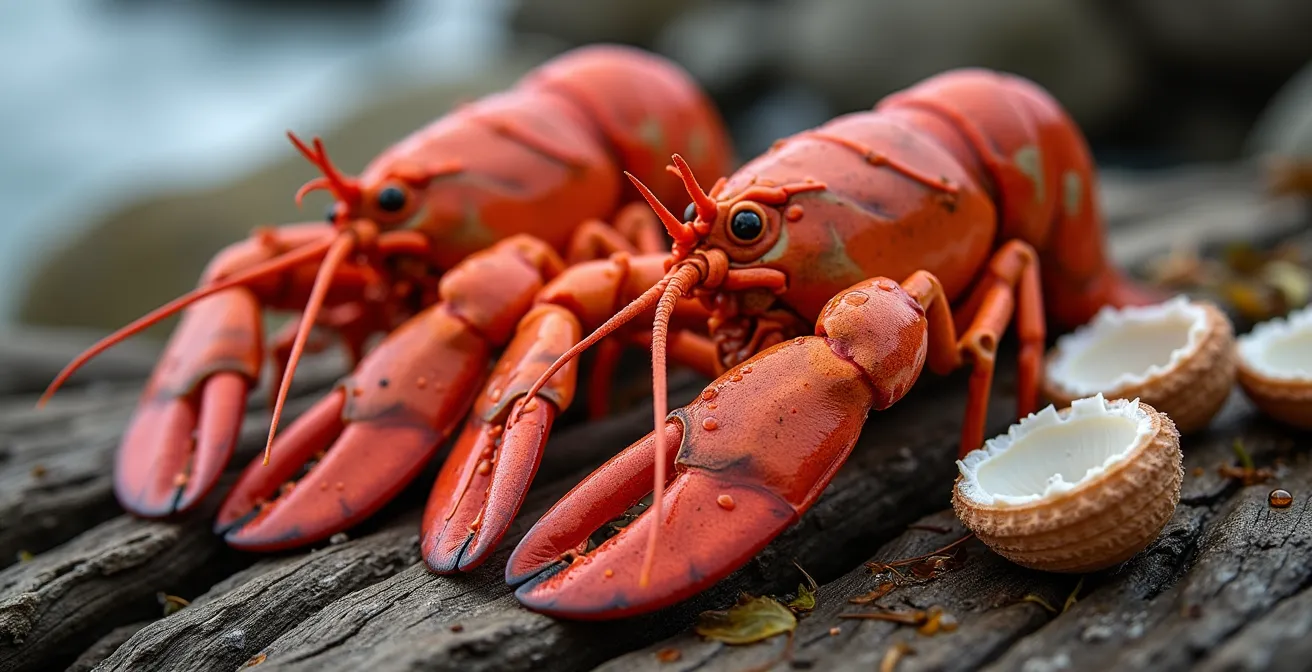
So, when you’re at the dock, ask for a “hard-shell market.” It’s the fisherman’s nod that says you know exactly what you’re looking for: the best flavour and the most meat for your money.
Frozen or Live: What is the Safest Way to Fly with 20 lbs of Seafood?
You’ve done it. You hit the jackpot at a wharf in Port Mouton and now you have a heavy box of fresh lobster, scallops, and haddock. The challenge: getting this precious cargo home on an airplane without it becoming a security incident or a smelly mess. The secret is in the prep and packaging, and knowing who to call. Don’t try to DIY this with a cooler and some ice packs from the gas station.
Your best bet is to go to a professional seafood market near the airport, like the legendary Fisherman’s Market or Clearwater Seafoods near Halifax Stanfield. They are experts in packing for air travel. Call them at least 24 hours ahead of your flight. They’ll ask if you want it live or frozen. For live lobster, the goal is to keep them cool and damp, not submerged in water. They’ll pack them in a special styrofoam-lined waxed cardboard box with damp newspaper or seaweed. It’s crucial that the box has proper drainage. When packed this way, research shows that properly packed lobsters can survive approximately 72 hours out of water, more than enough for any flight.
For other seafood or if your journey is extra long, frozen is the way to go. They will flash-freeze the product and pack it with gel packs. This airline-approved packaging is designed to be leak-proof and is accepted by most Canadian carriers as checked baggage. Just make sure to label the box clearly as “PERISHABLE SEAFOOD.” It’s an extra step, but there’s nothing quite like hosting a lobster boil a thousand miles away and telling everyone you brought them straight from the boat.
Your Action Plan: Flying with Nova Scotia Seafood
- Contact a Pro: Call a dedicated seafood market like Fisherman’s Market near the Halifax airport 24-48 hours before your flight.
- Request Correct Packaging: Ask specifically for an airline-approved, styrofoam-lined waxed cardboard box.
- Choose Your State: Decide between live (packed in damp newspaper) or frozen (packed with gel packs) based on your flight duration and the type of seafood.
- Verify with Airline: Double-check your airline’s policy for perishable goods, but most Canadian carriers allow it as checked baggage if properly packaged.
- Label Clearly: Mark the box as “PERISHABLE SEAFOOD” and include your name and contact information.
The “Market Price” Trap: How to Know if You Are Overpaying for a Lobster Roll?
You’ll see it on menus from Halifax to the Cabot Trail: “Lobster Roll – Market Price.” For visitors, this feels like a trap. What does it even mean? The “market price” reflects the daily fluctuations in what restaurants pay for lobster from their suppliers, which is affected by season, weather, and demand. However, it can also be used to charge a premium, and not all lobster rolls are created equal. Knowing if you’re getting a fair deal is another part of your seafood “sixth sense.”
A great lobster roll is not about fancy ingredients. It’s about three things: a pile of fresh, chilled lobster meat (mostly claw and knuckle), a touch of mayonnaise or melted butter, and a toasted, top-split hot dog bun. That’s it. If you see a roll loaded with celery, onions, or a mountain of lettuce, it’s often a sign they’re skimping on the main event. The price should reflect the amount of actual lobster meat you’re getting.
The ultimate way to avoid the market price trap? Make your own. As a case study shows, buying your lobster directly from the wharf isn’t just about freshness; you can expect to pay 30-50% less than you would for the same lobster in a restaurant. When a boat is selling “markets” for $10 a pound, you can make four incredible, overflowing lobster rolls for the price of one or two mediocre ones at a tourist spot. If you do buy a roll, look for the shacks and take-outs with a local following—the places with a line-up that isn’t just tour buses. Ask them how much meat is in their roll. A good one will have at least a quarter-pound.
Boil or Steam: How to Cook Fresh Mussels Without Turning Them into Rubber?
While lobster gets all the glory, let me tell you a secret: some of the best seafood you can get in Nova Scotia is a bag of rope-grown mussels, fresh from the water. They’re cheap, sustainable, and incredibly delicious—if you don’t mess them up. The biggest crime against mussels is overcooking them, which turns them from tender, briny morsels into chewy, rubbery disappointments. My grandfather’s method was simple, fast, and foolproof.
First, forget complicated recipes. You need heat, steam, and not much else. If you’re near the ocean, use a bucket of fresh, clean seawater. If not, make your own by dissolving about 35 grams of salt per litre of water. You want it to taste like the sea. Put a large pot with a splash of this water on high heat. You just need enough to create steam, not to submerge the mussels.
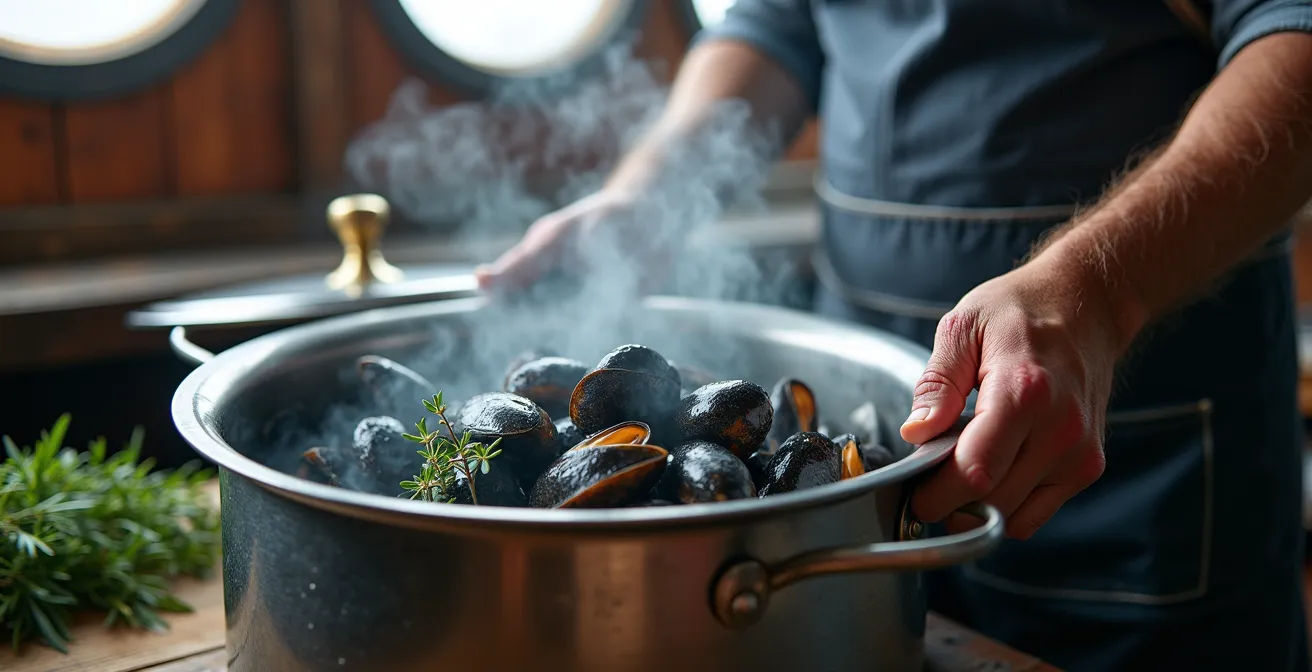
Once the water is at a rolling boil, toss in your cleaned mussels. You can add a splash of local Tidal Bay wine or craft beer for extra flavour, but it’s not essential. Put the lid on and let them steam. This is the crucial part: they are done the second their shells pop open. This takes only 2 to 4 minutes. Any longer and you’re entering the rubber zone. As soon as they’re open, pull them off the heat, drain the liquid, and serve immediately with a side of melted butter and maybe some fresh thyme. It’s the purest taste of the Nova Scotian coast, ready in minutes.
Lobster Traps and Diesel: Signs You Are in a Working Harbour vs. a Marina
So you’ve driven down a coastal road and found a harbour. Is it the real deal, or is it a postcard? The ability to distinguish a working fishing harbour from a pleasure-craft marina is fundamental to your quest. A marina is for tourists and yachts; a working harbour is where you buy your dinner. You need to learn to use your senses.
First, use your nose. A working harbour has a distinct, unapologetic smell: a mix of diesel, bait, and the low-tide brine of the Atlantic. A marina smells like sunscreen and restaurant kitchens. Next, use your ears. Listen for the sound of hydraulic winches, the crackle of VHF radios, and the rumble of boat engines. A marina is filled with the sound of music from boat stereos and tourist chatter. Finally, use your eyes. Look for mountains of stacked lobster traps, colourful tangles of rope and buoys, and boats with scuffed hulls and functional gear. A marina has polished fiberglass yachts and manicured docks.
This table can serve as your quick identification guide:
| Characteristic | Working Harbour | Tourist Marina |
|---|---|---|
| Visual | Scuffed boats, stacked traps, bait barrels | Polished yachts, manicured docks |
| Sound | Hydraulic winches, VHF radio chatter | Music, tourist conversations |
| Smell | Diesel, bait, briny salt air | Sunscreen, restaurant food |
| Examples | Sambro, Port Mouton, Lunenburg backside | Halifax waterfront, Baddeck |
Once you’ve identified a working harbour, you must remember one crucial thing: you are a guest in an active industrial workplace. This is not a petting zoo. As the local fishermen’s guidelines wisely state:
It’s an active industrial site: stay out of the way of forklifts and moving gear, ask permission before taking photos of people.
– Local Fishermen’s Guidelines, Nova Scotia Travel Guide
Be respectful, stay aware, and don’t get in the way. That quiet respect is the currency that gets you access to the freshest catch.
Fatty, Medium, or Lean: How to Order Your Smoked Meat Sandwich Like a Local?
While seafood is king, a true Nova Scotian culinary tour has a delicious detour: the classic deli-style smoked meat sandwich. Just as there’s a right way to buy a lobster, there’s a right way to order this Halifax staple. Walking into a place like The Hali Deli and fumbling your order is a dead giveaway you’re “from away.” But mastering the lingo is easy, and it unlocks the perfect sandwich.
It all starts with the fat. The flavour is in the fat. You’ll be asked if you want your smoked meat “Fatty,” “Medium-Fat,” or “Lean.” A real connoisseur often goes for Medium-Fat, which offers the best balance of flavour and texture. “Fatty” is for the purist who wants maximum juiciness, while “Lean” is an option but, between us, you’re missing out on the best part. The next choice is the bread, and there is only one correct answer: rye. Never ask for white or whole wheat. The final essential component is yellow mustard—again, never Dijon in a traditional spot. Your order should sound something like, “A medium-fat smoked meat on rye with mustard.”
This attention to detail and quality is a hallmark of the local food scene. As one visitor noted about their experience at a Halifax market:
Coming from Boston where fish markets are generally professional and knowledgeable, I was beyond blown away by Fisherman’s Market.
– Deli Customer
That same seriousness applies to the deli counter. A proper smoked meat sandwich is always served with a crunchy kosher dill pickle and a side of coleslaw. It’s a simple, perfect meal that’s as much a part of the local fabric as a lobster boil.
Key Takeaways
- Authenticity over aesthetics: A real fishing village has more working boats than pleasure craft and lacks large tour bus parking lots.
- Timing is everything: Lobster seasons are regional (LFA-based). Check the specific area’s season before you go.
- Value is in the details: A hard-shell, “market” size lobster offers the best meat-to-shell ratio and is the local’s choice for a shore boil.
How to Find Authentic Fishing Villages That Are Not Tourist Traps?
You have the knowledge. You know what to look for, what to listen for, and how to buy. Now, where do you go? The famous names are famous for a reason, but they are often crowded and commercialized. To find true, authentic fishing villages, you need to get off the beaten path and look for communities where fishing is still the primary way of life, not just a backdrop for tourism.
Start by exploring the roads less traveled. Instead of the main routes, take the scenic drives along the Eastern Shore (Highway 7) or the French Shore (Route 1). Look for villages that have signs of a living community beyond tourism: an active post office, a community hall, and a local convenience store. In these places, like Tangier or Saulnierville, the harbour is the heart of the town. You’ll see more fishing vessels than pleasure craft, and the infrastructure is built for work, not for show.
The ultimate sign of authenticity is a Fishermen’s Co-op. These are businesses owned and operated by the fishermen themselves. It is the most direct way to buy seafood from the source while supporting the local community. A prime example is the Victoria Co-op in Neils Harbour on the Cabot Trail. It’s a place where locals and fishermen interact, and the product is as fresh as it gets. Finding a co-op is like finding the secret entrance. It guarantees you are at the heart of the industry, getting the highest quality seafood directly from the people who caught it.
Now you have the map, both literally and figuratively. Go beyond the easy, polished tourist experience. Be curious, be respectful, and be ready for the smell of bait. The reward is not just the freshest seafood you will ever taste, but a genuine connection to the rugged, vibrant soul of Nova Scotia.