
A successful Canadian road trip budget isn’t an estimate; it’s a financial audit of the hidden variables that drive up the real cost.
- Cost variance between provinces is a major factor; gas prices can differ by over 30% due to regional taxes, and driving laws carry different financial penalties.
- Logistical liabilities, like missing a peak-season ferry or running out of food in a remote area, are not inconveniences but significant, unbudgeted expenses.
Recommendation: Treat your vehicle preparation and a robust emergency kit not as an upfront expense, but as a critical investment to mitigate high-cost breakdowns in Canada’s vast remote territories.
The cross-Canada road trip is an iconic journey, a ribbon of asphalt stretching from the Atlantic coast to the Pacific shores. Many budget-conscious planners sketch out the primary costs: fuel, food, and a place to sleep. They use online estimators, add a small buffer, and believe they have a solid financial plan. Yet, the final credit card statement often tells a different, more expensive story. The common approach of simple addition fails because it ignores the complex financial landscape of the country.
The real cost of a Canadian road trip isn’t found in the big-ticket items you anticipate, but in the dozens of small, variable expenses you don’t. These points of “budget leakage” are where a 14-day trip spirals out of control. We’re not just talking about sales tax differences; we’re talking about logistical liabilities that carry hundred-dollar consequences. Missing a ferry sailing in August doesn’t just mean a delay; it means a last-minute, overpriced hotel room. Assuming all driving laws are the same can lead to a $600 fine for holding your phone at a red light in one province but not another.
This guide abandons generic advice. As a travel finance consultant, my focus is the bottom line. Calculating the *real* cost of this journey is an exercise in risk management and detailed auditing. It requires you to look beyond the nightly rate of a motel and scrutinize the hidden fees. It means understanding that the price of gas is not a national standard but a patchwork of provincial policies. The key isn’t to budget more, but to budget smarter by identifying and neutralizing these hidden financial traps before you even turn the key.
This financial audit will deconstruct the true costs of a Canadian road trip, moving through each critical category of your budget. By understanding the variables and preparing for the contingencies, you can build a plan that reflects reality, not just optimistic estimates.
Summary: A Financial Breakdown of a Cross-Canada Road Trip
- Motels vs. Campgrounds: Which Option Saves More Money for a Family of 4?
- Radar Detectors and U-Turns: 3 Driving Laws That Change Between Provinces
- The Gas Station Diet: How to Find Real Food on the Trans-Canada Highway?
- The BC Ferries Mistake: Why You Cannot Just “Show Up” for the Nanaimo Crossing in August
- Offline Maps: How to Download Your Route Before Entering the Rockies?
- Why Your Gas Budget Will Vary by 30% Between Alberta and BC
- Walk-on vs. Drive-on: How Much Do You Save by Leaving the Car on the Mainland?
- How to Prepare Your Vehicle for the 7,800 km Trans-Canada Highway Crossing?
Motels vs. Campgrounds: Which Option Saves More Money for a Family of 4?
On the surface, the accommodation choice seems simple: camping is cheap, and motels are expensive. For a family of four, the baseline difference is stark, with the 2025 Canada Road Trip Budget Guide showing an average of CAD $35-$60 per night for camping vs. CAD $200-$300 for hotels. This initial math suggests camping saves over $2,000 on a two-week trip. However, this calculation is incomplete and fails to account for the hidden costs inherent in both options.
A true financial audit requires a deeper look at the associated expenses. Camping involves more than just a plot of land. You must factor in Parks Canada Discovery Passes, daily firewood bundles (which cannot be transported between provinces), reservation fees, and even coin-operated showers at some provincial parks. These small costs create significant “budget leakage.” Motels, while more expensive upfront, often include amenities like breakfast and eliminate the need for cooking gear, saving on both food costs and packing space. An Airbnb with a kitchen presents a hybrid option, offering food savings but adding cleaning and service fees.
To make an informed financial decision, you must compare the *total* cost of living, not just the cost of sleeping. The following table breaks down these figures, providing a more realistic comparison for a 14-day trip.
| Accommodation Type | Daily Cost (CAD) | 2-Week Total | Additional Costs |
|---|---|---|---|
| Provincial Campgrounds | $35-$60 | $490-$840 | Park passes, firewood ($7/bundle) |
| Private Campgrounds | $60-$90 | $840-$1,260 | Amenities fees, hookups |
| Budget Motels | $150-$200 | $2,100-$2,800 | Parking fees in cities |
| Airbnb with Kitchen | $170-$220 | $2,380-$3,080 | Cleaning fees, service charges |
Ultimately, the most cost-effective choice depends on your existing gear and travel style. A family already equipped with camping supplies will find camping cheaper, provided they meticulously budget for the add-ons. For those without gear, the initial investment might make budget motels a more financially sound option for a single trip.
Radar Detectors and U-Turns: 3 Driving Laws That Change Between Provinces
One of the most overlooked financial risks on a cross-Canada trip is assuming driving laws are uniform. This mistake can lead to fines that dismantle a carefully planned budget. Provincial discrepancies in traffic laws are a prime example of hidden variables that must be audited. For instance, a radar detector is perfectly legal in British Columbia and Alberta but will earn you a hefty fine and device confiscation in Ontario or Quebec. A U-turn at a traffic light is standard practice in some jurisdictions but illegal in others.
The financial consequences are not trivial. Fines for failing to slow down and move over for emergency vehicles range from $490 in Ontario to over $2,000 in Quebec. Distracted driving rules also vary; simply holding a phone at a red light can result in a $615 fine in Ontario, while the same action in B.C. costs $368. These aren’t just traffic tickets; they are major, unbudgeted expenses that can equal several days’ worth of accommodation costs.
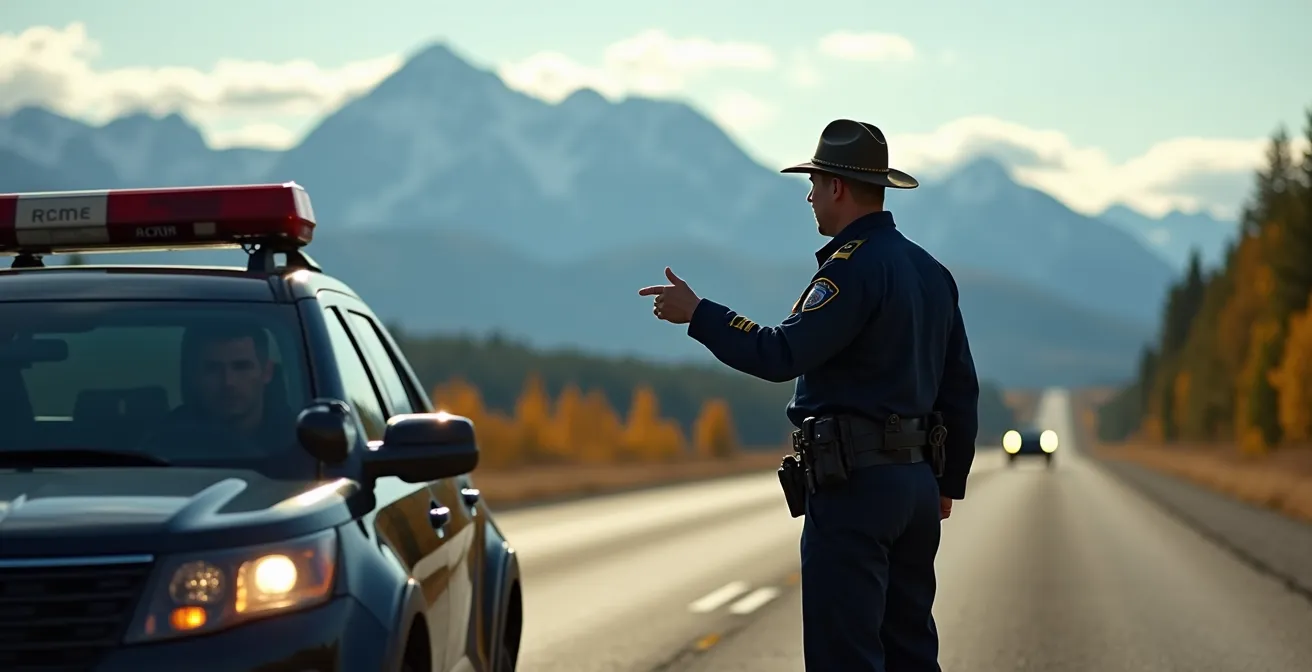
The presence of law enforcement along the Trans-Canada Highway, especially in mountain corridors, serves as a constant reminder that ignorance of local regulations is not a valid defense. Before crossing each provincial border, a five-minute review of key regulations is a critical risk-management activity. Specifically, focus on winter tire mandates (which have different dates in Quebec and BC), cellphone use policies, and “move over” laws. This proactive audit is a zero-cost way to protect your travel funds.
The bottom line is that your driving habits must adapt as you cross the country. Treating the entire 7,800 km journey as a single legal zone is a financial gamble. A prudent driver budgets time to learn the rules, not money to pay the fines.
The Gas Station Diet: How to Find Real Food on the Trans-Canada Highway?
A family of four living on gas station snacks and fast-food outlets will quickly erode their budget. The “gas station diet” is not only unhealthy but also surprisingly expensive. A more financially sound strategy is to focus on grocery stores, which requires careful logistical planning. According to a 2025 family road trip budget analysis, a realistic grocery budget is around CAD $300 per week for a family of four, a figure that is only achievable by avoiding the high markups of convenience stores.
The challenge lies in the geography of the Trans-Canada Highway. It features long stretches, particularly the 500 km “food desert” between Sault Ste. Marie and Thunder Bay in Northern Ontario, with no major supermarkets. Entering these zones without adequate supplies forces you into high-cost, low-quality food options. The key is to audit your route for grocery store locations (like Real Canadian Superstore, Sobeys, or Loblaws) and plan your overnight stops and major food purchases accordingly.
Strategic Grocery Shopping on the Trans-Canada Highway
A 2024 case study from a cross-country trip highlights the “Grocery Store Hop” strategy. By planning their daily drives to end in towns with major supermarkets, travelers saved 40% on their total food costs compared to relying on restaurants and convenience stores. One family leveraged the PC Optimum points program by shopping at Loblaws-affiliated stores and refueling at Mobil stations, earning $120 in free groceries over their two-week trip. The critical insight was stocking up on non-perishables *before* entering the Northern Ontario food desert, effectively bypassing the most expensive leg of the journey for food.
This approach transforms your food budget from a reactive expense into a planned investment. Utilizing a cooler with ice (budgeting $3.50-$4 for a new bag every two days) allows you to carry perishable items like fruits, vegetables, and dairy, further reducing reliance on costly pre-packaged foods. Planning meals that are simple to prepare at a campsite or picnic area—sandwiches, salads, and simple pasta dishes—is a cornerstone of this strategy.
In essence, you must treat your food supply like your fuel supply. Identify the long stretches between “refueling” opportunities and stock up beforehand. This small change in planning has a significant impact on your bottom line.
The BC Ferries Mistake: Why You Cannot Just “Show Up” for the Nanaimo Crossing in August
Treating BC Ferries like a simple walk-on service during peak season is one of the most common and costly mistakes a traveler can make. In July and August, particularly on the busy Horseshoe Bay to Nanaimo (Departure Bay) route, showing up without a reservation is a significant financial gamble. The wait for a spot on standby can stretch for multiple sailings, often resulting in a 4-6 hour delay. If you miss the last sailing of the day, you are forced to find a last-minute hotel room in West Vancouver, one of the most expensive municipalities in Canada.
The cost of this logistical error is substantial. Based on peak season analysis, a simple $17 reservation fee can save over $200 in unexpected hotel and meal costs. This is a classic example of a “logistical liability”—a small, preventable planning failure that triggers a cascade of major expenses. The math is clear: the small, certain cost of a reservation is far superior to the large, uncertain risk of being stranded.
The table below from a recent analysis illustrates the financial outcomes of different approaches to a peak-season ferry crossing. The “Standby Failure” scenario is the budget-killer that must be avoided at all costs.
| Scenario | Direct Costs | Hidden Costs | Total Impact |
|---|---|---|---|
| Reserved Sailing | $105 vehicle + $17 reservation | None | $122 |
| Standby Success (next sailing) | $105 vehicle only | 2-4 hour wait time | $105 + lost time |
| Standby Failure (overnight wait) | $105 vehicle | $180 hotel + $40 meals | $325+ |
| Saver Fare (off-peak) | $52.50 vehicle + $17 reservation | Schedule constraints | $69.50 |
For the budget-conscious planner, the strategy is non-negotiable: if traveling to Vancouver Island between June and September, a reservation is not an optional add-on, it is a mandatory component of your financial plan. For even greater savings, booking a “Saver Fare” on a less-popular sailing can cut the vehicle cost significantly, but requires flexibility in your schedule.
Offline Maps: How to Download Your Route Before Entering the Rockies?
Relying solely on a live cellular connection for navigation is a critical error when traveling through many parts of Canada. Large portions of the Trans-Canada Highway, especially through the Canadian Rockies and Northern Ontario, are notorious cellular “dead zones.” Losing your navigation can lead to missed turns, wasted fuel, and significant stress. More importantly, in an emergency, having no signal means you cannot call for help. Preparing for these dead zones is a non-negotiable part of your pre-trip audit.
The primary strategy is to download maps for offline use before you enter remote areas. Google Maps allows you to select and save large regions directly to your phone. This process should be done while on Wi-Fi and updated every 30 days. As a backup, installing an app like Maps.me or Organic Maps, which use OpenStreetMap data, provides an excellent secondary source for roads and even hiking trails. Beyond maps, you must also save all accommodation confirmations as PDFs and download entertainment like music or podcasts. A power bank is also essential to keep your devices charged when you’re away from your vehicle.
The Financial ROI of a Satellite Messenger
For travel through truly remote areas, a satellite messenger device like a Garmin inReach or SPOT is a sound financial investment. Analysis of 2024 road trips shows the clear return: one group’s rental of a Garmin inReach (costing ~$100 for a two-week trip) allowed them to send for roadside assistance in a dead zone near Thunder Bay, avoiding a potential $1,800 towing bill. Another family used their SPOT device to coordinate help on the Dempster Highway, preventing a medical situation from escalating into a $2,500 helicopter evacuation. With 70% of Canada’s landmass lacking cellular coverage, this device is an insurance policy against catastrophic, trip-ending costs.
Ultimately, a few gigabytes of downloaded data can save you from getting lost, but a satellite communication device can save you from a five-figure emergency bill. For a travel finance consultant, the small, fixed cost of the device is vastly preferable to the huge, potential liability of being stranded without a connection.
Why Your Gas Budget Will Vary by 30% Between Alberta and BC
The single largest variable in a Canadian road trip budget is fuel. However, most planners make a critical error: they calculate their total fuel cost using a single, national average price per litre. This approach is fundamentally flawed because Canada does not have a national gas price. Prices are set provincially, and the variance is extreme. According to recent provincial fuel price data, gas prices can range from $1.25/L in Alberta to $1.65/L or higher in British Columbia. On a 50-litre tank, that’s a $20 difference for a single fill-up.
This 30%+ cost variance isn’t driven by the base price of oil; it’s a direct result of provincial tax policy. Each province levies its own fuel tax on top of federal taxes and a carbon tax. This is where the discrepancy becomes clear. Alberta has a relatively low provincial tax, while British Columbia (especially Metro Vancouver) layers on a higher provincial tax, a carbon tax, and a dedicated transit levy.
To understand the bottom-line impact, you must look at the tax components that make up the price at the pump. The following table provides a simplified breakdown, illustrating why your fuel budget must be dynamic.
| Province | Base Price | Provincial Tax | Carbon Tax | Total/Litre |
|---|---|---|---|---|
| Alberta | $0.95 | $0.13 | $0.17 | $1.25 |
| BC (Vancouver) | $0.95 | $0.27 | $0.17 + transit levy | $1.65 |
| Saskatchewan | $0.95 | $0.15 | $0.14 | $1.35 |
| Ontario | $0.95 | $0.147 | $0.17 | $1.43 |
The actionable strategy is clear: plan your major refueling stops in provinces with lower gas taxes. Before crossing from Alberta into British Columbia, filling your tank in Canmore or Calgary is a mandatory cost-saving measure. Over the course of a 7,800 km trip, this “gasoline arbitrage” can easily save you $150-$250, more than enough to cover your Parks Canada Discovery Pass for the year.
Walk-on vs. Drive-on: How Much Do You Save by Leaving the Car on the Mainland?
For trips that include Vancouver Island, a key financial decision is whether to take your vehicle on the ferry or travel as a foot passenger. A surface-level analysis suggests walking on is always cheaper: a $17 one-way foot passenger fare is substantially less than the $105 one-way fare for a standard vehicle. However, this simple comparison ignores the cost of on-island mobility, which can quickly negate the initial savings.
The “right” financial choice is entirely dependent on your island itinerary. If your destination is downtown Victoria, which is highly walkable and well-serviced by public transit ($5 for a day pass), leaving the car on the mainland is a clear win. You save on the ferry fare and avoid steep downtown parking fees ($25+/day). However, if your plan is to explore more remote areas like Tofino or Ucluelet, the equation flips.
Victoria Weekend vs. Pacific Rim Explorer Cost Analysis
A 2024 travel data comparison illustrates this tipping point perfectly. A “Victoria Weekender” saved $180 over two days by walking on the ferry ($34 round-trip) and using public transit, compared to the cost of taking a vehicle. In contrast, the “Pacific Rim Explorer” visiting Tofino for three days found driving on to be more economical. The car ferry and gas ($270 total) was significantly cheaper than walking on and renting a car in Tofino, which would have cost nearly $400 including the rental, gas, and foot passenger fare. The analysis concluded that for stays longer than two days or any travel outside of Victoria/Nanaimo, bringing your own vehicle is the more cost-effective option.
To make the optimal choice, you must conduct a full cost-benefit analysis. Calculate the total cost of each scenario: (ferry fare + on-island transportation + parking) versus (foot passenger fare + taxi/bus from terminal + car rental/public transit). Don’t forget to factor in the logistical hassle of carrying luggage for a family of four as a foot passenger.
In short, there is no universal “cheaper” option. The answer lies in a personalized audit of your specific travel plans, balancing ferry costs against the price and necessity of on-island mobility.
Key Takeaways
- Provincial Discrepancies: Gas taxes, insurance rates, and traffic laws vary significantly by province, directly impacting your budget and financial risk.
- Logistical Liabilities: Missing a peak-season ferry or failing to book campsites isn’t an inconvenience; it’s a major, unbudgeted expense that must be managed with reservations.
- The True Kilometre Cost: Your real cost-per-kilometre must include vehicle depreciation, pre-trip inspections, and a robust emergency kit as non-negotiable line items.
How to Prepare Your Vehicle for the 7,800 km Trans-Canada Highway Crossing?
Your vehicle is not just your transportation; it is the single most critical piece of equipment for your trip. A mechanical failure in a remote part of Saskatchewan or Northern Ontario is not an inconvenience—it’s a financial crisis. A 2024 cost analysis confirms that spending $100-$200 on a pre-trip inspection can prevent over $500 in common emergency repairs. This is the definition of a high-return investment. The “True Kilometre Cost” of your journey goes beyond fuel; it must include preventative maintenance, depreciation (~$0.15/km for an average vehicle), and a budget for emergency preparedness.
A standard roadside emergency kit is inadequate for the realities of the Trans-Canada Highway. The sheer distance between service stations (often exceeding 200 km) means a “donut” spare tire is useless, and a basic towing plan with a 10km range is a joke. Your preparation must account for self-rescue. This means having the tools and supplies to handle common issues until you can reach a proper service center.
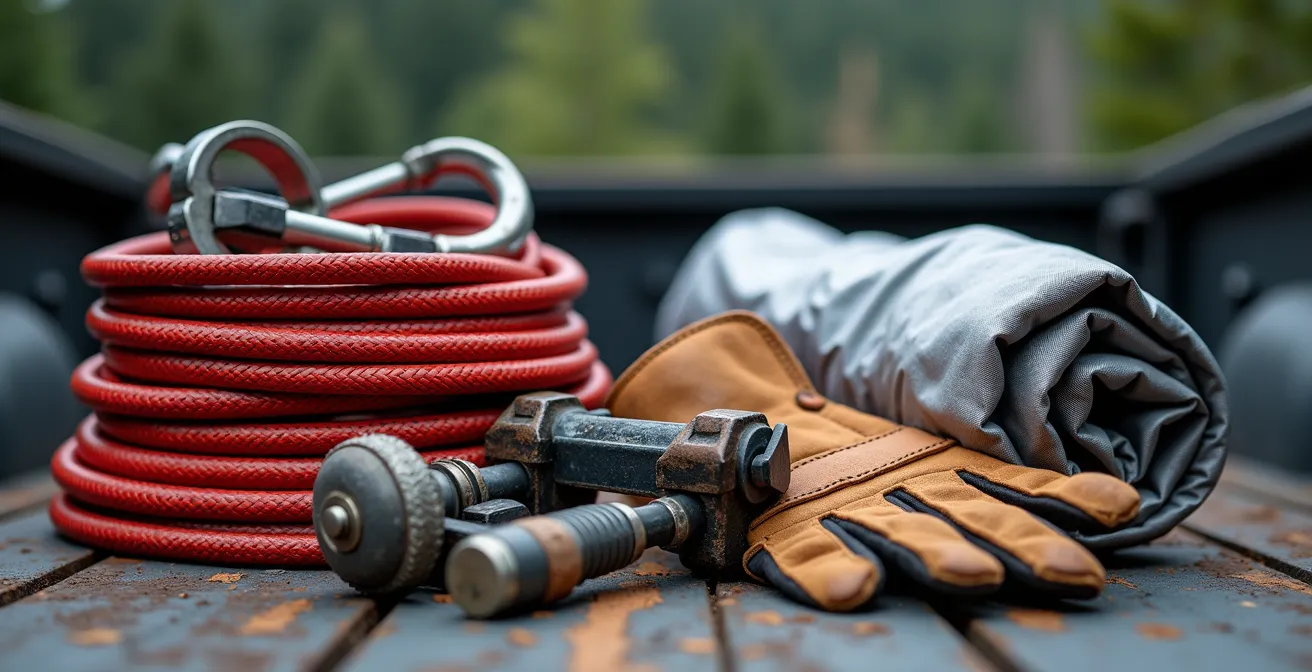
As this image of a well-stocked kit suggests, preparation involves more than just a first-aid kit. It includes robust tools for tire repair, power for your devices, and survival gear for a worst-case scenario. This isn’t paranoia; it’s sound financial planning against the high cost of being stranded.
Your Cross-Canada Vehicle Readiness Audit
- Tire Integrity: Pack a heavy-duty tire plug kit and a 12V compressor. Ensure your vehicle has a full-size spare tire, not a temporary donut.
- Power Systems: Carry 6-meter (20-foot) booster cables for wide highway shoulders and a portable power bank for electronics.
- Towing and Assistance: Upgrade your CAA/BCAA membership to a Premier plan, which offers a 320km tow range versus the basic 10km. This $120 annual investment can save you over $1,000 on a single tow.
- Vehicle Protection: Install a bug deflector and heavy-duty mud flaps to prevent windshield and body damage from gravel trucks, which can save a $500+ windshield replacement.
- Survival Gear: Stock a 72-hour kit with a -40°C rated sleeping bag, non-perishable food, water, and a satellite communication device for areas with no cell service.
Stop estimating and start auditing. Your vehicle is your primary asset on this trip. Protecting it with preventative maintenance and a comprehensive emergency kit is the most important financial decision you will make. It’s the ultimate insurance against the trip-ending costs that a simple budget will never see coming.