In summary:
- The Seawall operates on a principle of “urban flow”; respecting its one-way, counter-clockwise system is non-negotiable for safety.
- Your bike choice (cruiser vs. e-bike) depends on your fitness and goal; cruisers are for sightseeing, e-bikes for efficiency, but both must obey the 15 km/h speed limit.
- Locals value predictable movement. Avoid sudden stops for photos, keep to the right of the bike lane, and use designated pull-outs.
- The Seawall experience extends beyond the ride. Plan for a post-cycle sunset at English Bay and budget-friendly food on Denman Street.
- Never feed wildlife. This is a serious offence with legal consequences and directly leads to animal aggression and culls, as seen in the 2021 coyote crisis.
Every sunny Vancouver day, the Stanley Park Seawall becomes a stage for a silent, often frustrating, ballet. Tourists, mesmerized by the coastal mountain views, wobble into the path of seasoned local commuters. A sudden stop for a squirrel selfie causes a chain reaction of swerving bikes and exasperated sighs. Many guides will tell you to “rent a bike” and “be careful,” but they miss the fundamental point. Riding the Seawall isn’t just about avoiding pedestrians; it’s about understanding and integrating into its unique urban flow.
The common advice treats the Seawall as a simple park path, ignoring its function as a vital transportation artery and recreational pulse for thousands of Vancouverites daily. The real friction doesn’t come from the crowds, but from a misunderstanding of the unwritten rules of conduct—the Seawall etiquette. The key to a truly great ride isn’t just seeing the sights, but moving with the rhythm of the city, becoming part of the flow instead of an obstacle within it.
This guide shifts the perspective. Instead of a tourist checklist, this is a local’s briefing on how to master the Seawall. We’ll explore how to choose the right bike for the right purpose, decode the logic behind the strict one-way rule, and plan your ride to perfectly sync with the best of Vancouver life, from sunset viewing to post-ride eats. By the end, you won’t just have cycled the Seawall; you’ll have understood its role in the city and ridden it with the confidence and respect of a local.
To help you navigate this iconic Vancouver experience, this article breaks down the essential knowledge into key components. From the practicalities of your ride to integrating it with the local lifestyle, each section is designed to build your confidence and ensure a smooth, enjoyable journey.
Contents: A Guide to Mastering the Stanley Park Seawall
- E-Bike vs. Cruiser: Which Bike is Best for a Full Loop of the Seawall?
- One-Way Traffic: Why You Cannot Turn Around on the Seawall Bike Path?
- English Bay: When to Arrive to Get a Bench for the Sunset?
- Second Beach Pool vs. Ocean: Which is Warmer for a Swim?
- Coyotes and Raccoons: Why You Should Never Feed Animals in Stanley Park?
- Sushi and Pizza: Why These Two Foods are the Cheapest Staples in Vancouver?
- No-Hike Views: The Top 5 Drive-Up Viewpoints in the Rockies
- How to Travel British Columbia on a Budget of $150 CAD per Day?
E-Bike vs. Cruiser: Which Bike is Best for a Full Loop of the Seawall?
Your first decision sets the tone for your entire Seawall experience, and it’s about more than just comfort. Choosing between a classic cruiser and an e-bike is a strategic choice that should align with your fitness, budget, and desired pace. A cruiser bike is the quintessential choice for a leisurely ride. It encourages a slower pace, making it ideal for those who want to stop frequently for photos at spots like the Brockton Point totem poles or Siwash Rock. Its simplicity and lower cost make it a fantastic option for the relatively flat sections of the Seawall.
However, the Seawall loop isn’t entirely flat. The section from Siwash Rock towards the Lions Gate Bridge presents a noticeable incline. This is where an e-bike shines. It allows you to conquer the hills without breaking a sweat, ensuring you have enough energy to complete the full loop and explore further. E-bikes are perfect for riders who are less confident in their fitness or want to cover more ground quickly. The trade-off is the cost, as e-bikes are typically double the price of a standard cruiser.
Regardless of your choice, the most important local rule to respect is the 15 km/h speed limit. E-bikes can easily surpass this, but doing so is the quickest way to annoy locals who use the path for their own relaxed rides. The goal is to blend in, not to race. Mastering the Seawall flow starts with picking the right tool for your personal journey and using it responsibly.
Your Action Plan: Choosing Your Seawall Ride
- Assess your fitness level: Can you handle the incline from Siwash Rock to Lions Gate Bridge without assistance? If not, an e-bike is your best bet.
- Calculate your budget: E-bikes typically cost double (around $45 vs. $24 for 3 hours). A cruiser is the budget-friendly choice.
- Consider your riding style: Do you want to stop frequently for photos (cruiser) or complete the loop efficiently (e-bike)?
- Commit to the speed limit: Whichever bike you choose, you must respect the 15 km/h speed limit to avoid creating friction with other users.
- Book in advance: Check rental shops like Cycle City or Spokes online, as many offer a 10% discount for advance bookings.
One-Way Traffic: Why You Cannot Turn Around on the Seawall Bike Path?
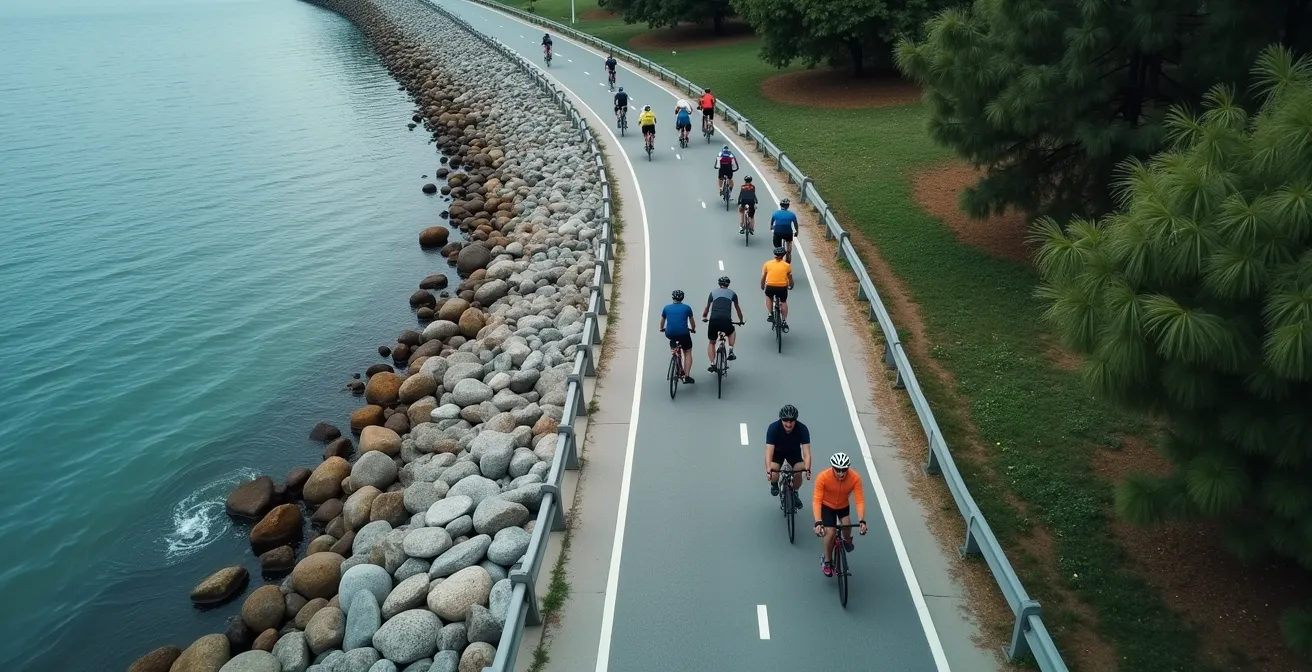
The single most important rule to understand on the Seawall is its strict, counter-clockwise, one-way system for cyclists. This isn’t an arbitrary rule; it’s the core of the traffic management system that allows thousands of people to use this narrow path safely every day. The Seawall is divided into two distinct lanes: the path closer to the water is for walkers and joggers (who can travel in both directions), while the inner path is exclusively for cyclists and inline skaters moving in a counter-clockwise direction only. Attempting to turn around or ride clockwise in the bike lane is the most common and dangerous mistake tourists make.
This system was implemented by the Vancouver Park Board to manage the immense popularity of the path, which is the most used recreational spot in the city. The one-way flow prevents head-on collisions and creates a predictable, fluid environment. Think of it like a roundabout for the entire park; everyone moves in the same direction, minimizing conflict points and allowing for a smoother, safer experience for all. This principle of predictable movement is key to urban cycling safety, and on the Seawall, it’s the law.
This highly organized flow is what allows a family on a leisurely ride to coexist with a seasoned commuter. Understanding and respecting this system is the primary way to show respect to locals and ensure your own safety.
If you need to leave the path before completing the full loop, don’t just turn around. Use one of the designated “escape routes” that locals use. These are official paths or roads that cut through the park, like Pipeline Road near Lumberman’s Arch or turning onto Stanley Park Drive at Second or Third Beach. These routes provide safe, two-way access back towards the park entrance without disrupting the essential one-way flow of the Seawall.
English Bay: When to Arrive to Get a Bench for the Sunset?
Completing the Seawall loop often concludes near English Bay, perfectly timed for one of Vancouver’s legendary sunsets. However, you won’t be the only one with this idea. Securing a prime viewing spot, especially one of the coveted benches, requires a local’s sense of timing. The strategy changes dramatically depending on the season and whether there’s a major event happening. During the Celebration of Light fireworks in summer, for instance, the most dedicated locals claim benches by early afternoon.
On a regular summer weekday, the rhythm is more relaxed. To guarantee a bench, you should aim to arrive 30 to 45 minutes before the official sunset time. This gives you enough time to settle in as the sky begins its colourful transformation. For photographers, the “golden hour” starts about an hour before sunset, offering the best light on the city skyline and the North Shore mountains. In the quieter shoulder season, like October, you can often arrive just as the sun begins to dip below the horizon and still find a good spot.
But true locals know that the benches aren’t the only option. For a more authentic Vancouver experience, claim a spot on one of the massive driftwood logs that line the beach; they are surprisingly comfortable and offer a more grounded connection to the scene. Alternatively, the grassy hill above English Bay Beach provides an elevated, less crowded perspective. For an even quieter experience, a short five-minute walk will take you to Sunset Beach, which offers an equally spectacular, west-facing view. Positioning yourself near the iconic Inukshuk statue provides the classic, most-photographed sunset angle in the city.
Second Beach Pool vs. Ocean: Which is Warmer for a Swim?
A mid-ride swim is a classic Vancouver way to break up a cycle around the Seawall, and at Second Beach, you’re presented with a tempting choice: the vast Pacific Ocean or the inviting, turquoise water of the Second Beach Pool. From a temperature perspective, there is no contest. The pool is a heated, saltwater oasis maintained at a constant, bath-like 29°C (84°F). In stark contrast, the Pacific Ocean at its absolute warmest in peak summer rarely surpasses 17-18°C (63-64°F). For most people, this makes the pool the far more comfortable option for a prolonged swim.
The decision, however, goes beyond just temperature. It’s about the kind of experience you’re looking for. The pool is a social hub, buzzing with families and friends. It has lifeguards, washrooms, and a concession stand, making it a convenient and safe option, especially if you have children. There is a modest entrance fee (around $7 for an adult), but the amenities and warm water are often worth it. It represents a controlled, comfortable, and social swimming experience.
The ocean, on the other hand, is free and offers a rugged, authentic West Coast experience. A quick plunge into the bracingly cold water is incredibly refreshing after a long bike ride and connects you directly with the natural environment of the park. It’s a test of fortitude and a quintessential Pacific Northwest activity. There are no facilities, just you and the natural setting. The choice ultimately depends on your priority: guaranteed warmth and amenities, or a free, invigorating dip in nature.
To help you decide, here is a direct comparison of what each option offers. As the data from the Vancouver Park Board shows, the temperature difference is the most significant factor.
| Feature | Second Beach Pool | Pacific Ocean |
|---|---|---|
| Temperature | Heated to 29°C | 17-18°C in summer |
| Cost | $7 entrance fee | Free |
| Amenities | Lifeguards, washrooms, concession | Natural setting, no facilities |
| Vibe | Family-friendly, social hub | Rugged, West Coast experience |
| Best for Seawall ride | Mid-ride break with facilities | Quick refreshing plunge |
Coyotes and Raccoons: Why You Should Never Feed Animals in Stanley Park?
While cycling through Stanley Park, you will almost certainly encounter wildlife, from raccoons ambling near the path to majestic eagles overhead. It can be tempting to offer a piece of your snack to a seemingly friendly animal. This is, without exception, a terrible idea with severe consequences for both the animals and humans. The number one rule of wildlife interaction in any British Columbia park is: do not feed the animals. Feeding wildlife habituates them to humans, causing them to lose their natural fear and become aggressive when they don’t get the food they expect.
A Cautionary Tale: The 2021 Stanley Park Coyote Crisis
The most powerful local example of this danger is the 2021 coyote crisis in Stanley Park. A sustained pattern of humans feeding coyotes led directly to a dramatic increase in animal aggression, resulting in dozens of attacks and bites on park visitors, including cyclists and children. The situation became so dangerous that it forced a controversial, park-wide cull by BC Conservation Officers, leading to several coyotes being euthanized. This tragic incident serves as a stark reminder that a seemingly harmless act of feeding has lethal consequences, turning naturally wary animals into a public safety threat.
This rule is not just a suggestion; it is enforced by law. According to the BC Wildlife Act, feeding dangerous wildlife (which includes coyotes, bears, and cougars) is illegal. Violators face serious legal repercussions, and as one report highlights, this can include potential fines of up to $50,000. The best way to appreciate Stanley Park’s wildlife is from a distance. Keep your food secured, dispose of all trash in designated wildlife-proof bins, and if an animal approaches you, make yourself look big and make loud noises to scare it away. Your respect for this rule protects the animals, yourself, and future visitors.
Sushi and Pizza: Why These Two Foods are the Cheapest Staples in Vancouver?
After completing your Seawall ride, you’ll emerge onto Denman Street, a corridor buzzing with food options. You’ll quickly notice a curious pattern: an incredible density of cheap sushi joints and pizza-by-the-slice shops. This isn’t a coincidence; it’s a direct reflection of Vancouver’s unique cultural and economic landscape. These two foods have become the city’s unofficial budget staples, perfect for a post-ride refuel without breaking the bank.
The phenomenon of affordable, high-quality sushi has deep roots in the city’s history. Vancouver is the birthplace of the now-famous California Roll, invented by Chef Hidekazu Tojo. This innovation, combined with decades of Japanese immigration and the city’s prime location on the Pacific coast, created a fiercely competitive market. The result is numerous “hole-in-the-wall” spots where you can get a delicious and fresh sushi combo for around $15. It’s a luxury in most cities, but a daily staple in Vancouver.
The prevalence of cheap pizza, on the other hand, is an economic response to Vancouver’s status as one of the world’s most expensive cities to live in. For residents and visitors on a budget, the $3-4 slice is a critical and accessible meal option. Shops like Nat’s Pizza have become local institutions, serving as essential refuelling stations in dense neighbourhoods like the West End. For a Seawall cyclist, this means a hot, satisfying meal is always just a few steps away from the park entrance, allowing you to cap off your ride with a quintessentially Vancouver experience.
Key Takeaways
- Master the Flow: The Seawall is a one-way, counter-clockwise path for cyclists. Respecting this rule is the foundation of safety and local etiquette.
- Ride Predictably: Avoid sudden stops, keep right, use hand signals, and pull over in designated areas to take photos. Your movements should be clear to others.
- Respect Wildlife and the Law: Never feed any animal. It’s dangerous, illegal, and carries heavy fines (up to $50,000 for dangerous wildlife).
From Seawall to Skyline: Connecting to Vancouver’s “No-Hike” Views
While the title might mention the Rockies, the principle of accessible, stunning viewpoints is deeply embedded in Vancouver’s landscape, and the Seawall is your starting point. You don’t need to drive nine hours to find breathtaking vistas. The very Coast Mountains you admire from your bike on the Seawall are the same range that extends eastward to form the Rockies. Vancouver offers a “micro” version of this grandeur through a series of incredible drive-up or easily accessible viewpoints that require no hiking.
After experiencing the intimate, sea-level views of the mountains from Stanley Park, your perspective can be elevated—literally. A short 10-minute drive from the park takes you to Queen Elizabeth Park, the highest point in Vancouver. From here, you get a stunning 180-degree panorama of the city skyline against its mountain backdrop, a view that perfectly complements what you just saw from the Seawall.
For an even more dramatic perspective, the Cypress Mountain Lookout on the way to Cypress Mountain Resort offers a sweeping, elevated vista of the entire region, from the Lion’s Gate Bridge and Stanley Park to the sprawling city and Mount Baker in the distance. This is a favourite local spot for sunset photography. These “no-hike” views aren’t a lesser alternative to the Rockies; they are a unique expression of Vancouver’s identity, showcasing the spectacular intersection of urban life and wild nature. The Seawall is not just a ride; it’s the first leg of a larger visual journey through the region’s accessible beauty, from the water’s edge to the mountain viewpoints.
How to Travel British Columbia on a Budget of $150 CAD per Day?
Traveling in British Columbia, especially Vancouver, can seem expensive, but with a local’s approach, a daily budget of $150 CAD is entirely feasible. The key is to leverage free and low-cost activities, with the Stanley Park Seawall cycle as the cornerstone of your strategy. Cycling is not just a world-class activity; it’s also your transportation for the day, eliminating the need for transit fares or taxis while you explore the city’s biggest highlights.
The Perfect Seawall Day: A Budget Breakdown
A perfect day centered on the Seawall proves that you can have a world-class experience on a budget. As a breakdown of a typical day shows, you can start with a full-day cruiser rental for about $35. For lunch, grab a delicious sushi-to-go combo from a Denman Street spot for $15. An afternoon swim at the Second Beach Pool adds $7. A post-ride happy hour craft beer costs around $6. For dinner, you can pick up $20 worth of groceries from a budget-friendly store like No Frills and have a picnic while watching the sunset at English Bay. The total for this amazing day comes to just $83, leaving you with $67 for your accommodation or other activities, well within the $150 daily budget.
To stretch your budget even further, integrate other free activities around the Seawall. Spend time beachcombing at low tide on Third Beach, explore the impressive Totem Poles at Brockton Point, watch the talented street buskers perform along the path, or join a free outdoor yoga session on the grass at English Bay during summer mornings. By combining a core, low-cost activity like cycling with smart food choices and free local experiences, you can fully enjoy Vancouver without feeling financially strained. This approach turns a potentially expensive trip into an affordable and deeply authentic adventure.
To plan your own budget-friendly Vancouver adventure centered on the Seawall, start by mapping out your day using the principles of flow, safety, and smart spending. Evaluate what kind of experience you want and build from there.