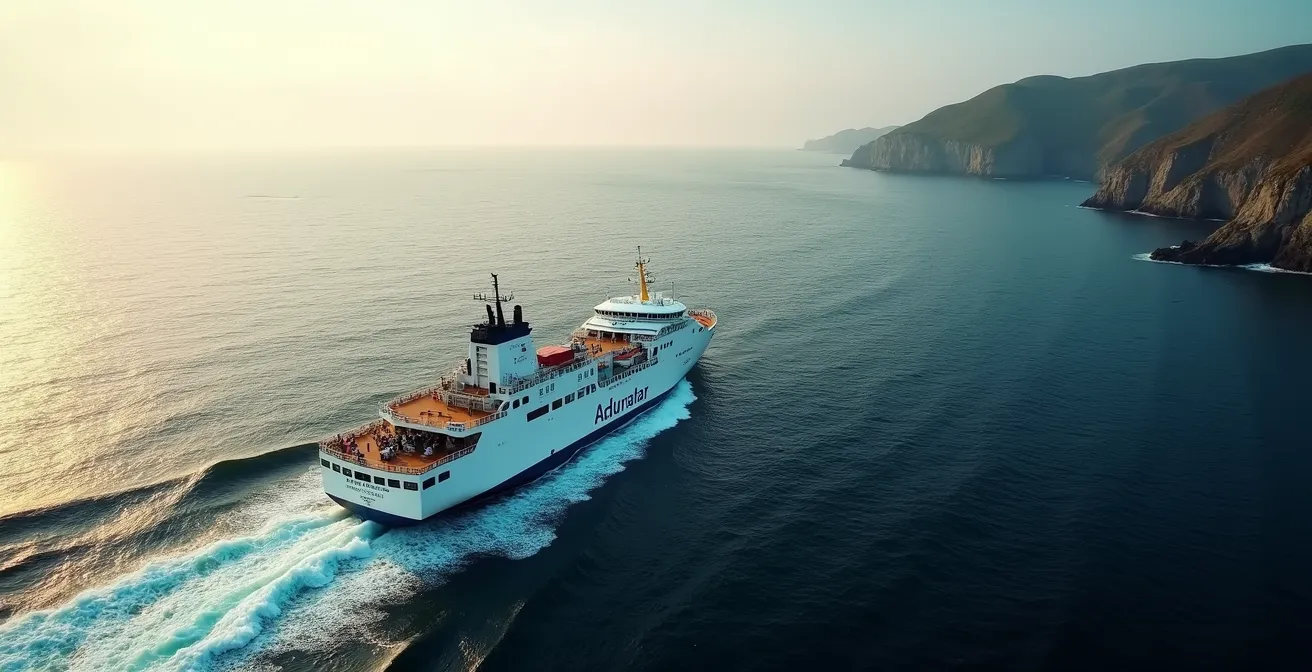
The choice to fly or take the ferry to Newfoundland isn’t about the journey itself, but about guaranteeing your mobility once you arrive.
- The island’s severe rental car shortage means bringing your own vehicle via ferry acts as crucial “mobility insurance.”
- The time theoretically saved by flying is often lost or nullified by the stress and expense of being stranded without transport.
Recommendation: Prioritize the ferry if your itinerary involves exploring beyond St. John’s. Analyze your on-island driving needs first, then choose your travel method to support them.
Planning a trip to “The Rock” presents a classic Canadian travel dilemma: do you fly in, or brave the Atlantic on the Marine Atlantic ferry? Most travelers immediately pull out a calculator, comparing flight prices to ferry fares and crossing times. They weigh the few hours in the air against the 6 to 17 hours at sea. This approach, however, is the single biggest planning mistake you can make, and it’s rooted in a fundamental misunderstanding of Newfoundland’s unique logistical challenges.
The common wisdom focuses on getting *to* the island. But the real question, the one that dictates the success of your entire trip, is: how will you get *around* the island? The decision to fly or ferry isn’t a simple time-versus-money trade-off. It is a strategic choice that hinges on a critical, often-overlooked variable: the extreme difficulty and astronomical cost of securing a rental car in Newfoundland. This guide reframes the problem entirely. We’ll move past the surface-level comparisons and focus on the on-island realities that truly matter. By understanding the logistical bottlenecks first, you can make a decision that doesn’t just get you there, but ensures you can actually experience the rugged beauty you came to see.
For those who want a visceral sense of the journey by sea, the following video captures the raw power of the North Atlantic waters that separate Newfoundland from the mainland. It’s a powerful reminder of the nature you’re choosing to embrace.
This article will walk you through the critical logistical factors, from the rental car crisis to the on-the-ground driving realities, that should inform your decision. By tackling these issues in a logical order, you’ll be equipped to plan your trip like a seasoned local, avoiding the anxiety and budget blowouts that trap so many first-time visitors.
Summary: Deciding Your Newfoundland Travel Strategy
- The Rental Car Crisis: Why You Must Book Your Car in Newfoundland 6 Months in Advance
- Port aux Basques vs. Argentia: Which Ferry Route Fits Your Itinerary?
- Gros Morne to St. John’s: Why This Drive Takes 7 Hours (Not 3)
- Wind and Fog: Why Your Umbrella is Useless in St. John’s
- Night Driving in Newfoundland: Why You Should Never Do It?
- Domestic Flights vs. Via Rail: Which Choice Saves You More Time and Money?
- The BC Ferries Mistake: Why You Cannot Just “Show Up” for the Nanaimo Crossing in August
- How to Book a Stay in a Heritage Lighthouse in Canada?
The Rental Car Crisis: Why You Must Book Your Car in Newfoundland 6 Months in Advance
The most significant factor in the fly-or-ferry debate is not the cost of a plane ticket, but the availability of a vehicle when you land. Newfoundland faces a chronic, severe shortage of rental cars, especially from June to September. Stories of travellers arriving at St. John’s International Airport (YYT) to find every single car on the island is booked are not exaggerations; they are the norm. This isn’t a minor inconvenience; it’s a logistical bottleneck that can derail your entire trip, leaving you stranded in the city or facing exorbitant costs for last-minute Turo rentals.
Waiting until your flights are booked to think about a car is a recipe for disaster. The demand far outstrips the limited supply, and prices skyrocket for any remaining vehicles. Booking a rental car 6 to 8 months in advance is not overly cautious; it’s essential. If you plan to fly, your very first action after booking your flight should be to secure a car. If you cannot find one, you should seriously reconsider your plan and pivot to taking the ferry with your own vehicle. Bringing your own car is not a cost; it’s a form of mobility insurance against the very real risk of being unable to explore the island.
Your Action Plan: Securing a Newfoundland Rental Car
- Book Immediately: The moment your flights are confirmed, book your car. Do not wait for sales or for other plans to solidify.
- Check All Airports: Search for availability not just at St. John’s (YYT), but also Gander (YQX) and Deer Lake (YDF), and consider one-way rentals between them.
- Expand Your Search: Check major providers like Enterprise, Avis, and Budget across all their locations, not just the airport depots.
- Research Alternatives: Look into Turo as a peer-to-peer backup option, but be aware that availability can be just as tight during peak season.
- Plan for Ferry Arrival: If you arrive by ferry as a foot passenger, pre-arrange a shuttle to a larger town like Corner Brook or Port aux Basques to pick up a rental, as options at the terminal are non-existent.
The stress and uncertainty of the rental situation is the primary source of “ferry anxiety” for planners. By addressing this head-on, you can make a clear-headed decision.
Port aux Basques vs. Argentia: Which Ferry Route Fits Your Itinerary?
Once you’ve acknowledged the rental car challenge and decided the ferry is the most logical choice for your trip, the next decision is which route to take. Marine Atlantic operates two distinct services from North Sydney, Nova Scotia, and your choice will fundamentally shape your itinerary. This isn’t just about a shorter or longer time at sea; it’s about where you begin your Newfoundland adventure. Do you want to start amidst the fjords of the west coast, or closer to the historic capital in the east?
The Port aux Basques route is the workhorse: a shorter, year-round service that drops you in the southwest corner of the island. It’s the ideal entry point if your primary goal is to explore Gros Morne National Park, the Northern Peninsula, and the Viking Trail. The Argentia route, by contrast, is a seasonal, longer, and more expensive journey that feels more like a mini-cruise. It delivers you to the Avalon Peninsula, just a 90-minute drive from St. John’s, making it perfect for those who want to explore the capital, Cape Spear, and the Irish Loop first.
The following comparison breaks down the key differences to help you align your ferry choice with your travel plans. As you can see, the cost and time commitments vary significantly.
| Feature | Port aux Basques Route | Argentia Route |
|---|---|---|
| Duration | 6-8 hours | 15-17 hours |
| Schedule | Year-round, 2 daily sailings | June-September, 3 weekly sailings |
| Base Cost (2021) | $44/adult + $115/car | $99.80/adult + $207.25/car |
| Arrival Location | Southwest Newfoundland | Southeast (135km from St. John’s) |
| Best For | Gros Morne & West Coast explorers | Avalon Peninsula first visitors |
Choosing the right port is the first step in building a realistic itinerary, saving you from a full day of backtracking across the island.
Gros Morne to St. John’s: Why This Drive Takes 7 Hours (Not 3)
A common mistake for first-time visitors is underestimating the sheer scale of Newfoundland. On a map, the drive from Gros Morne National Park on the west coast to the capital city of St. John’s on the east looks manageable. Google Maps might even quote you a time that seems reasonable. The reality on the ground, however, is vastly different. That drive is a 700-kilometre journey that will consume a full day. Expect it to take a minimum of seven to eight hours of pure driving time, without stops for food, gas, or photos.
The Trans-Canada Highway is the island’s main artery, but it’s not a multi-lane superhighway you might find elsewhere in Canada. It’s largely a two-lane road that cuts through a vast, remote wilderness. While mostly in decent condition, you must be prepared for changing road quality and frequent construction zones that can cause significant delays, especially in the short summer season. Venturing off the main highway onto smaller coastal roads requires even more patience, as potholes are a common feature.
A Traveler’s Reality on the Trans-Canada
An RV traveler’s experience highlights the conditions: “The Trans-Canada is mostly in good shape although even there you’ll encounter some rough roads and lots and lots of construction, but anytime you venture off of it, lots and lots of potholes are the norm. A big island with lots of roads + small population doesn’t lend itself to a large enough tax base to keep up with road repairs. We drove all over for weeks and didn’t have major problems; just be prepared to take it slow!” This underscores the need to build buffer time into every travel day.
This isn’t a complaint, but a critical piece of logistical advice. The time-value illusion of flying fades quickly when you realize the immense driving distances required to see the island’s premier attractions. A one-week trip trying to cover both Gros Morne and St. John’s will mean spending two full days just driving across the island. Understanding this scale is key to building a realistic and enjoyable itinerary.
Wind and Fog: Why Your Umbrella is Useless in St. John’s
Newfoundland’s weather is not just a topic of small talk; it’s a powerful, unpredictable force that dictates daily life and travel plans. The island, and particularly the Avalon Peninsula where St. John’s is located, is a battleground of weather systems. The most defining features are wind and fog. St. John’s is one of the foggiest, windiest, and cloudiest major cities in Canada. An umbrella is famously useless here; the wind will destroy it in seconds. A good quality, waterproof windbreaker with a hood is non-negotiable, even in July.
This has serious implications for your travel choice. While the ferry can be delayed by extreme sea states, flights are highly susceptible to fog. It’s not uncommon for St. John’s International Airport (YYT) to be completely socked in, leading to flight cancellations and delays that can last for days. This unpredictability must be factored into your schedule. As local tourism operators often advise, the weather is the one thing you cannot plan for, but you must plan *around* it.
Heavy fog can, and often does, cancel puffin and whale watching tours or ground flights at YYT
– Local tourism operators, Newfoundland travel guides and weather advisories
The wind is an equally formidable factor. The island experiences average wind speeds among the highest in major Canadian cities, which can make hiking coastal trails challenging and ferry crossings choppy. Whether you fly or take the ferry, building at least one or two “buffer days” into your itinerary is a wise strategy to absorb potential weather-related disruptions without derailing your entire vacation.
Night Driving in Newfoundland: Why You Should Never Do It?
If there is one piece of advice that every local will give you, it’s this: do not drive on Newfoundland highways at night. This isn’t a suggestion; it’s a critical safety rule. The reason is simple and imposing: moose. The island has one of the densest moose populations in North America, and these massive animals are most active from dusk until dawn. Striking a moose, which can weigh over 500 kilograms, is often catastrophic for both the vehicle and its occupants.
The highways are long, dark, and cut through dense forests, giving you very little reaction time when a moose steps onto the road. They are notoriously difficult to see at night as their dark coats absorb light and their eyes don’t reflect in headlights like a deer’s. The statistics are sobering; historical research in the Wildlife Society Bulletin reveals that of 5,422 moose-vehicle collisions recorded over a six-year period, a staggering 75% occurred between dusk and dawn.

This safety imperative has a direct impact on your travel logistics. It means your travel days must end by sunset. A seven-hour drive across the island must be started in the morning to ensure you arrive at your destination before dark. This restriction makes your driving schedule less flexible and reinforces the need for meticulous planning. A late-arriving flight that puts you on the road after dark, or a ferry that docks at twilight, can create a dangerous situation. Always plan to be at your accommodation for the night before the sun goes down.
Domestic Flights vs. Via Rail: Which Choice Saves You More Time and Money?
For travelers coming from other parts of Canada, the journey to the North Sydney ferry terminal is a significant undertaking in itself. While most people will drive, there’s a more scenic, albeit slower, alternative to consider: combining train and ferry travel. This option reframes the question from a simple “fly vs. ferry” to a more holistic “how do I want to experience the journey to The Rock?”
The primary domestic flight option is to fly directly into a Newfoundland airport like St. John’s (YYT) or Deer Lake (YDF). This is undoubtedly the fastest method in terms of pure travel time. However, as we’ve established, this speed comes with the significant risk and cost of the on-island rental car crisis. The alternative approach involves embracing the journey itself as part of the vacation.
A Multi-Modal Journey to the Ferry
A popular scenic option is taking Via Rail’s “The Ocean” service, which runs from Montreal to Halifax. From Halifax, it’s a beautiful four-hour drive in a rental car to the North Sydney ferry terminal. This multi-modal approach transforms the trip into a grand Canadian tour. The journey involves approximately 20 hours on the train, offering a unique perspective on the landscapes of Quebec and the Maritimes before you even set foot on the ferry. While it takes significantly longer, it avoids a long, tiring drive and replaces it with a relaxing and memorable rail experience.
This option doesn’t “save” time or money in the traditional sense. Its value lies in changing the nature of the trip. It’s for the traveler who values the journey as much as the destination, and who wants to arrive at the ferry terminal relaxed and ready for the next leg of the adventure. It’s a strategic choice that prioritizes experience over pure efficiency, completely bypassing airport stress and connecting you to the landscape of Eastern Canada in a way a flight never could.
The BC Ferries Mistake: Why You Cannot Just “Show Up” for the Nanaimo Crossing in August
For many Canadians, particularly those from British Columbia, the concept of a ferry is tied to the BC Ferries system. With its frequent sailings and the ability to often get on a vessel by just showing up and waiting, it creates a certain set of expectations. Applying this mindset to the Marine Atlantic crossing to Newfoundland is a colossal and costly mistake. The two systems are fundamentally different, and assuming they operate similarly is a primary source of travel planning failure.
Unlike the multiple daily sailings between Vancouver and Vancouver Island, the Newfoundland ferry is a long-haul journey with limited capacity and infrequent departures. The Port aux Basques route typically has only two sailings a day, and the Argentia route just three per *week* in peak season. There is no “next sailing in an hour” if you miss your spot. During the summer, sailings are often sold out months in advance. The idea of “showing up” in August without a reservation is not just risky; it’s a virtual guarantee of being turned away.
The Inflexibility of the Marine Atlantic System
A traveler’s experience highlights the system’s rigidity: “We booked our tickets over 2 months ago… The day we set sail, Nova Scotia got hit with a monster storm. We got an email regarding the situation and they offered to reschedule for the same night, but we lost the cabin as they were fully booked.” This real-world example, detailed in a guide on ferry booking, shows that even with a reservation, flexibility is limited. Unlike the high-frequency BC Ferries routes, a disruption on Marine Atlantic can have cascading effects with very few alternative spots available.
Understanding this distinction is critical. You must treat your Marine Atlantic booking with the same seriousness as an international flight. It is the logistical anchor of your trip. Book it as early as possible, and do not assume there will be any flexibility on the day of travel.
Key Takeaways
- The decision to fly or take the ferry hinges entirely on securing a rental car; if you can’t book a car 6+ months out, take the ferry with your own vehicle.
- Newfoundland is vast. A drive from one coast to the other is a full-day, 700km journey that must be completed before dusk due to moose hazards.
- Weather is a major logistical factor. Fog grounds flights, and high winds impact tours and ferry crossings; build buffer days into your itinerary.
- The Marine Atlantic ferry system is not like BC Ferries. Reservations are mandatory months in advance as capacity is extremely limited.
How to Book a Stay in a Heritage Lighthouse in Canada?
After navigating the complex logistics of getting to and around Newfoundland, the rewards are experiences you simply can’t find anywhere else in the world. One of the most unique is the opportunity to stay overnight in a restored heritage lighthouse, perched on a dramatic cliff edge overlooking the Atlantic. These accommodations are the pinnacle of Newfoundland travel, offering unparalleled solitude, stunning views, and a deep connection to the province’s maritime soul. However, like everything else on The Rock, securing a spot requires significant advance planning.
These lighthouse inns are not typical hotels. Many are operated by local non-profits dedicated to preserving maritime heritage. They are often in remote locations, accessible only by a scheduled boat transfer, and operate completely off-grid. This is a chance to disconnect—expect limited electricity and almost certainly no Wi-Fi. It’s an immersive experience that is the ultimate payoff for your meticulous logistical planning. Having your own vehicle is often the only way to reach the remote departure points for these lighthouse transfers.
Booking one of these coveted stays is the final piece of your logistical puzzle, and it follows the same core principle: plan far, far in advance. Availability is extremely limited, often with only a few rooms per lighthouse, and they are typically booked a year or more ahead of time. This isn’t a spontaneous addition to your trip; it’s a central goal that you must build your entire itinerary around.
Your Roadmap to a Lighthouse Stay
- Research Locations: Identify specific accommodations, such as the famous Quirpon Lighthouse Inn on the northern tip of the island.
- Book a Year Out: Start your booking process 6 to 12 months in advance, especially for the peak summer season.
- Prepare for Remoteness: Confirm the logistics of getting there, as many are accessible only by a single daily boat transfer.
- Pack for Off-Grid: Be ready for limited amenities. This is part of the charm; pack books, a headlamp, and a desire to unplug.
- Consider the Impact: Know that your stay often supports local community efforts to preserve these vital pieces of Canadian history.
This type of unique, remote travel is the very reason why solving the transportation puzzle is so important. These incredible experiences are reserved for those who plan ahead.
Frequently Asked Questions About Getting to Newfoundland
What happens if my ferry is delayed due to weather?
Marine Atlantic monitors conditions closely and will rebook passengers on the next available sailing. No compensation for weather delays, so build in 1-2 extra days for potential disruptions.
Can I bring my pet on the Marine Atlantic ferry?
Yes, pets can stay in your vehicle or in designated kennels during the crossing. Check specific guidelines before traveling.
Are there direct flights from the United States?
Some seasonal direct flights operate from cities like Newark, New York, Orlando, and Tampa to St. John’s International Airport.