Experiencing Canada’s top culinary scenes on a budget isn’t about finding cheap eats; it’s about mastering the hidden systems of “smart luxury.”
- True value lies in understanding regional differences, like Montreal’s BYOB culture versus Toronto’s high liquor taxes and Vancouver’s unique seafood ecosystem.
- Strategic choices—such as opting for lunch service, dining at the bar, or leveraging restaurant weeks wisely—unlock Michelin-level experiences without the Michelin-level price tag.
Recommendation: Shift your focus from the menu price to the total dining system. By decoding tipping norms, reservation policies, and culinary subcultures, you can consistently enjoy exceptional meals for under $100 per person.
For a foodie couple exploring Canada, the allure of Montreal, Toronto, and Vancouver’s celebrated culinary scenes is powerful. Yet, in an era of inflation, the dream of a high-end dining experience often clashes with the reality of a limited budget. The internet is flooded with familiar advice: “go for lunch instead of dinner,” “try a prix-fixe menu,” or “check out restaurant weeks.” While not wrong, this surface-level guidance barely scratches the veneer of a complex and nuanced dining landscape. It tells you *what* to do, but rarely explains the *why* or the *how* to truly extract value.
These tips often miss the intricate economic and cultural threads that define dining in each city. Why does the same glass of wine cost dramatically more in Toronto than in Montreal? What makes a dim sum meal in Richmond a world apart from one in Vancouver’s Chinatown? This is the price-tag illusion: the menu price is just the beginning of the story. The real cost—and the real value—is buried in local tax laws, tipping etiquette, and the specific economics of a restaurant’s operation.
But what if the key wasn’t just finding discounts, but understanding the system itself? This guide takes a different approach. We will operate as a “smart luxury” strategist, moving beyond the platitudes to decode the systems that govern Canadian fine dining. We’ll explore the hidden mechanics of cost and value, turning you from a simple tourist into a discerning diner who can spot culinary arbitrage opportunities that others miss. It’s not about being cheap; it’s about being clever.
This article provides an insider’s roadmap to navigating the sophisticated dining scenes of Canada’s major cities. We will dissect everything from tipping expectations to the strategic value of restaurant weeks, equipping you with the knowledge to make intentional choices that maximize every dollar spent on your culinary journey.
Contents: A Critic’s Guide to Smart Luxury Dining in Canada
- Why You Need to Budget 18-20% for Tips in Toronto and Vancouver Restaurants
- Chinatown vs. Richmond: Where to Find the Best Dim Sum in Greater Vancouver?
- Why a Glass of Wine Costs $18 CAD: Understanding Canadian Liquor Taxes
- The “No-Show” Fee Trap: What Happens If You Miss Your Reservation in Top Tier Restaurants?
- Summerlicious vs. MTLàTABLE: Which City Offers Better Value During Restaurant Weeks?
- Sushi and Pizza: Why These Two Foods are the Cheapest Staples in Vancouver?
- 1 Star vs. 2 Stars: What is the Difference in Service and Creativity?
- Is the Michelin Tasting Menu in Toronto Worth the $400 Price Tag?
Why You Need to Budget 18-20% for Tips in Toronto and Vancouver Restaurants
One of the first realities a visiting foodie couple must confront is Canada’s tipping culture, which has evolved significantly. While a 15% tip was once the standard, in major metropolitan hubs like Toronto and Vancouver, the expectation has firmly shifted. The point-of-sale terminals will often default to options starting at 18%, and can go as high as 25% or 30%. This isn’t just arbitrary inflation; it’s a reflection of the high cost of living in these cities and the wage structures for service staff, which often rely heavily on gratuities.
Ignoring this unwritten rule can lead to awkward moments and is generally considered a social faux pas. The baseline for good service is now widely considered to be 18%, with 20% or more reserved for exceptional experiences. This is more than just a suggestion; it’s a baked-in part of the dining economy. In fact, a 2024 survey confirms that nearly a quarter of Canadians are willing to tip 18% or more at restaurants. For a couple on a budget, this is a critical calculation. A $100 meal is actually a $118-$120 commitment before taxes.
The smartest approach is to treat this as a fixed cost, not an optional one. When planning your dining budget, calculate your target meal price and then add 20% for the tip and the relevant provincial sales tax (HST in Ontario, GST/PST in BC). This prevents the “bill shock” at the end of the meal and allows you to accurately assess if a restaurant fits within your “under $100” goal. Remember that for larger groups, often six or more people, an automatic gratuity of 18-20% is frequently added to the bill, removing any ambiguity.
Chinatown vs. Richmond: Where to Find the Best Dim Sum in Greater Vancouver?
For lovers of dim sum, Greater Vancouver presents a tale of two cities: the historic, tourist-friendly Chinatown and the sprawling, foodie-centric Richmond. While both offer world-class experiences, they represent two fundamentally different approaches to Cantonese cuisine, and the discerning diner must choose based on their priorities: tradition and convenience, or innovation and authenticity.
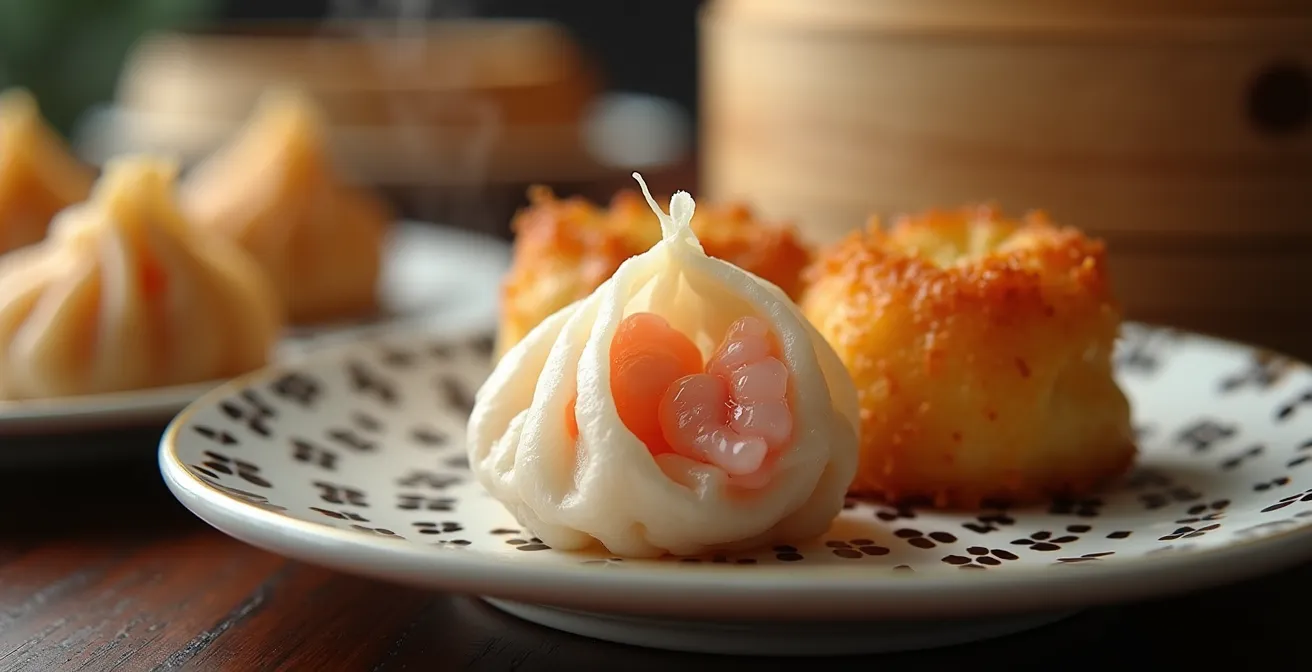
Vancouver’s Chinatown offers a nostalgic experience. Here you’ll find some of the last remaining restaurants with traditional trolley carts, where servers wheel steaming baskets of har gow and siu mai directly to your table. It’s central, easily accessible from downtown, and offers a vibrant, historical atmosphere. However, the food, while classic and comforting, can sometimes be less refined than what’s found elsewhere.
Richmond, on the other hand, is the undisputed epicentre of Chinese cuisine in North America. It demands a journey via the Canada Line or car, but the reward is immense. Restaurants here are modern, reservations are essential, and the focus is on made-to-order dishes that showcase incredible technical skill and premium ingredients. This is where you’ll find “culinary arbitrage”—paying slightly more for a product that is exponentially better in quality. The following table breaks down the core differences in the experience.
| Factor | Vancouver Chinatown | Richmond |
|---|---|---|
| Average Cost per Person | $25-40 | $30-50 |
| Transportation Cost | Central, walkable from downtown | Canada Line ($3-6) or parking ($8-15) |
| Restaurant Style | Traditional, vintage trolley carts | Modern, made-to-order |
| Best For | Tourist-friendly historical experience | Foodie purist seeking innovation |
| Wait Times | 30-45 minutes weekends | 60+ minutes, reservations essential |
Case Study: Chef Tony’s Richmond
Chef Tony’s in Richmond represents the pinnacle of elevated dim sum, offering innovative fusion dishes like Steamed Cuttlefish Ink Shrimp Dumplings and Matsutake Dumplings that rival Michelin-starred establishments in Asia. Located at Unit 101-4600 No. 3 Road, this restaurant requires reservations due to its popularity among food purists seeking cutting-edge culinary innovation beyond traditional Cantonese offerings. It’s a prime example of why foodies make the pilgrimage to Richmond.
Why a Glass of Wine Costs $18 CAD: Understanding Canadian Liquor Taxes
For many couples, a nice glass of wine is a non-negotiable part of a fine dining experience. However, visitors to Canada, particularly in provinces like Ontario and British Columbia, are often stunned by the price. An $18 price tag for a standard pour of a mid-range wine is not uncommon, and it’s a direct consequence of Canada’s tightly controlled liquor distribution system and heavy taxation. Understanding this system is key to managing your beverage costs.
In most provinces, liquor is sold through a government-run monopoly, like the LCBO in Ontario or the SAQ in Quebec. Restaurants must purchase their wine from these entities, which already have federal and provincial taxes baked into the price. On top of that, restaurants typically apply a markup of 200-300% to cover their own costs and generate profit. This is why a bottle that costs $20 at the store can easily be listed for $60 or more on a restaurant menu. Even local Canadian VQA (Vintners Quality Alliance) wines, while avoiding import duties, are subject to the same hefty restaurant markups.
This is where understanding regional differences provides a massive “smart luxury” advantage. As a travel guide from Authentik Canada notes, Montreal has a thriving and legal “Apportez Votre Vin” (AVV) or “Bring Your Own Bottle” (BYOB) culture. This is not a quirky loophole; it’s a legal and cultural distinction that profoundly impacts the cost of dining out. Many of Montreal’s best restaurants are BYOB, allowing you to purchase a high-quality bottle of wine at a government store for its retail price and enjoy it with your meal for a small or non-existent corkage fee. This single factor makes Montreal significantly more affordable for wine lovers than Toronto, where licensed restaurants that do allow BYOB (a rarity) often charge corkage fees of $25-$50.
As Tourism Montreal highlights in its guide, this is a celebrated part of the city’s identity:
Montreal’s strong ‘Apportez Votre Vin’ (BYOB/AVV) culture, a legal and cultural distinction that allows fine dining on a budget
– Tourism Montreal, Montreal BYOB Restaurant Guide
The ‘No-Show’ Fee Trap: What Happens If You Miss Your Reservation in Top Tier Restaurants?
In the world of high-demand, top-tier dining, a reservation is more than a simple booking; it’s a contract. As restaurants operate on razor-thin margins, the financial damage from a “no-show” (a party that fails to appear without cancelling) is significant. To protect themselves, a growing number of elite restaurants in cities like Toronto and Vancouver have implemented strict cancellation policies, with fees that can be a painful surprise for the unprepared diner.
These policies can range from a per-person fee for late cancellations (often within 24-48 hours of the booking) to requiring full pre-payment for the entire tasting menu at the time of reservation. These aren’t idle threats; they are legally enforceable as deposits under Canadian consumer protection laws. A missed reservation for two at a high-end spot could easily result in a $150-$300 charge on your credit card, completely derailing a travel budget.
Case Study: Toronto’s Michelin-Starred Reservation Policies
Toronto’s top-tier restaurants like Alo and Edulis have implemented strict reservation policies post-pandemic. Edulis requires full pre-payment with built-in gratuity for all bookings, making it non-refundable. Alo, a one-star establishment, releases reservations on the first Tuesday of every other month, with cancellation fees ranging from $50-$150 per person depending on timing. This illustrates the high stakes involved in securing a table at the city’s most sought-after restaurants.
While these fees can seem punitive, they are a necessary part of the business model for these establishments. For the smart diner, the key is not to fear them, but to manage them strategically. Always read the fine print when booking, set calendar alerts, and understand your options if your plans change unexpectedly.
Action Plan: How to Avoid or Manage Restaurant Cancellation Fees
- Immediate Contact: Contact the restaurant immediately if an emergency arises. Many will waive fees for documented medical or travel emergencies, as they value goodwill.
- Reservation Transfer: Check if the restaurant allows you to transfer the reservation to friends or family. This is often a win-win solution.
- Resale Platforms: Look for Canadian reservation resale platforms like Seated or community forums where you might be able to transfer your booking to another diner.
- Book Refundable Options: When available, choose reservations that offer a 24-48 hour cancellation window, giving you more flexibility.
- Consider Insurance: For extremely high-value bookings (e.g., a pre-paid $800 dinner for two), some booking platforms may offer reservation insurance for a small fee.
Summerlicious vs. MTLàTABLE: Which City Offers Better Value During Restaurant Weeks?
Restaurant weeks are city-wide culinary events that offer diners the chance to experience top establishments through prix-fixe menus at a reduced price. For the budget-conscious foodie, they seem like a golden ticket. Toronto’s Summerlicious (and its winter counterpart, Winterlicious) and Montreal’s MTLàTABLE are two of Canada’s most prominent examples. While both offer fantastic opportunities, the discerning diner knows that “value” is about more than just the sticker price.

On the surface, Montreal often appears to have a slight edge. Based on recent data, MTLàTABLE offers 3-course meals from $35-55 CAD, compared to Toronto’s Summerlicious at $39-69 CAD. This suggests a lower entry point for fine dining in Montreal. Furthermore, Montreal’s events tend to offer a slightly higher percentage discount off the regular menu prices, often in the 30-40% range compared to Toronto’s 25-35%.
However, the real “culinary arbitrage” opportunity lies in a factor we’ve already discussed: wine. The inclusion of many BYOB restaurants in MTLàTABLE is a game-changer. A couple can enjoy a three-course meal for $100 and pair it with a fantastic $30 bottle of wine they brought themselves, for a total of $130. In Toronto, that same quality meal might cost $120, but adding a comparable bottle of wine from the restaurant’s list could add another $70-$90, pushing the total closer to $200. The following table provides a clearer comparison of these two major events.
| Feature | Toronto Summerlicious | Montreal MTLàTABLE |
|---|---|---|
| Price Range (3-course) | $39-69 CAD | $35-55 CAD |
| Participating Restaurants | 200+ including Michelin-starred | 150+ focus on local gems |
| Typical Discount | 25-35% off regular menu | 30-40% off regular menu |
| Wine Pairing Options | $25-45 additional | BYOB at many venues |
| Booking System | Often crashes on launch day | More stable, staggered release |
Sushi and Pizza: Why These Two Foods are the Cheapest Staples in Vancouver?
In most major cities, “cheap” and “quality” are opposing forces. Yet, in Vancouver, a unique economic and cultural ecosystem allows two particular cuisines—sushi and pizza—to defy this logic, offering exceptional quality at surprisingly low price points. For the foodie couple looking to supplement their high-end dining with delicious, affordable meals, understanding why this is the case reveals another layer of the city’s culinary DNA.
Pizza’s affordability is relatively universal, tied to inexpensive ingredients and a scalable production model. However, Vancouver’s sushi scene is a true anomaly. The city is home to hundreds of sushi restaurants, and it’s possible to get a substantial, high-quality meal for under $20. This isn’t the low-grade sushi you might find elsewhere; it’s often made with fresh, local ingredients. This phenomenon is a direct result of several converging factors: Vancouver’s status as a major Pacific port city, its deep-rooted Japanese immigrant community, and its direct access to world-class BC seafood.
Case Study: Vancouver’s Affordable Omakase Revolution
The “systemic value” in Vancouver’s sushi scene is so profound that it has given rise to the ‘affordable omakase’—a chef’s tasting menu experience for under $100. This is virtually unheard of in other major North American cities. Restaurants are able to offer this incredible value by leveraging direct access to local spot prawns, sea urchin (uni), and wild salmon. The combination of low-cost logistics (seafood doesn’t need to be flown in), a highly skilled labour pool from the large Japanese community, and fierce market competition creates a unique environment where high-end sushi experiences remain remarkably accessible.
For the visiting couple, this means you can have a Michelin-level experience one night and a world-class, affordable omakase the next, without feeling like you’re compromising on quality. It’s the ultimate example of “smart luxury”—leveraging local market dynamics to enjoy premium products at a fraction of their typical cost.
1 Star vs. 2 Stars: What is the Difference in Service and Creativity?
When the Michelin Guide arrived in Toronto and Vancouver, it introduced a new lexicon for dining excellence. For many, the stars are a simple shorthand for “best,” but the smart diner understands the nuances. The difference between a one-star and a two-star restaurant isn’t just a matter of “better food.” It represents a significant leap in ambition, consistency, and, most notably, price. However, the system also contains hidden pathways to value, chiefly through the often-overlooked Bib Gourmand category.
A one-star restaurant is defined by Michelin as offering “high-quality cooking, worth a stop.” The focus is on the plate. The ingredients are top-tier, the technique is precise, and the flavours are distinct and memorable. A two-star rating signifies “excellent cooking, worth a detour,” indicating a higher level of artistry, personality, and creativity. The experience is more holistic, often involving more elaborate service and a unique culinary vision from the chef. The leap from one to two stars often involves a doubling or tripling of the price, reflecting the immense investment in staff, ingredients, and innovation required.
For the budget-conscious couple, chasing two-star experiences can be prohibitive. The real “smart luxury” play lies in the Bib Gourmand list—Michelin’s designation for restaurants offering “good food at moderate prices.” These are often the places where a chef’s creativity shines without the formal constraints (and costs) of a starred establishment.
Case Study: Toronto’s Bib Gourmand Success Stories
The 2025 Michelin Guide added six new Bib Gourmand restaurants to Toronto’s list, recognizing establishments that deliver exceptional food at great value. For example, restaurants in Kensington Market offer refined Indian cuisine with sharing plates under $30, while spots in Oakville provide handmade pasta experiences for under $40 per person. These establishments prove that Michelin-recognized quality doesn’t have to come with a triple-digit price tag, offering a perfect hunting ground for a memorable meal under $100 for two.
Even at one-star restaurants, value can be found by dining at the bar for à la carte options, choosing the less expensive lunch service, or strategically ordering two appetizers and a dessert instead of a traditional three-course meal. It’s about hacking the system to get a taste of the top-tier without paying for the full, multi-hour tasting menu.
Key Takeaways
- Budgeting for an 18-20% tip is non-negotiable in major Canadian cities and should be factored in as a fixed cost.
- Regional specificities, like Montreal’s BYOB culture or Vancouver’s affordable high-quality sushi, offer the best opportunities for “smart luxury” dining.
- Leverage restaurant weeks strategically by considering total cost (including wine), and explore Michelin’s Bib Gourmand category for recognized quality at moderate prices.
Is the Michelin Tasting Menu in Toronto Worth the $400 Price Tag?
This is the ultimate question for the discerning diner standing at the crossroads of ambition and budget. Is a $400-per-person tasting menu truly worth it? The answer, frustratingly, is: it depends. “Worth” is a deeply personal calculation of value, weighing cost against creativity, service, and memory. However, by using the tools of a smart luxury critic, we can deconstruct the question to arrive at a more informed decision.
The price spectrum in a Michelin-starred city like Toronto is vast, illustrating the dramatic jump between star ratings. As a report from SevernWoods Fine Homes on Toronto’s dining scene highlights, the price for a tasting menu can range from a staggering $680 per person at the two-star Sushi Masaki Saito to a more approachable $155 at the one-star Alo. This isn’t an arbitrary difference; it reflects the rarity of ingredients, the level of craftsmanship, and the sheer audacity of the chef’s vision at the highest echelons.
For a $400 price tag, you are paying for more than just food. You are paying for a performance—a multi-hour culinary journey orchestrated with flawless service, rare ingredients, and dishes that are as much art as they are sustenance. For a special occasion, it can be an unforgettable memory. However, for a foodie couple on a budget, this often represents poor “culinary arbitrage.” The law of diminishing returns applies: a $400 meal is rarely twice as good as a $200 meal. The true value is often found just below this peak.
Consider the value proposition offered by a top one-star restaurant, as described in the same report:
The four savoury courses and dessert are priced at $155 per person and may even include a surprise dish or two from the expert culinary artisans during the meal
– SevernWoods Fine Homes, Best Fine Dining Experiences in Toronto
This is where the sweet spot lies. At this level, you get 90% of the creativity and quality for less than half the price of a top-tier tasting. By understanding the systems we’ve discussed—tipping, wine costs, reservation strategies, and the Michelin hierarchy—you can confidently decide where your money is best spent. Perhaps the ultimate “smart luxury” move is to skip the $400 tasting menu and instead enjoy two or three exceptional Bib Gourmand or one-star experiences for the same total cost.
Armed with this insider knowledge, you are now equipped to go beyond the tourist traps and generic advice. The next step is to start planning your culinary adventures with the confidence of a seasoned critic, ready to unlock the incredible value hidden within Canada’s vibrant food cities.
Frequently Asked Questions About Dining in Canada
Why are wine prices so high in Canadian restaurants?
Restaurant wine prices are high due to a combination of factors. First, provincial and federal taxes are already included in the base price that restaurants pay to government monopolies like the LCBO (Ontario) or SAQ (Quebec). Second, restaurants typically apply a 200-300% markup on this cost to cover service, storage, and profit, leading to the expensive per-glass or per-bottle price you see on the menu.
Are Canadian VQA wines more affordable in restaurants?
While local Canadian VQA wines from regions like Ontario or British Columbia avoid international import duties, they are still subject to the same significant restaurant markups as imported wines. Consequently, they may offer only slightly better value, but are not dramatically cheaper than their international counterparts on a restaurant list.
What’s the difference between Montreal and Toronto for wine costs?
The primary difference is Montreal’s widespread “Apportez Votre Vin” (BYOB) culture, which is legally permitted. This allows diners to bring their own wine to many restaurants for a minimal or no corkage fee. In Toronto, BYOB is rare, and when it is allowed, corkage fees are typically high ($25-$50), making it significantly more expensive to enjoy wine with a meal.