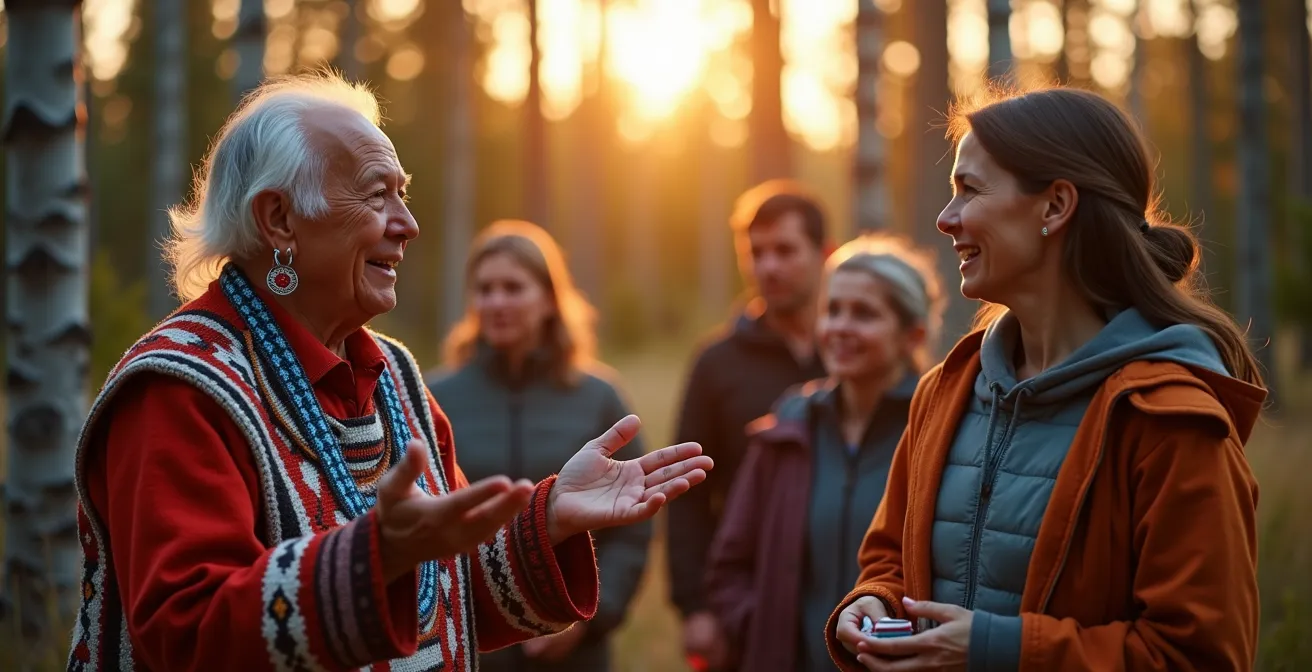
True engagement with Indigenous tourism in Canada isn’t about avoiding mistakes, but about actively choosing to be in a respectful relationship with the peoples and cultures you visit.
- Look for the ‘Original Original’ mark to ensure your money directly supports Indigenous-owned businesses and self-determination.
- Understand that sacred items like regalia and somber sites like former residential schools are not tourist attractions, but require active witnessing and respect.
- Embrace modern Indigenous expressions, from urban cuisine to contemporary art, as vital signs of living, evolving cultures.
Recommendation: Shift your mindset from a consumer of experiences to a partner in cultural revitalization and Indigenous economic sovereignty.
You want to travel through Canada and connect with the deep, vibrant, and diverse cultures of First Nations, Inuit, and Métis peoples. You’ve heard about incredible wildlife tours, stunning art, and profound stories. But a nagging fear holds you back: “What if I do it wrong? What if I’m disrespectful? What if my tourist dollars support exploitation instead of empowerment?” This hesitation is valid. For too long, Indigenous cultures have been misrepresented, commodified, and appropriated without consent or compensation. The usual advice—”be respectful” or “buy local”—feels too vague to be truly helpful, leaving you uncertain about how to turn good intentions into meaningful action.
But what if the key wasn’t a list of rules, but a fundamental shift in perspective? The difference between a transactional trip and a relational one is at the heart of authentic Indigenous tourism. It’s about moving beyond the role of a passive consumer and becoming an active, conscious participant in a story of resilience, revitalization, and self-determination. This is not about a fear of getting it wrong, but the joy of getting it right—for you, and for the communities that welcome you. As we, in the Indigenous tourism sector, build our economies and share our cultures, we invite you to be partners in this journey.
This guide provides the practical tools and understanding you need to navigate this space with confidence. We will explore the symbols that guarantee authenticity, the etiquette for participating in cultural events, and the principles that distinguish respectful appreciation from harmful appropriation. By the end, you’ll see that every choice you make as a traveler can be a powerful act of reconciliation and support for Indigenous sovereignty.
Summary: A Guide to Meaningful Indigenous Travel in Canada
- The ITAC Symbol: What Does the Original Indigenous Certification Mean for Your Trip?
- Pow Wow Etiquette: Can Non-Indigenous People Attend and Dance?
- Residential School Memorials: How to Visit with Respect and Somberness?
- Bannock and Game Meat: Where to Find Modern Indigenous Cuisine in Cities?
- Direct to Artist: Why You Should Buy Beadwork at a Market, Not a Duty-Free Shop?
- Poutine Variations: When Does Innovation Become Cultural Appropriation?
- Birch Bark vs. Kevlar: How the Indigenous Design Shape Defines Modern Canoeing?
- What Do the Indigenous Names of Canadian Cities Actually Mean?
The ITAC Symbol: What Does the Original Indigenous Certification Mean for Your Trip?
In a marketplace filled with “Indigenous-inspired” products and experiences, how do you know you’re supporting the real thing? The single most important tool for a conscious traveler in Canada is The Original Original mark. Developed by the Indigenous Tourism Association of Canada (ITAC), this symbol is your guarantee that a business is at least 51% Indigenous-owned and has met a rigorous set of standards defined by Indigenous people, for Indigenous people. It’s a powerful statement of storytelling sovereignty—ensuring that the narrative you engage with is authentic and self-determined.
Choosing a business with The Original Original accreditation is about more than just a quality experience; it’s a direct investment in economic sovereignty. When you see this mark, you know that your money is flowing back into Indigenous communities, supporting families, and fueling cultural revitalization. The sector is a major economic force; in Canada, Indigenous tourism’s economic significance reached 39,000 workers and a $1.9 billion annual GDP contribution before the pandemic, and it is rebuilding rapidly. Your choice to support an accredited business is a meaningful contribution to this growth.
The Original Original mark is, as ITAC states, a promise that you’re getting “quality tourism experiences from businesses that are truly authentic.” It cuts through the noise and removes the guesswork. Before you book a tour, visit a gallery, or stay at a lodge, take a moment to look for the symbol. It transforms a simple transaction into a relational act of solidarity.
Your Checklist for Identifying Authentic Indigenous Tourism
- Look for The Original Original mark displayed prominently by the business.
- Ask “Who is telling the story?” and ensure that Indigenous voices are leading the narrative and interpretation.
- Inquire “Where does the money go?” to confirm that revenue directly benefits Indigenous owners and their communities.
- Verify if the business is listed as a member on the official ITAC or provincial Indigenous tourism association websites.
- Assess if the experience promotes respect, honour, and integrity—the core values of Indigenous-led tourism.
Pow Wow Etiquette: Can Non-Indigenous People Attend and Dance?
The sound of the drum, the flash of colourful regalia, the collective energy of the dancers—attending a Pow Wow is a powerful and unforgettable experience. As a non-Indigenous guest, you are welcome, but understanding the etiquette is key to participating respectfully. The first thing to know is that a Pow Wow is a cultural celebration and a spiritual gathering, not a performance for tourists. The Master of Ceremonies (MC) is your guide; listen to their announcements carefully. They will explain the meaning behind different dances and will let you know when it is appropriate for everyone to participate.
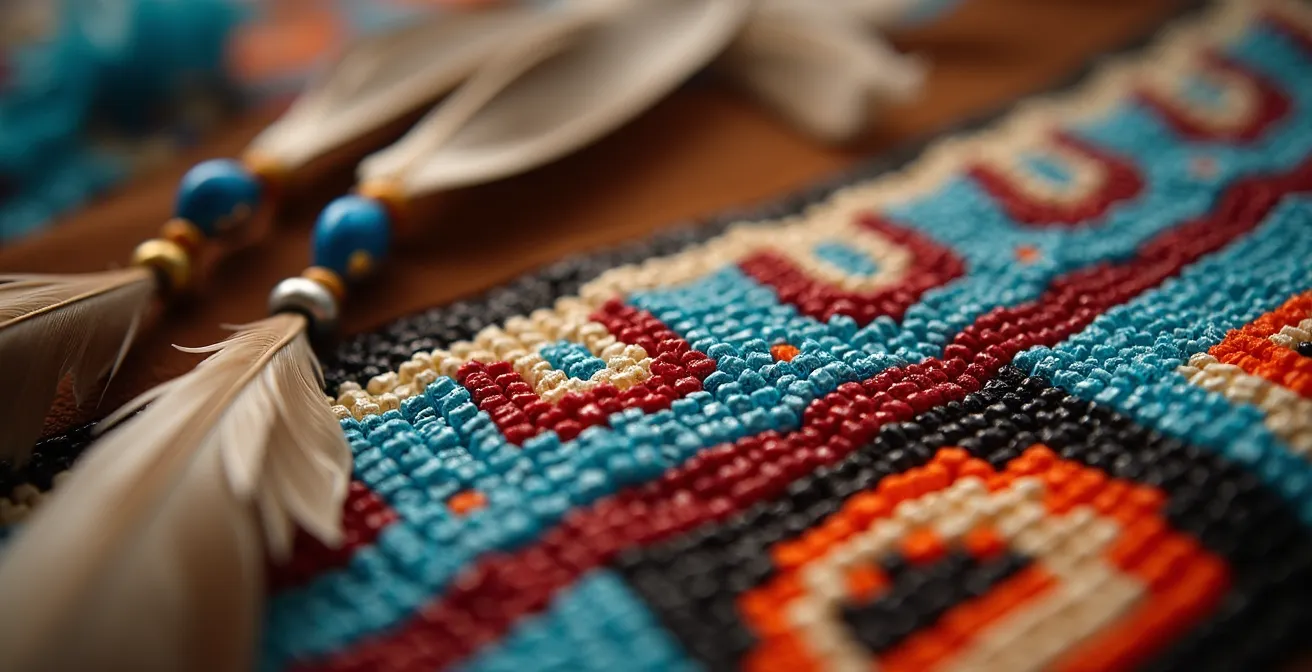
One of the most important aspects of etiquette revolves around regalia. These are not costumes. Each piece of a dancer’s regalia is a deeply personal, often sacred, and spiritually significant item. It may hold family stories, represent spiritual visions, or be part of a healing journey. For this reason, never touch a dancer’s regalia without permission. Likewise, always ask a dancer for permission before taking their photograph. They will usually be happy to oblige, but asking is a fundamental sign of respect for their cultural and personal property.
So, can you dance? Absolutely! The MC will announce “Inter-tribal” dances, which are times when everyone—Indigenous and non-Indigenous, young and old—is invited into the dance arbour. This is a moment of shared celebration. Simply join the circle and follow the lead of those around you. It’s a chance to feel the heartbeat of the drum and be part of the community. Just remember to be respectful: don’t bring food or drinks into the arbour, and always be mindful of the elders and dancers around you. Attending a Pow Wow is a gift, and participating with an open heart and a respectful mind makes that gift even more meaningful.
Residential School Memorials: How to Visit with Respect and Somberness?
Across Canada, the sites of former “Indian” Residential Schools are being transformed into places of memory, truth, and healing. These are not tourist attractions; they are sites of profound trauma and remembrance. As Destination Indigenous poignantly states, these are places “where thousands of our Peoples were abused and murdered at the hands of those who were meant to protect them.” Visiting these memorials is a crucial part of reconciliation, but it must be approached with the utmost respect and somberness. Your role here shifts from tourist to that of an active witness.
Before you go, prepare yourself. This is not a casual stop. Read the relevant Calls to Action from the Truth and Reconciliation Commission of Canada. Research the specific history of the school you plan to visit and, most importantly, look for any protocols established by the local First Nation. Some sites may have specific rules about offerings, photography, or designated quiet areas. Arriving with this knowledge demonstrates that you are there to honour the Survivors and the children who never came home, not just to observe.
During your visit, your actions should be guided by quiet reflection. This is a place for listening and learning, not for spectacle. Instead of taking photographs, consider writing your reflections in a personal journal. Photography can feel extractive and intrusive in such a sacred space. If it is culturally appropriate and permitted by the local Nation, leaving a tobacco tie is a traditional way to show respect and offer prayers. A financial contribution to the National Centre for Truth and Reconciliation or a local Survivors’ society is another tangible way to support the ongoing work of healing and education. Your visit is an act of solidarity, a commitment to remembering the truth so that such injustices are never repeated.
Bannock and Game Meat: Where to Find Modern Indigenous Cuisine in Cities?
For too long, Indigenous food in Canada has been stereotyped or overlooked. Today, a powerful culinary movement is changing that narrative, plate by plate. As Destination Indigenous highlights, “All across the country, authentic Indigenous chefs and culinary experts are cooking up delicacies that infuse modern recipes with traditional techniques and flair.” From bustling food trucks to high-end restaurants in cities like Vancouver, Winnipeg, and Toronto, a new generation of chefs is showcasing the diversity, sophistication, and deep connection to the land that defines Indigenous cuisine. This is cultural revitalization served on a plate.

So, where do you find it? The key is to look for chefs and establishments that are explicit about their connection to Indigenous culinary traditions. These restaurants often feature menus built around the principles of seasonality and locality, using ingredients that have been staples for millennia: game meats like bison and elk, fish like wild salmon and pickerel, and foraged plants, berries, and mushrooms. Bannock, a type of fried bread, is often a star, but you’ll see it reimagined in countless ways—as a base for an “Indian taco,” served alongside a modern soup, or as a sweet dessert with saskatoon berries.
Supporting these establishments is a delicious way to engage with living culture. You are not just eating a meal; you are tasting a story. You are experiencing the resilience of foodways that have survived despite colonial disruption and the creativity of chefs who are both honoring the past and forging a new future. When you seek out and dine at an Indigenous-owned restaurant, you are using your consumer power to support economic sovereignty and celebrate a vibrant, evolving culinary art form that is central to Canadian identity.
Direct to Artist: Why You Should Buy Beadwork at a Market, Not a Duty-Free Shop?
You see a beautiful pair of beaded earrings in a generic airport gift shop. They are labeled “Native-inspired.” A few aisles over, another pair, almost identical, is made by a non-Indigenous company. This is the frontline of cultural appropriation, where designs are divorced from their creators and profits are siphoned away from the communities that originated the art form. The most powerful way to counter this is simple: buy directly from Indigenous artists whenever possible. This ensures your purchase is an act of appreciation, not appropriation.
When you buy from an artist at a Pow Wow, a community market, or through their own online store, you are participating in a relational exchange. You can ask about the story behind the piece, the meaning of the design, or the materials used. As Destination Indigenous reminds us, “Every piece, from the smallest bracelets to the largest sculpture, tells a story that transcends generations and the ages. Every purchase you make helps to keep those stories alive.” Your purchase becomes a direct investment in an artist’s livelihood and the continuation of their cultural traditions. It is a form of economic sovereignty in action, ensuring that the full value of the work flows back to the creator and their community.
The collective economic impact of these individual choices is immense. According to The Original Original, Indigenous tourism businesses contribute $800 million in tax revenues to all levels of government, a number built from countless authentic transactions. By choosing to buy from a verified Indigenous artist, you are not only acquiring a beautiful and meaningful piece of art, but you are also actively rejecting an exploitative system and contributing to a sustainable, Indigenous-led economy. So, walk past the duty-free knock-offs and seek out the artist. The connection you make is as valuable as the art you take home.
Poutine Variations: When Does Innovation Become Cultural Appropriation?
Indigenous cultures, like all living cultures, are constantly evolving. This innovation is exciting and vital, but it also raises complex questions, particularly when non-Indigenous creators borrow cultural elements. A poutine with bannock croutons could be a brilliant fusion, or it could be harmful appropriation. How do we tell the difference? The key lies in a framework often referred to as the “Three Cs”: Context, Credit, and Compensation. This framework helps us distinguish between respectful cultural exchange and extractive appropriation.
Cultural appropriation happens when a dominant culture borrows from a marginalized culture without understanding or respecting the original context. It often involves profiting from these elements without giving credit or compensation to the source community. In contrast, respectful cultural fusion or appreciation involves a genuine effort to engage with and honour the source culture.
This table breaks down the crucial differences:
| Aspect | Cultural Fusion (Respectful) | Cultural Appropriation (Harmful) |
|---|---|---|
| Context | Understanding cultural significance and history | Ignoring or misrepresenting cultural meaning |
| Credit | Acknowledging origin and creators | Claiming as own or leaving source unnamed |
| Compensation | Revenue flows back to originating culture | Profit without benefiting source community |
Case Study: Métis Crossing’s Authentic Innovation
A powerful example of respectful innovation is seen at Métis Crossing in Alberta. An analysis of their programming highlights authentic innovation like their Fire & Ice Wellness program. This experience combines traditional knowledge of cedar-infused saunas with modern wellness practices like cold plunges. It is developed and led by the Métis community (Credit), rooted in cultural practices (Context), and all revenue supports the community’s mission (Compensation). It is a model of how to innovate with integrity.
Birch Bark vs. Kevlar: How the Indigenous Design Shape Defines Modern Canoeing?
The canoe is an iconic symbol of Canada, but its origins are deeply and specifically Indigenous. The elegant, efficient, and versatile shape of the modern recreational canoe is a direct descendant of the birch bark canoes perfected by First Nations across the woodlands of North America over thousands of years. While modern materials like Kevlar and carbon fibre have replaced birch bark, resin, and cedar roots, the fundamental hydrodynamics—the raised ends, the shallow arch of the hull, the beam width—are a testament to the brilliance of Indigenous science and engineering.
This enduring design legacy is a form of cultural sharing that has shaped the Canadian experience. As ITAC notes, “Indigenous communities have shared their culture with visitors to their traditional territories since time immemorial, closely guided by community values of respect, honour and integrity.” The canoe is perhaps one of the most widely adopted examples of this sharing. When you paddle a modern canoe, you are participating in a story that connects you directly to the original innovators who first understood how to travel these waterways with grace and efficiency. Recognizing this connection is an act of respect and a way of honouring the knowledge embedded in the object itself.
This legacy of innovation continues to drive the Indigenous tourism sector forward. The deep knowledge of the land and water that led to the canoe’s design is the same knowledge that now powers world-class guiding companies, eco-lodges, and cultural tours. It is a foundation for a thriving, modern economy. With ITAC’s ambitious vision aiming for a $6 billion GDP contribution target by 2030, it’s clear that this blend of ancient wisdom and modern enterprise is the future. Every paddle stroke in a modern canoe is a reminder of this powerful, living heritage.
Key Takeaways
- Authenticity is guaranteed by the “Original Original” mark, which ensures a business is at least 51% Indigenous-owned and meets community-set standards.
- Shift your role from a passive tourist to an “active witness” at sensitive sites and a respectful guest at cultural events like Pow Wows.
- Support economic sovereignty by buying art directly from artists and dining at Indigenous-owned restaurants, ensuring your money benefits the source communities.
What Do the Indigenous Names of Canadian Cities Actually Mean?
Many travelers visit Canadian cities like Toronto, Ottawa, or Quebec without realizing that the names themselves are windows into the land’s deep Indigenous history. These are not just random syllables; they are descriptive words from Algonquin, Cree, or Haudenosaunee languages that reveal the original purpose or geography of the place. Reconnecting with these names is a powerful act of reconciliation, transforming a simple map into a story of place and people. It helps us see the land not as a blank slate that was “discovered,” but as a landscape with a rich, pre-existing history and meaning.
Understanding these names shifts our entire perception of a city. For example:
- Toronto comes from the Mohawk word Tkaronto, meaning “where there are trees standing in the water,” referring to ancient fishing weirs at the narrows of Lake Simcoe. It signifies a place of gathering and sustenance.
- Ottawa is derived from the Algonquin word adawe, meaning “to trade,” acknowledging the river’s timeless role as a major commerce hub for many Nations.
- Winnipeg comes from the Cree words win for “muddy” and nipee for “water,” a simple, accurate description of the lake that gives the city its name.
- Quebec originates from the Algonquin word kébec, meaning “where the river narrows,” perfectly describing its strategic location on the St. Lawrence River.
Learning and using these original names is more than a trivia exercise. It is a way of honouring the Indigenous presence that continues to shape these lands. Incorporating them into land acknowledgements or supporting campaigns for dual naming are tangible ways to participate in this reclamation. As Randy Boissonnault, Canada’s Minister of Tourism, stated, “Indigenous tourism provides unique experiences to Canadians as well as international visitors and drives economic growth for Indigenous communities.” This unique experience begins with understanding the very names of the places we stand upon.
Frequently Asked Questions about Indigenous Tourism in Canada
What is the difference between traditional and competition Pow Wows?
Traditional Pow Wows are community-focused gatherings primarily for cultural preservation, spiritual practice, and celebrating heritage. Competition Pow Wows, like the Manito Ahbee Festival in Winnipeg, feature inter-tribal dance and drum competitions with significant prize money, often attracting larger, more diverse audiences.
Why can’t I photograph regalia without permission?
Regalia are not costumes but sacred items that are deeply personal and spiritually significant to the wearer. Each piece can contain generations of family history, elements of spiritual protection, or ceremonial meaning. Asking for permission is a fundamental act of respecting the person and the sacredness of their regalia.
When can non-Indigenous visitors participate in dancing at a Pow Wow?
You should listen carefully to the Master of Ceremonies (MC). They will clearly announce “Inter-tribal” dances, which are open to all visitors and guests. These are specific times when everyone is welcome to enter the dance arbour and join the celebration. The MC provides all necessary guidance for appropriate participation.
Your journey through Canada can be more than a vacation; it can be a transformative experience of connection and contribution. By applying these principles—seeking authenticity, understanding etiquette, and supporting Indigenous-led enterprises—you move beyond being a simple tourist. You become a valued partner in the resilience, celebration, and prosperity of First Nations, Inuit, and Métis cultures. The next step is to start planning your trip with these new tools in hand.