
In summary:
- True accessibility goes beyond “paved.” It requires a detailed check of trail width, grade, surface, and amenities.
- Parks Canada offers adaptive equipment like all-terrain wheelchairs for free, but you must reserve them in advance.
- For activities like whale watching or finding viewpoints, the type of vehicle or vessel is more critical than the destination itself.
- Always verify accessibility details directly with providers, asking specific questions about bathroom layouts, bed heights, and door widths.
Planning a multi-generational trip to one of Canada’s stunning national parks should be about creating joyful memories, not facing last-minute barriers. Yet, for families travelling with seniors or members with limited mobility, the fear is real: arriving at a trail marked “accessible” only to find a steep gravel slope or a viewpoint blocked by a flight of stairs. The dream of sharing the majestic beauty of the Rockies or the Atlantic coast can quickly turn into a frustrating experience, confined to the parking lot.
The standard advice—”check the park’s website” or “look for paved paths”—is a starting point, but it often fails to capture the reality on the ground. A path might be paved but too narrow for a wheelchair. A cabin might be listed as accessible but feature a bathroom where a transfer is impossible. As an accessibility advocate who has personally vetted these experiences, I’ve learned that true access isn’t found in a brochure’s checkbox; it’s discovered through a specific line of questioning and a keen eye for detail.
This guide is built on that principle. We’re moving beyond generic labels to give you the tools of a ‘detail detective.’ The key isn’t just knowing *where* to go, but *how* to verify that an experience will be genuinely comfortable, safe, and dignified. It’s about understanding the subtle differences between what is technically compliant and what is truly enjoyable. We’ll explore the availability of adaptive gear that opens up new terrains, compare tour types to find the safest options, identify genuinely “no-hike” scenic spots, and provide a checklist to ensure your nature-based accommodation meets your real-world needs.
This article provides a structured approach to planning your accessible adventure in Canada. Follow along as we break down everything from specialized equipment and tours to accommodation and nearby nature loops, ensuring your next family trip into the wild is a resounding success.
Summary: A Practical Guide to Accessible Adventures in Canadian Parks
- All-Terrain Wheelchairs: Which Parks Offer Free Loans of Adaptive Gear?
- Zodiac vs. Large Vessel: Which Whale Watching Tour is Safe for Seniors with Back Pain?
- No-Hike Views: The Top 5 Drive-Up Viewpoints in the Rockies
- The Agawa Canyon Train: Is the Fall Foliage Tour Worth the Ticket Price for Seniors?
- Glamping vs. Cabins: How to Find Accessible Nature Stays with Real Bathrooms?
- Peggy’s Cove vs. Cape Spear: Which Iconic Lighthouse is More Accessible for Seniors?
- Rouge National Urban Park: Which Trails are Truly Wheelchair Accessible?
- Where to Find Paved Nature Loops Within 30 Minutes of Downtown Toronto?
All-Terrain Wheelchairs: Which Parks Offer Free Loans of Adaptive Gear?
The idea that wheelchair users are limited to paved, flat surfaces is one of the biggest misconceptions in accessible travel. Many of Canada’s most beautiful landscapes, from sandy beaches to forested trails, are now within reach thanks to adaptive equipment. The most significant game-changer is the all-terrain wheelchair, often featuring rugged, wide tires that can navigate sand, gravel, and uneven ground. The best part? Several national parks offer them for free.
Accessing this equipment requires a little bit of planning. You can’t just show up and expect one to be available. Parks Canada has a clear policy: you must contact them at least 72 hours in advance to reserve adaptive gear. This ensures the equipment is ready for you at the specified location, whether it’s a visitor centre or a specific trail head. This simple phone call or email can be the difference between seeing the park from a distance and experiencing it up close.
Several flagship parks across the country are leading the way with these programs. Knowing which ones participate can help shape your travel itinerary around these opportunities. Here are some of the national parks offering free loans of adaptive wheelchairs:
- Gros Morne National Park, NL: An all-terrain wheelchair is available at the main visitor centre, opening up access to its dramatic fjord landscapes.
- Forillon National Park, QC: Beach wheelchairs are available at Penouille, complete with a specialized cart to help manage slopes down to the water.
- Cape Breton Highlands, NS: A beach wheelchair can be reserved for use at Freshwater Lake. You simply need to contact the park via email (cbinfo@pc.gc.ca) to arrange it.
- Pacific Rim National Park, BC: An all-terrain wheelchair is available for loan at the Kwisitis Visitor Centre, perfect for exploring its iconic long beaches.
A crucial final check, especially for island parks, is to verify equipment availability and logistics with any boat operators you book. Confirming that the wheelchair can be transported and used at the destination is a vital step in your accessibility audit.
Zodiac vs. Large Vessel: Which Whale Watching Tour is Safe for Seniors with Back Pain?
Whale watching is a quintessential Canadian experience, but the thrill of seeing a breaching humpback can be overshadowed by concerns about comfort and safety, especially for seniors or anyone with back issues. The choice of vessel is not a minor detail; it is the single most important factor determining the quality of the experience. The two main options, Zodiacs and larger tour boats, offer vastly different levels of accessibility and stability.
Zodiacs, or rigid-hulled inflatable boats, are often marketed for their agility and ability to get close to wildlife. However, they come with significant accessibility challenges. Boarding often requires stepping down into the boat, seating is typically bench-style with no back support, and their low profile means every wave is felt, leading to a bumpy, high-impact ride. For someone with back pain, this is often a non-starter. In contrast, larger vessels are designed for stability and comfort, making them the superior choice for accessible touring.
This direct comparison highlights the critical differences to consider before booking a tour. A careful review of these features is a core part of performing your own travel “accessibility audit.”
| Feature | Zodiac Boats | Large Vessels |
|---|---|---|
| Boarding Method | Step down, requires agility | Ramp or gangway available |
| Seating | Bench-style, minimal back support | Individual seats with back support |
| Stability | High impact from waves | More stable in rough water |
| Accessibility | Limited for mobility devices | Wheelchair accessible options |
| Shelter | Exposed to elements | Indoor viewing areas available |
Some parks have gone even further, integrating whale watching directly into their accessible infrastructure, removing the need for a boat altogether for a quality viewing experience.
Case Study: Saguenay-St. Lawrence Marine Park
The Marine Environment Discovery Centre at Saguenay-St. Lawrence offers a model for barrier-free wildlife observation. The main building provides full wheelchair accessibility from the gravel parking lot. From there, visitors can access stable, sheltered viewing platforms and boardwalks overlooking the marine park. With binoculars provided, seniors and those with mobility challenges can comfortably watch for whales from land, eliminating concerns about boat stability and exposure to the elements.
No-Hike Views: The Top 5 Drive-Up Viewpoints in the Rockies
The majesty of the Canadian Rockies should be accessible to everyone, not just seasoned hikers. The good news is that some of the most iconic, postcard-perfect vistas don’t require strenuous effort to reach. Decades of thoughtful infrastructure development have resulted in numerous “no-hike” viewpoints, where the parking lot is mere steps from a breathtaking panorama. For families travelling with members who have limited mobility, these spots are pure gold.
The key to a successful experience at these locations is understanding the “last 50 meters.” This is the crucial link between your vehicle and the viewpoint itself. Is the path paved? Is it wide enough for a wheelchair? Is there a curb? Knowing these small details in advance prevents disappointment upon arrival. The best drive-up viewpoints have invested in this final connection, ensuring a seamless transition from car to vista.
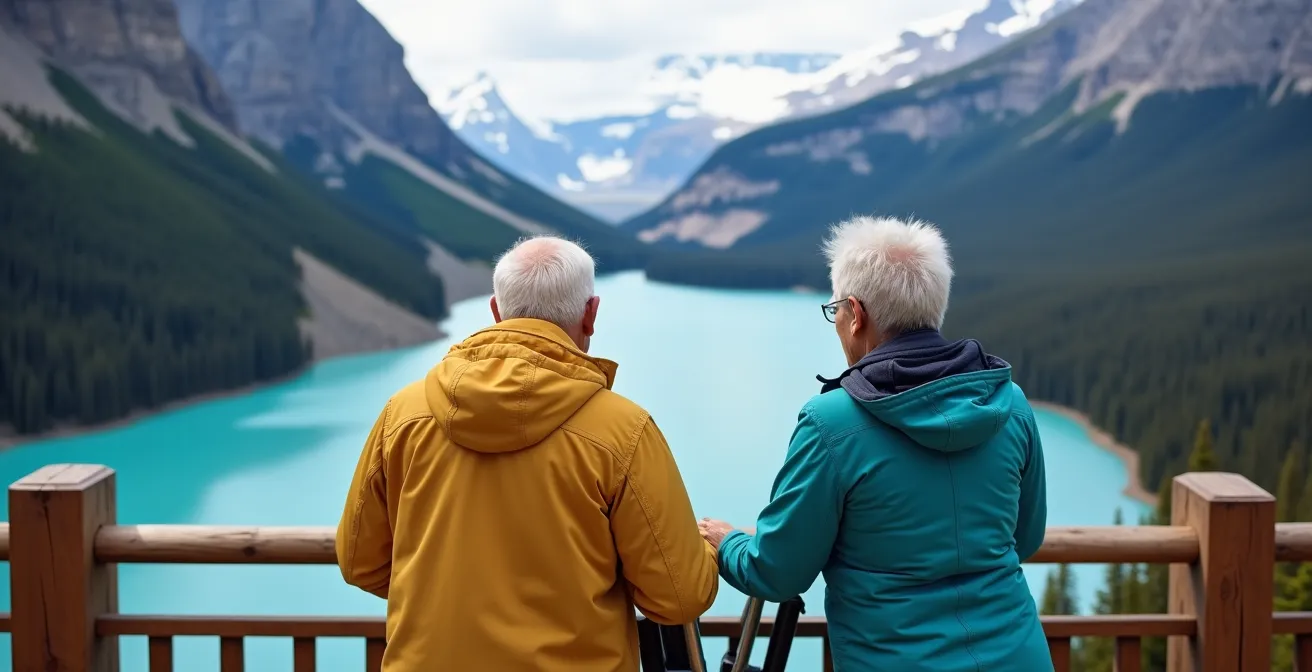
The viewing platform at Peyto Lake, shown above, is a prime example of accessible design harmonizing with nature. It allows visitors of all mobility levels to safely enjoy one of the most spectacular scenes in the Rockies. These spots prove that an epic view doesn’t have to be earned with an epic hike. Here are five of the top drive-up viewpoints that are highly accessible:
- Lake Louise: Features designated accessible parking that leads to a short, wide, and paved path right to the lakeshore. Accessible restrooms are conveniently located at the entrance.
- Peyto Lake: The main viewing platform is accessible during the summer months, offering its famous wolf-head-shaped lake view. The path is manageable, though companion assistance is recommended for some.
- Moraine Lake: While access is restricted to shuttles or commercial tours in summer, the area at the lake’s edge has a crushed gravel surface that is generally manageable for wheelchairs, offering stunning views of the Valley of the Ten Peaks.
- Bow Lake: A beautiful and often quieter spot right off the Icefields Parkway. The picnic area has paved wheelchair paths leading from the parking lot, perfect for a scenic stop.
- Vermilion Lakes: This is a flat drive on a road that runs parallel to the Trans-Canada Highway just outside Banff. There are multiple pull-offs with docks and benches, offering classic views of Mount Rundle, all accessible directly from your vehicle.
The Agawa Canyon Train: Is the Fall Foliage Tour Worth the Ticket Price for Seniors?
The Agawa Canyon Tour Train is legendary, promising a journey through a landscape of fiery fall colours that inspired the Group of Seven. For many seniors, it seems like the perfect way to experience the vast wilderness of Northern Ontario without any physical exertion. But with a significant ticket price, the question is valid: is it truly the best value for an accessible nature experience?
While the train itself offers a comfortable and scenic ride, it’s important to view it as just one of many options. My advocacy work has taught me to always look for local, integrated solutions that can offer more flexibility and often better value. For example, the cost of a single train tour can sometimes exceed the price of an annual park pass. For seniors, the value proposition is even more compelling, as seniors receive a discounted rate for the Parks Canada Discovery Pass, which provides unlimited access to over 80 national parks for just $61.75.
This pass opens the door to countless accessible experiences. Instead of being locked into one fixed route on one day, you gain the freedom to explore at your own pace. Many parks have developed their own accessible transit systems, creating cost-effective alternatives to expensive private tours. This approach empowers visitors, allowing them to connect with nature on their own terms, and often for a fraction of the cost.
In the Canadian Rockies, for instance, local partnerships have revolutionized accessible travel beyond the confines of a tour bus or train car. This is a model of what’s possible when parks and municipalities work together.
Jasper National Park’s collaboration with the Municipality of Jasper is a standout example, establishing fully accessible public transit services to popular campgrounds and high-visitation areas. Similarly, the Banff Roam Public Transit offers wheelchair-accessible buses with fold-out ramps connecting the Banff townsite, Lake Louise, and Canmore. For a senior traveller, this means you can use your pass to explore multiple world-class sites over several days, all for less than the price of a single specialty tour.
Glamping vs. Cabins: How to Find Accessible Nature Stays with Real Bathrooms?
Staying overnight in a national park is a magical experience, but the thought of rustic camping can be daunting for anyone with mobility needs. The rise of “glamping” and the availability of modern cabins have made nature stays more comfortable, but the word “accessible” on a booking website can mean very different things. The most critical, and often overlooked, element is the bathroom.
A truly accessible stay isn’t just about a ramp to the front door; it’s about dignity and safety in the most private spaces. This is where your “detail detective” skills are most crucial. You must ask specific, targeted questions before booking. Does the “accessible bathroom” have a roll-in shower, or just a small stall with a grab bar? Is the bed at a safe height (under 22 inches is a common standard) for easy transfers? Is there a minimum 3-foot clearance around the bed to maneuver a wheelchair?
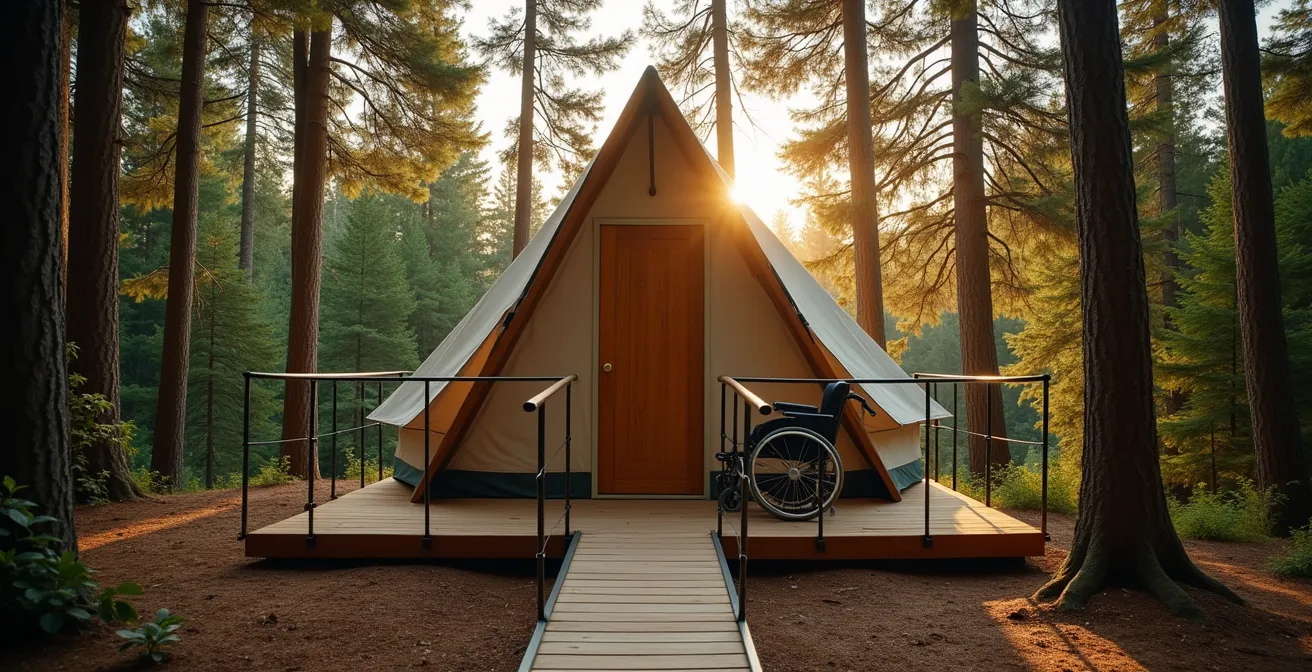
Parks Canada’s oTENTik structures—a hybrid between an A-frame cabin and a tent—are an increasingly popular option. Many parks now offer accessible versions, complete with ramps and thoughtful interior layouts, as pictured above. However, even with these improved designs, verification is key. Asking for photos of the specific unit you’re booking, including the bathroom, is not an unreasonable request; it’s smart planning.
Your Verification Checklist for Accessible Accommodations
- Verify roll-in shower availability with grab bars in specific positions.
- Confirm bed height is under 22 inches for safe transfers from a wheelchair.
- Request photos showing a 3-foot clearance around all sides of the bed.
- Ask about all door widths (a minimum of 32 inches is required for most wheelchairs).
- Check if designated accessible oTENTiks are available at Parks Canada locations.
- Inquire about the proximity and pathway to any shared accessible washroom facilities.
- Confirm the location of accessible parking relative to your accommodation’s entrance.
Using this checklist transforms you from a passive booker into an active advocate for your own needs. It forces providers to go beyond vague assurances and provide concrete proof, ensuring your nature retreat is restful and worry-free.
Peggy’s Cove vs. Cape Spear: Which Iconic Lighthouse is More Accessible for Seniors?
Visiting an iconic lighthouse is a highlight of any trip to Canada’s East Coast. Two of the most famous, Peggy’s Cove in Nova Scotia and Cape Spear in Newfoundland, offer dramatic coastal scenery. For years, however, the rugged, uneven terrain at these sites posed significant challenges for visitors with mobility issues. While both have made improvements, a recent major overhaul has made one a clear winner in terms of accessibility.
Historically, navigating Peggy’s Cove meant scrambling over large, weathered granite rocks, which was impossible for wheelchair users and treacherous for anyone unsteady on their feet. Cape Spear offered paths, but their mixed surfaces and exposure to high winds could be challenging. In 2021, a massive infrastructure project transformed the Peggy’s Cove experience. A new, expansive wooden and concrete viewing deck was built, providing a smooth, wide, and safe surface from which to view the lighthouse and surrounding coastline.
This development fundamentally changed the accessibility equation. While Cape Spear remains a beautiful and historic site, Peggy’s Cove now offers a more reliable and comfortable experience for a wider range of visitors. The comparison below illustrates the key differences:
| Accessibility Feature | Peggy’s Cove | Cape Spear |
|---|---|---|
| Viewing Platform | New wood/concrete deck | Asphalt and gravel paths |
| Surface Quality | Smooth, recently upgraded | Mixed surfaces, some rough |
| Parking Distance | Close to viewing area | Moderate walk required |
| Crowd Navigation | Dense crowds on deck | More dispersed visitors |
| Weather Exposure | Moderate wind protection | High wind exposure |
This example shows that accessibility is not static; it evolves as parks and sites invest in new infrastructure. It’s also a reminder that sometimes the most famous attraction isn’t the only option. In nearby Cape Breton Highlands National Park, all viewpoints along the famous Cabot Trail are wide, paved, and wheelchair accessible. The Lakie’s Head viewpoint even features a dedicated ramp to the viewing platform, demonstrating a deep commitment to inclusive design.
Rouge National Urban Park: Which Trails are Truly Wheelchair Accessible?
Nestled on the edge of Toronto, Rouge National Urban Park offers a unique blend of wilderness and city convenience. But in a park with a diverse trail network, how do you identify the routes that are genuinely wheelchair accessible, not just “easy”? The key lies in looking for trails specifically designed or designated for barrier-free access, which usually means a combination of paved surfaces, compacted fine gravel, and gentle grades.
The park’s official maps and guides are a good starting point, and recent efforts have improved clarity. For example, a new comprehensive Trail Guide was introduced to provide detailed accessibility information for each area. This commitment is also reflected in on-the-ground improvements. In summer 2024, Parks Canada enhanced accessibility at Rouge Beach by installing ‘mobi-mats’—specialized portable mats—that create a firm path from the beach area down to the shoreline, allowing wheelchair and stroller users to get right to the water’s edge. This is a fantastic example of a targeted, effective accessibility solution.
Based on official information and reports from trail users, several trails within Rouge Park stand out as reliably accessible. It’s important to note that some popular trails, like the Riverside and Mast trails, have steep sections and are not recommended.
Here are the verified wheelchair-accessible trails to prioritize in Rouge National Urban Park, according to a recent review of the park’s trail network:
- Celebration Forest Trail: A short, 0.5 km paved loop located near the Twyn Rivers parking area, perfect for a quick and easy nature outing.
- Glen Eagles Vista Trail: This 0.6 km trail is fully wheelchair and stroller accessible, offering pleasant river views.
- Rouge Marsh Trail: Another 0.5 km accessible trail with excellent wetland views, which conveniently connects to the much larger Martin Goodman Waterfront Trail.
- Vista Trail Viewing Platform: The trail to the two-level accessible viewing platform is a must-do, especially for enjoying the vibrant autumn colors.
These trails represent the park’s commitment to creating inclusive spaces. Staff engagement is also high, with park staff making over 26,000+ visitor connections during the 2024 season, providing a great opportunity to ask for real-time trail condition updates.
Key Takeaways
- Go Beyond the Label: True accessibility requires detailed verification of features like surface type, grade, and the “last 50 meters” from parking to attraction.
- Leverage Adaptive Gear: Free, reservable all-terrain wheelchairs in many national parks can unlock beaches and non-paved trails, transforming your travel possibilities.
- Choose the Right Vehicle: For tours like whale watching, the stability and amenities of a large vessel will almost always provide a safer and more comfortable experience than a Zodiac.
Where to Find Paved Nature Loops Within 30 Minutes of Downtown Toronto?
For visitors to Toronto or residents looking for a quick nature escape, finding accessible trails close to the urban core can seem challenging. However, the city and its surroundings are threaded with an impressive network of paved, multi-use paths that offer beautiful scenery without the need for a long drive. These routes are perfect for a spontaneous afternoon outing, providing fresh air and lakefront or river views just a short distance from downtown.
The crown jewel of Toronto’s accessible network is the Martin Goodman Trail, a 56 km paved path that runs along the city’s waterfront. It’s accessible at numerous points via TTC transit and offers constantly changing views of Lake Ontario, city parks, and marinas. It’s flat, wide, and well-maintained, making it ideal for wheelchairs, strollers, and anyone seeking a smooth surface.
Beyond the main waterfront, several other green spaces offer excellent paved loops. Getting to some of these locations has also become easier. Parks Canada has partnered with Parkbus to provide free weekend shuttles from downtown Toronto to Rouge National Urban Park during the spring, summer, and fall. These buses are fully accessible, though spots fill up quickly due to high demand. This service is a game-changer for those who rely on public transit.
Here are some of the top paved nature loops and trails easily reachable from downtown Toronto:
- Martin Goodman Trail: This extensive 56 km waterfront trail is the city’s premier accessible route, fully paved and accessible by TTC at many points.
- Toronto Islands: The ferries are accessible (always check wheelchair boarding procedures), and the islands are crisscrossed with paved paths perfect for a day of exploring with skyline views.
- Lower Don River Trail: A 7.7 km paved trail that follows the Don River, offering a unique blend of nature and urban infrastructure views with very gentle grades.
- High Park: While hilly in some areas, the park has multiple paved paths and accessible parking near key sites like the Colborne Lodge Drive entrance.
- Scarborough Bluffs: Offers a 4.2 km trail with accessible sections at the base of the cliffs, providing amazing views of the Bluffs and Lake Ontario.
Applying this “detail detective” mindset to every aspect of your trip planning—from trails and tours to accommodations—is the key to unlocking a truly seamless and joyful adventure in Canada’s magnificent natural spaces. Your next step is to take these checklists and questions and start planning your journey with confidence.