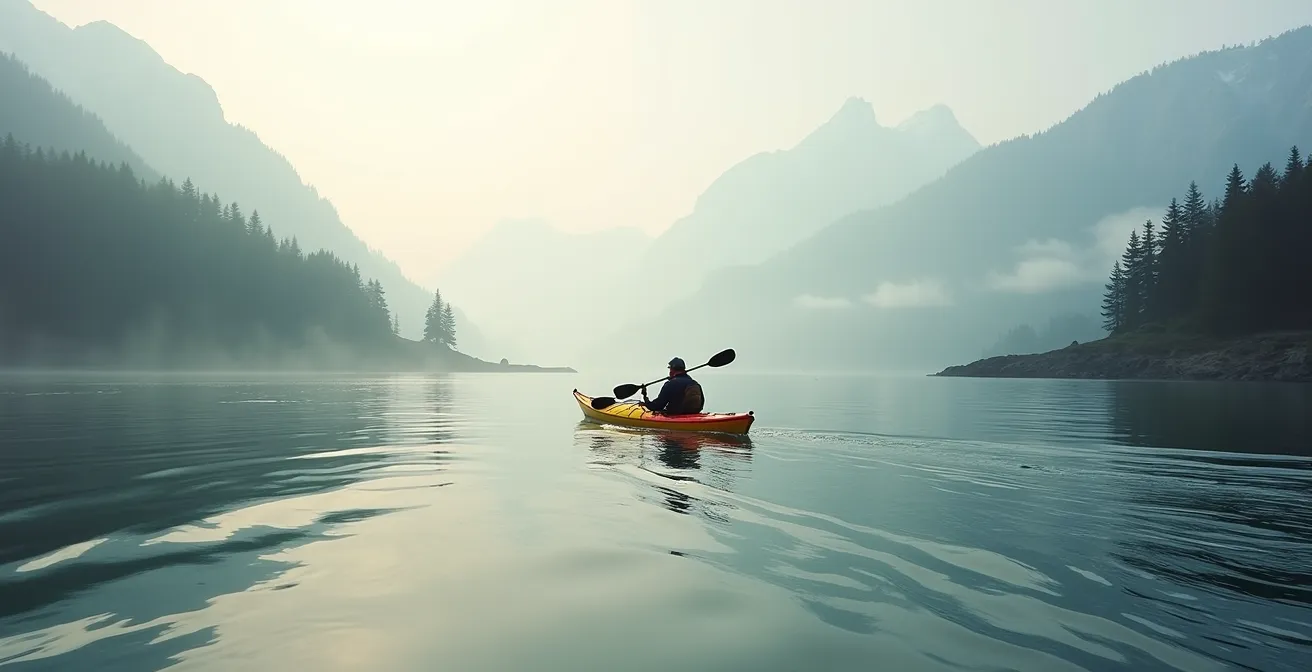
Paddling the Pacific Ocean is not an extension of lake kayaking; it is a completely different discipline that demands new knowledge and profound respect for the sea’s power.
- The primary dangers are invisible: tidal currents that can overpower you, water cold enough to be lethal in minutes, and large vessels that cannot see you.
- Your recreational lake kayak is structurally unsafe for ocean conditions. A proper sea kayak with sealed bulkheads and a longer hull is mandatory.
Recommendation: Before attempting a trip, you must master capsize recovery techniques in cold water and invest in certified instruction to recalibrate your understanding of risk.
The gentle lapping of water against your hull on a calm cottage lake is a soothing sound. It’s predictable, contained, and forgiving. That feeling of mastery, of being able to paddle anywhere you please, is what gets many people hooked on kayaking. But the mistake many intermediate lake paddlers make is assuming that experience translates directly to the open ocean off the coast of British Columbia. The Pacific is not a bigger lake. It is a complex, dynamic system of invisible forces that can be utterly unforgiving of ignorance.
Most online advice will give you a simple checklist: wear a PFD, check the weather. That’s dangerously incomplete. It fails to address the fundamental shift in mindset required. It’s not about simply having the right gear; it’s about understanding the ‘why’ behind it. Why a 10-foot kayak is a death trap in ocean swell, why the tide is more than just the water level, and why the beautiful, cold water of the Pacific is the single greatest threat you will face. This guide moves beyond the platitudes. It is your initial briefing, as a sea kayak guide, to recalibrate your internal risk-meter. We will dissect the critical differences between these two worlds, focusing on the specific skills and knowledge you must acquire before your bow ever touches saltwater in places like Tofino or the Gulf Islands.
This article will break down the essential safety pillars for any paddler looking to make the transition. We will cover tidal calculations, vessel selection, shipping lane navigation, critical self-rescue skills, thermal protection, emergency communications, and responsible wildlife encounters.
Summary: How to Safely Transition from Lake to Ocean Kayaking
- The Rule of Twelfths: How to Calculate Safe Crossing Times in Tidal Waters?
- Sea Kayak vs. Recreational Boat: Why You Cannot Take a 10-Foot Kayak into the Ocean?
- Ferries and Freighters: How to Cross Shipping Lanes Without Getting Run Over?
- The Wet Exit: Why You Must Master Capsize Recovery Before Your Trip?
- Dry Suit or Wetsuit: Which is Necessary for Canadian Waters in July?
- Satellite Messenger vs. PLB: Which Device is Best for Solo Hikers in Canada?
- The 400-Meter Rule: Why You Must Keep Your Distance from Endangered Killer Whales?
- How to Go Whale Watching in the St. Lawrence Without Harassing the Animals?
The Rule of Twelfths: How to Calculate Safe Crossing Times in Tidal Waters?
On a lake, water is static. In the ocean, it is a river, constantly in motion. This is the single biggest concept a lake paddler must grasp. Tidal currents, the horizontal movement of water, are an invisible force that can easily overpower the strongest paddler. A 3-knot current is moving at 5.5 km/h; you cannot fight that for long. Crossing a channel at the wrong time means you won’t end up where you intended, and could be swept into dangerous waters or out to sea. The key is not to fight the current, but to understand and use it by paddling at slack water—the brief period between high and low tide when the current stops.
To predict the current’s speed between slack tides, guides use the Rule of Twelfths. It’s a crucial tool for planning any crossing. The rule approximates the current’s velocity, which flows in a sine-wave pattern. The total volume of water moves over a six-hour period, but not evenly. It’s slow at the beginning and end, and fastest in the middle.
- First hour after slack: The current flows at 1/12th of its maximum speed.
- Second hour: The current increases to 2/12ths (or 1/6th) of its max speed.
- Third hour: The current reaches its peak at 3/12ths (or 1/4th) of its max speed.
- Fourth hour: The current is still at its peak, flowing at 3/12ths of its max speed.
- Fifth hour: The current begins to decrease, flowing at 2/12ths of its max speed.
- Sixth hour: The current slows to 1/12th of its max speed before reaching slack again.
In a place like Clayoquot Sound, this knowledge is not academic, it’s survival. As local guides at Tofino Sea Kayaking report, currents in the area can surge to 5 knots, creating standing waves large enough to surf—or instantly capsize an unprepared paddler. Understanding the Rule of Twelfths allows you to plan your crossings for the first or last hour of the tide, avoiding the dangerous peak flow.
Sea Kayak vs. Recreational Boat: Why You Cannot Take a 10-Foot Kayak into the Ocean?
Your 10-foot recreational kayak is perfect for a calm lake, but taking it into the Pacific Ocean is an act of profound ignorance. It is not designed for waves, wind, or recovery. A proper ocean-going vessel, a sea kayak, is a completely different craft, built as a self-contained survival system. The differences are not suggestions; they are fundamental safety requirements.
A sea kayak is longer (typically 14-18 feet) for speed and tracking in wind. Most importantly, it features sealed bulkheads. These are waterproof walls behind the seat and near the pedals, creating airtight compartments (bow and stern). If you capsize, only the cockpit fills with water. The bow and stern remain full of air, keeping the kayak floating high on the surface, making it possible to re-enter. Your recreational kayak is an open-top bathtub; when it capsizes, it fills completely and sinks or becomes too unstable to re-enter from the water. A sea kayak also has perimeter deck lines, a rope running around the outside edge, which are your handholds to get back to and into your boat in churning water.
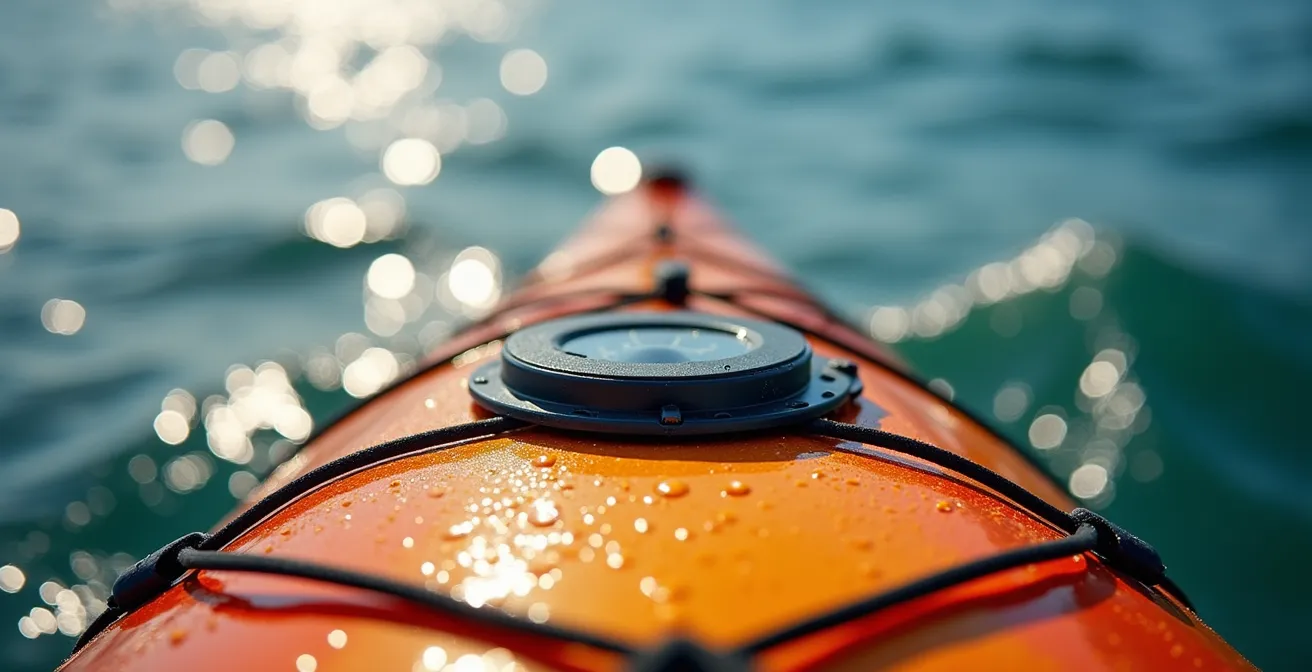
The table below, based on Transport Canada requirements and outfitter standards, outlines the critical distinctions. Underestimating these differences is the first mistake a lake paddler makes, and it can be the last.
| Feature | Ocean/Sea Kayak | Lake/Recreational Kayak |
|---|---|---|
| Length | 14-18 feet | 9-12 feet |
| Hull Design | Sealed bulkheads, perimeter lines | Open cockpit, minimal flotation |
| Required Safety Gear (Canada) | PFD, whistle, bilge pump, paddle float, spare paddle | PFD, whistle, bailer |
| Stability | Secondary stability for waves | Primary stability for flat water |
| Transport Canada Classification | Suitable for ‘unprotected waters’ | Protected waters only |
Ferries and Freighters: How to Cross Shipping Lanes Without Getting Run Over?
In the busy waters of the Georgia Strait or near major ports like Vancouver and Prince Rupert, you are not just a paddler; you are a tiny, nearly invisible object in a highway of giants. A ferry or freighter cannot stop for you, and in many conditions, their bridge crew cannot even see you. Safety experts warn that kayakers can become completely invisible to the bridge of a large vessel when waves reach just a 1-foot chop. Your mental model must shift from “they will see me” to “I am invisible, and I must stay out of their way.”
Crossing a designated shipping lane requires a formal, disciplined procedure. It is not something to be done casually. In controlled waters like Vancouver Harbour, kayakers are expected to use a VHF marine radio to communicate with Vessel Traffic Services (VTS). This is the marine equivalent of air traffic control. You must monitor the channel to build a mental map of traffic, then make a broadcast announcing your intention to cross. This is not a request for permission; it is a declaration of your actions so other vessels are aware of your presence.
The procedure is a non-negotiable safety protocol. Attempting a crossing without it is like running across a highway at night wearing black. Here is the standard VHF protocol:
- Monitor: Before you even approach the lane, listen to the designated VTS channel (e.g., Channel 12 for Vancouver) to understand traffic flow.
- Announce: Make a “Securité” call (a safety message) stating your vessel type (kayak), your precise position, and your intended crossing route.
- Listen: Wait for VTS to acknowledge your call and listen for any specific traffic advisories they provide.
- Cross: Paddle across the lane at a 90-degree angle (the shortest path) and at your maximum safe speed. Do not stop.
- Confirm: Upon safely reaching the other side, make a second Securité call to inform VTS that you are clear of the lane.
The Wet Exit: Why You Must Master Capsize Recovery Before Your Trip?
In the warm water of a summer lake, capsizing is an inconvenience. In the Pacific Ocean, it is the start of a life-threatening emergency. The water temperature along the BC coast, even in summer, rarely rises above the low teens. According to data from Environment Canada, BC coastal waters remain between 8-13°C year-round. At these temperatures, you do not have the luxury of time. Your body’s response is swift and debilitating.
You must know the 1-10-1 Principle, a stark timeline for cold water immersion promoted by the Canadian Safe Boating Council. You have one minute of cold shock, where your breathing is uncontrollable and you may gasp involuntarily, inhaling water. You have about ten minutes of meaningful movement, during which you can perform the actions necessary for self-rescue. After that, your muscles cool to the point of uselessness. You then have about one hour before you lose consciousness due to hypothermia. This means your survival depends entirely on what you can accomplish in those first ten minutes.
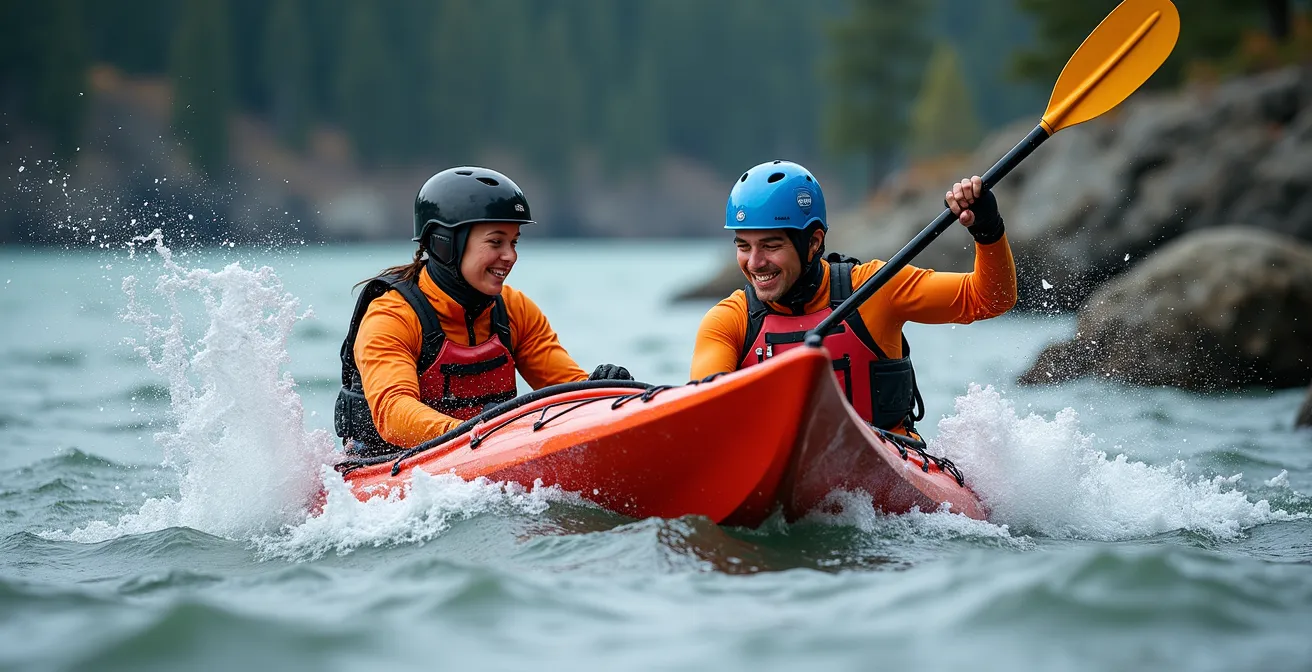
This is why mastering a “wet exit” (calmly exiting a capsized kayak) and, more importantly, a self-rescue or assisted rescue, is not an advanced skill; it is a prerequisite. You and every member of your group must be able to get a paddler back into their boat efficiently in wavy conditions. Techniques like the T-rescue (assisted) or the paddle-float roll (self-rescue) must be practiced in a safe environment until they are second nature. Going to the ocean without this physical, muscle-memory knowledge is gambling with your life, betting that you won’t capsize. That’s a bet no sane guide would ever take.
Dry Suit or Wetsuit: Which is Necessary for Canadian Waters in July?
A common, and potentially fatal, misconception among those coming from warmer inland climates is that a wetsuit is adequate for summer padding in Canada. A wetsuit works by trapping a thin layer of water against your skin, which your body then heats. In the 8-13°C water of the Pacific, this system is quickly overwhelmed. A wetsuit will extend your functional time slightly, but it will not keep you warm or dry; it merely delays the inevitable onset of hypothermia. It is inadequate for a real-world rescue scenario where you may be in the water for more than a few minutes.
The standard for safe paddling in British Columbia is a dry suit. A dry suit is a waterproof shell with latex gaskets at the neck and wrists that keeps you completely dry. You wear insulating layers of fleece or wool underneath. Its purpose is not to keep you comfortable while paddling, but to keep you alive if you end up in the water. It is a piece of survival equipment, not a fashion choice. The cost is significant, but the alternative is unthinkable. As the Sea Kayak Association of BC warns, immersion without proper protection is a life-threatening event.
Your Dry Suit Layering System: The Key to Warmth
- Base Layer: Start with a moisture-wicking layer of merino wool or synthetic long underwear. This pulls sweat away from your skin.
- Mid Layer: Add one or two layers of fleece or wool for insulation. The thickness (e.g., 200-weight fleece) depends on the air and water temperature.
- Avoid Cotton: Never wear cotton. It absorbs moisture, loses all its insulating properties, and will make you colder.
- Extras: Pack a complete set of extra dry layers in a waterproof dry bag. If you do get wet, you must be able to change into warm, dry clothing.
- Extremities: Consider a neoprene hood and gloves, as you lose a significant amount of heat through your head and hands.
The following table from the Sea Kayak Association of B.C. clearly illustrates the difference in protection. The choice is not between comfort and discomfort, but between safety and extreme danger.
| Protection Type | Water Temp Range | Immersion Time | Cost (CAD) | BC Summer Suitability |
|---|---|---|---|---|
| Dry Suit | 0-15°C | 1+ hours | $1500-3500 | Recommended standard |
| Full Wetsuit (5mm) | 10-18°C | 30-45 minutes | $300-600 | Marginal, inadequate for rescues |
| No Protection | Any | 10 minutes functional | $0 | Dangerous |
Satellite Messenger vs. PLB: Which Device is Best for Solo Hikers in Canada?
On the rugged, convoluted coastline of British Columbia, cell service is a rare luxury. Venturing into areas like the Broughton Archipelago or the outer coast of Vancouver Island means you are entirely on your own. As multi-day trips into these remote areas highlight, you are often hours or even days away from the nearest help, with no means of traditional communication. Should you encounter a medical emergency, equipment failure, or become trapped by weather, your phone is a useless brick. For this reason, carrying a satellite-based emergency communication device is not optional; it is a mandatory piece of safety equipment.
p>
Two main options exist: a satellite messenger (like a Garmin inReach or Zoleo) and a Personal Locator Beacon (PLB). A satellite messenger offers two-way communication. You can send pre-set messages, custom texts, and receive replies, which is excellent for non-emergency check-ins or describing a complex but not immediately life-threatening situation. It operates on a commercial satellite network and requires a subscription.
A Personal Locator Beacon (PLB), on the other hand, does one thing only: it sends a powerful 406 MHz distress signal to the international Cospas-Sarsat satellite system. This signal is routed directly to search and rescue authorities, along with your GPS coordinates. There is no two-way messaging. It is a “red button” for grave and imminent danger. PLBs do not require a subscription but must be registered with the Canadian government. For a solo paddler, a PLB is arguably the more foolproof lifeline. When you press that button, you are declaring a life-or-death emergency, and the professionals are coming.
Your PLB Registration Checklist: A Canadian Requirement
- Visit the Registry: Go to the official Canadian Beacon Registry website at beacons.nss.gc.ca.
- Create an Account: Set up an account with your personal details and crucial emergency contact information.
- Register the Code: Enter your PLB’s unique 15-character hexadecimal ID (or “Hex Code”).
- Specify Activities: List “sea kayaking” as your primary activity and mention your typical paddling regions (e.g., “coastal British Columbia”).
- Keep it Current: You must update your registration if your contact information changes or if you sell the device.
The 400-Meter Rule: Why You Must Keep Your Distance from Endangered Killer Whales?
One of the most profound experiences you can have on the Pacific coast is an encounter with whales. However, a moment of magic for you can be a moment of stress for them. This is especially true for the critically endangered Southern Resident Killer Whales. This unique population, which feeds primarily on Chinook salmon, is on the brink of extinction. One of the primary threats they face is vessel disturbance and underwater noise, which interferes with their ability to hunt and communicate using echolocation.
To protect them, there are strict, legally-enforceable regulations. This is not just a guideline; it is the law. Under Canada’s Fisheries Act, kayakers and all other vessels must stay away from killer whales. Specifically, Fisheries and Oceans Canada (DFO) mandates you maintain a 400-meter mandatory distance from all Southern Resident Killer Whales in their designated critical habitat areas (including parts of the Gulf Islands and Juan de Fuca Strait). For other killer whales, the distance is 200 meters, and for all other whales like humpbacks and grays, it is 100 meters.
As a paddler, you are not exempt. In fact, your silence can make you a bigger surprise threat. The “Be Whale Wise” guidelines are your rules of engagement:
- Maintain 400 meters from Southern Resident Killer Whales in critical habitats.
- Maintain 200 meters from all other killer whales.
- Maintain 100 meters from all other marine mammals, including dolphins and porpoises.
- If whales approach you: stop paddling, group together with other kayakers (raft up) to appear as one large object, and allow them to pass. Do not pursue them.
- Report any whale in distress or any violation of these rules to the DFO Observe, Record, Report line at 1-800-465-4336.
Respecting these animals means giving them space. The best whale encounter is one that happens on their terms, without you altering their natural behaviour in any way.
Key Takeaways
- The ocean is a system of invisible forces (tides, temperature) that a lake kayaker is unprepared for.
- Your equipment is your life support: a proper sea kayak and a dry suit are non-negotiable for the Canadian Pacific.
- Skills are paramount: mastering capsize recovery and understanding navigation rules are prerequisites, not optional extras.
How to Go Whale Watching in the St. Lawrence Without Harassing the Animals?
The core principle of ethical wildlife viewing is universal across Canada, from the Pacific to the Atlantic. Whether you are paddling with orcas in British Columbia or Belugas in the St. Lawrence Estuary, the foundational rule is the same: you are a visitor in their home, and your presence must not cause harm or stress. The specific regulations may change, but the philosophy of respect and minimal impact remains constant. It’s a mindset of paddler’s humility.
A powerful model for this approach can be seen in the partnerships between tour operators and First Nations on the West Coast. Many operators, like Hello Nature Adventure Tours in Ucluelet, now center their practices on environmental stewardship and acknowledge the traditional territory and Indigenous rights of the Nuu-cha-nulth First Nations. This is a recognition that these waters have been respected and managed for millennia, and that modern visitors have a responsibility to uphold that legacy of stewardship. This philosophy of deep respect for the ecosystem is precisely what should guide your actions in the St. Lawrence or anywhere else.
This respect translates into concrete actions and rules. For example, on the Pacific coast, there are specific protocols for interacting with seals and sea lions, animals that are just as much a part of the ecosystem as whales. These rules are designed to prevent stampedes at haul-out sites and avoid disturbing mothers and pups during sensitive times.
- Always maintain a 100-meter distance from seal and sea lion haul-out sites to prevent a panic-induced stampede into the water.
- Never position your kayak between the animals and their escape route to the open water.
- Be especially cautious and give a wide berth to harbour seal pupping areas from May to July.
- When landing on a beach, always store food in bear-proof containers.
- Make noise (talking, singing) as you approach shorelines to alert any unseen bears of your presence and avoid a surprise encounter.
Whether in the St. Lawrence or Barkley Sound, the responsibility is yours to learn the local regulations, understand the species you might encounter, and always, always prioritize their well-being over your desire for a closer look or a better photo.
The ocean demands humility and preparation. Your journey from lake to sea begins not on the water, but in your mind, by replacing confidence with respect and by seeking out certified, professional instruction. To put these principles into practice and learn the hands-on skills required, the next logical step is to enroll in a sea kayaking course from a certified organization like Paddle Canada.