
In summary:
- Master the “Yoke Flip,” a technique using momentum, not just strength, to get the canoe onto your shoulders alone.
- Treat your gear as a single system. Consolidate everything to achieve a “single carry” and avoid walking the trail three times.
- Choose your footwear strategically: embrace the “wet foot” system with quick-drying shoes for summer, and use waterproof boots only in the cold of spring and fall.
- Beat the bugs with a three-part system of treated clothing, a head net, and a solid repellent, combined with mental fortitude to accept the “bug tax.”
- Respect the law. Ensure you have all four mandatory safety items required by Transport Canada before you leave the shore.
The portage. The word alone can make a beginner’s shoulders ache. It’s seen as the brute-force chore between serene paddles, a necessary evil of the Canadian Shield backcountry. Most guides tell you the basics: “lift with your legs,” “pack light.” But that advice misses the point entirely. It treats portaging like moving furniture. It’s not. It’s a skill, a rhythm, a dance with a 50-pound partner over roots and rock.
For years, I’ve seen hopeful trippers defeated by the carry. They try to muscle the boat, fight the trail, and curse the deer flies, ending their day exhausted and demoralized. They focus on the pain, not the purpose. The secret isn’t about being stronger; it’s about being smarter. It’s about understanding the physics of the lift, the strategy of the pack, and the mental game required to walk a kilometre with a canoe on your head while a cloud of mosquitoes serenades you.
But what if you could learn to move with the canoe, not against it? What if the portage could become a point of pride, not pain? This isn’t about simply surviving the trail. It’s about mastering it. This guide will walk you through the real-world techniques and veteran mindset needed to conquer any Algonquin portage, from the moment you flip the yoke onto your shoulders to the second you slide it back into the water, feeling accomplished, not broken.
Summary: A Veteran’s Guide to Conquering the Solo Portage in Algonquin Park
- The Yoke Flip: How to Get a 50lb Canoe onto Your Shoulders Alone?
- Single vs. Double Carry: How to Pack Your Gear to Avoid Walking the Trail Twice?
- Wet Foot vs. Dry Foot: What Shoes are Best for Muddy Portage Landings?
- The Yellow Blaze: How to Find the Portage Trailhead from the Water?
- Deer Flies and Mosquitoes: Why the Portage is the Buggiest Part of the Trip?
- Why June is the Worst Month for Camping in the Canadian Shield?
- The Law of the Land: What Safety Gear is Legally Required in Your Canoe?
- How to Camp in the Boreal Forest During “Bug Season” Without Going Crazy?
The Yoke Flip: How to Get a 50lb Canoe onto Your Shoulders Alone?
This is the first moment of truth. Getting a 16-foot canoe from the ground to your shoulders solo seems like a feat of strength, but it’s not. It’s a ballet of controlled momentum. Trying to muscle it up will only lead to a pulled back and a bruised ego. The key is the “Yoke Flip,” a fluid motion that uses your legs and a gentle rocking to do most of the work. It’s a technique you practice until it becomes second nature, as automatic as a paddle stroke.
The goal is to use leverage, not lift. You rest the canoe on your thighs, creating a pivot point. From there, a gentle rock and a well-timed heave lets the boat’s own weight help it arc over your head. Forget brute strength; think finesse. The first few times will feel awkward, but soon you’ll feel the rhythm. The satisfying thud of the yoke settling perfectly onto your shoulders is the first victory of the trail.
For those with heavier boats or less confidence, there’s the “Teepee Lift.” You leave the stern on the ground and flip the canoe over your head with the stern pivoting on the ground. This method lets you lift only half the weight at a time. You then walk backwards until your shoulders are under the yoke. It’s a great alternative that prioritizes safety over speed.
- Find your space: Stand at the center of the canoe in an area with no obstructions. Grasp the closest gunwale with your hands shoulder-width apart.
- Lift to thighs: Bend your knees (not your back!) and slide the canoe up your legs until it rests comfortably on your thighs.
- Build momentum: Begin a gentle rocking motion. This is crucial for timing and is not about brute force.
- Heave and grab: Use the leg closest to the bow to give a small heave upwards. As it rises, grab the far gunwale with your bow-side hand.
- The flip: Initiate another rocking motion with your bow-side leg, then smoothly flip the canoe overhead in an arc. Don’t fight it; guide it.
- Settle in: Duck your head forward slightly as the yoke settles onto your shoulders. Rotate your body to face the bow, find your balance, and you’re ready to walk.
Single vs. Double Carry: How to Pack Your Gear to Avoid Walking the Trail Twice?
The eternal debate on the trail: one trip or two? A double carry means walking the portage three times (over, back, over again). A 1km portage becomes a 3km ordeal. A single carry, or “one-trip,” is the holy grail of portaging efficiency. It’s a badge of honour earned not by muscle, but by discipline and organization. It requires you to think of your gear as a single, integrated system designed for transport, not a random collection of bags.
The enemy of the single carry is the FRO: F*ing Random Object. That loose water bottle, the stray fishing rod, the jacket tied around your waist—every item not secured in a pack is a liability. Before you even think about lifting the canoe, all your gear should be consolidated into one main portage pack (like a 60L barrel or pack) and a smaller daypack worn on your chest for balance. This creates a stable, manageable load you can carry with the canoe.
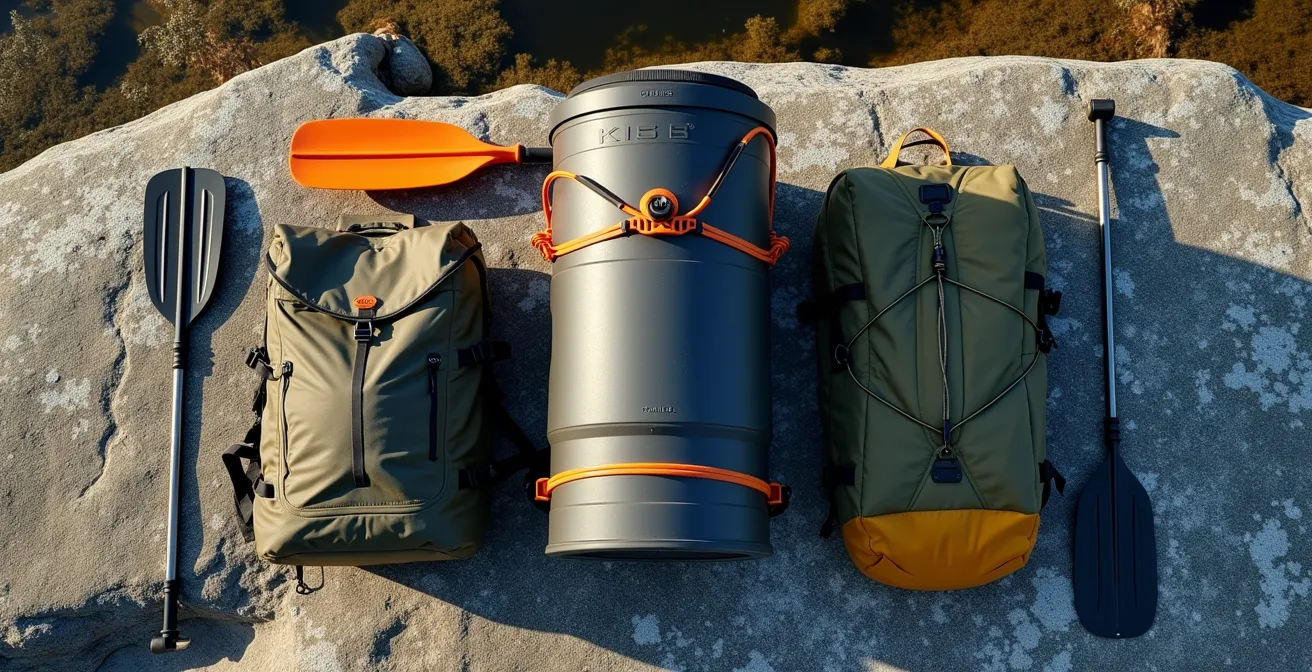
However, there’s no shame in a double carry, especially on long or difficult trails. For a punishing 3-kilometre portage, the “Leapfrog Method” is a veteran’s trick: carry your first load (e.g., the canoe) to the halfway point, drop it, and walk back for your gear pack. Then, carry the pack all the way to the end. Your final walk is only a 1.5-kilometre trip back to retrieve the canoe. This breaks the portage into manageable chunks and is far more efficient than a traditional double carry.
- Eliminate all FROs: Before the portage begins, get every loose item inside a pack or clipped securely to it.
- Count your items: Know exactly how many pieces of gear you have. Lay them out in one pile at the landing so nothing is forgotten.
- Consolidate: Combine smaller bags into one larger pack. The fewer items you have to touch, the better.
- Use a balanced system: A 60L barrel pack on your back, supplemented with a small daypack on your front, provides the best weight distribution under a canoe.
Wet Foot vs. Dry Foot: What Shoes are Best for Muddy Portage Landings?
Every portage begins and ends at the “Landing Zone”—the often-mucky interface of water and land. Your footwear choice for this transition defines your entire philosophy: “wet foot” or “dry foot.” The dry-foot canoeist painstakingly balances on slippery rocks and logs, trying to keep their expensive waterproof boots dry. The wet-foot canoeist simply steps into the shin-deep water, secures the boat, and walks out. In the Canadian Shield summer, only one of these approaches is sane.
Embrace the wet-foot system from June to September. The idea is not to stay dry—an impossible task—but to wear footwear that performs well when wet and dries quickly. Closed-toe water shoes, sturdy sandals, or old running shoes paired with wool socks are ideal. They provide grip on slimy rocks and drain instantly. Your feet will be wet, but they will be comfortable and functional. Trying to keep your feet dry in summer is a losing battle that risks a slip and a serious injury.
The “dry foot” approach, using waterproof knee-high boots, has its place. It’s essential during the shoulder seasons. In the icy waters of May or October, stepping into the lake is a serious hypothermia risk. Here, boots like Muck boots are not a luxury; they are critical safety equipment. They allow you to manage your canoe in cold water while keeping your feet warm and dry. Choosing the right system depends entirely on the water temperature, not the rain.
This detailed analysis from northern apparel experts provides a clear guide. As their seasonal footwear comparison shows, the optimal choice changes dramatically with the time of year.
| Season | Recommended System | Footwear Type | Key Benefit | Main Risk |
|---|---|---|---|---|
| May/October | Dry Foot | Waterproof boots | Hypothermia prevention | Reduced grip on wet rocks |
| June-September | Wet Foot | Water shoes/sandals | Quick drying, better grip | Potential for blisters |
| Spring (high water) | Hybrid | Neoprene booties + wool socks | Warmth + flexibility | Slower drying time |
The Yellow Blaze: How to Find the Portage Trailhead from the Water?
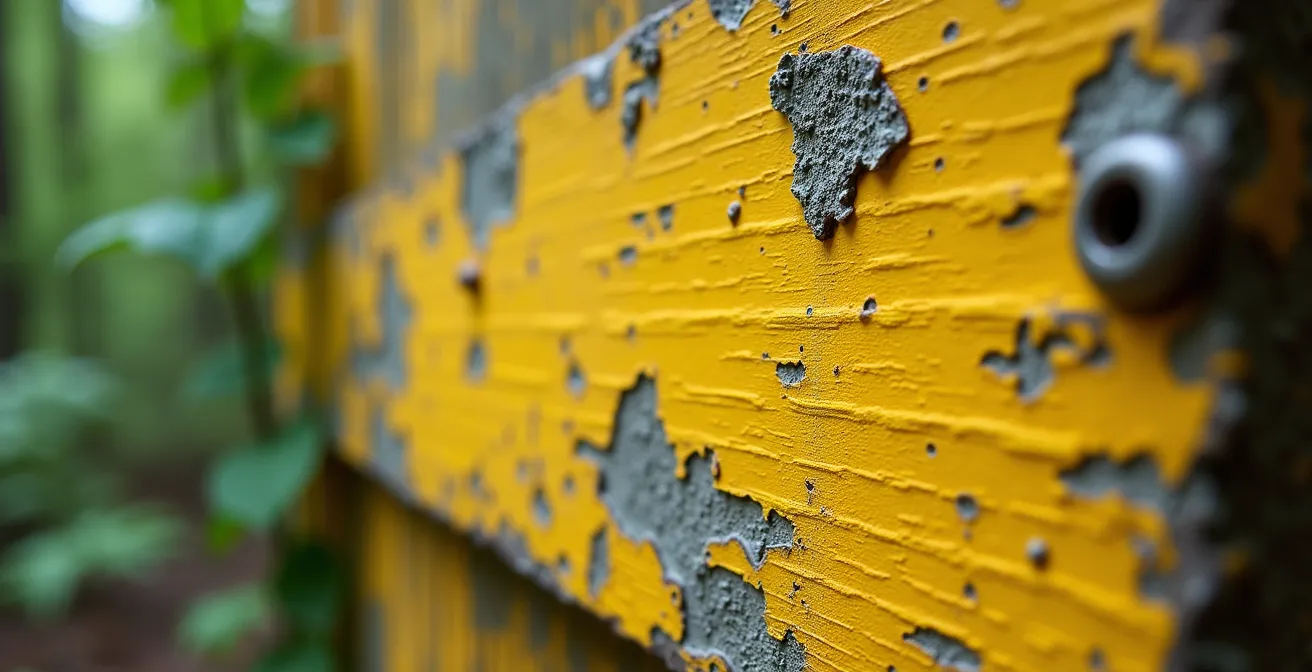
You’ve paddled across a vast, windy lake, and your map says a portage is “somewhere along this shore.” Now what? Finding the trailhead from the water is a skill in itself. Within Algonquin Park’s official network that spans over 2,000 kilometres of canoe routes and portages, trail markers can be surprisingly subtle. You’re looking for a small, yellow, often weathered sign—the “yellow blaze”—tacked to a tree, sometimes obscured by leaves or shadows. It’s an analog sign in a digital world.
Scanning the shoreline from a hundred metres out is inefficient. The best technique is to paddle relatively close to the shore in the area where you expect the trail to be. Look for tell-tale signs of a landing: a small clearing, a break in the vegetation, or an area of worn rock or soil where hundreds of canoeists have landed before you. The yellow sign is often just confirmation of what these other clues suggest. It will have the portage symbol and the distance in metres.
In modern tripping, however, you should never rely solely on your eyes. A digital backup is essential. Before your trip, download an offline map app like Avenza Maps and purchase a high-quality map like Jeff’s Map of Algonquin. With your phone’s GPS enabled (which works without cell service), you can pinpoint your exact location on the lake. Cross-referencing your GPS dot with the map will tell you with near-perfect accuracy where the trailhead is, long before you can see the sign.
Your action plan for navigation should be robust. Prepare your digital tools before you lose service, because you will.
Your Digital Navigation Backup Plan: Finding Portages
- Pre-Trip Download: Install the Avenza Maps app on your phone while you still have an internet connection.
- Map Purchase: Buy and download the official Algonquin Park map or “Jeff’s Map” for offline use within the Avenza app.
- Enable GPS: Turn on your phone’s location services. This allows the app to find your position using satellites, no cell signal needed.
- Cross-Reference: As you approach the shoreline, check your live GPS position on the offline map to identify the precise location of the portage landing.
- Visual Confirmation: Use the GPS to guide you in, then look for the classic yellow portage sign with the distance marked in metres to confirm the landing spot.
Deer Flies and Mosquitoes: Why the Portage is the Buggiest Part of the Trip?
Every seasoned tripper knows the truth: the bugs on the water are just an appetizer. The main course is served on the portage trail. The moment you step out of the breezy sanctuary of the open lake and into the humid, still air of the forest, they descend. Mosquitoes swarm, deer flies buzz aggressively around your head, and black flies find every inch of exposed skin. But why is it so much worse here?
It’s a perfect storm of conditions. Portages are often located in low-lying, damp areas—the ideal breeding ground for mosquitoes. The dense forest canopy blocks the wind, which is your primary defence against flying insects on the lake. Your body is also working hard, producing heat, sweat, and carbon dioxide—an irresistible dinner bell for every bug in a square kilometre. You are a slow-moving, warm-blooded buffet, and they are here to feast. This is the “Bug Tax” you pay for accessing the pristine lakes beyond.
Fighting them is a two-front war: physical defence and mental fortitude. The best physical defence is a three-part system. First, treat your outer layer of clothing with Permethrin 24 hours before your trip. Second, wear a full head net; it’s the single best piece of gear for maintaining sanity. Third, use a Picaridin-based lotion, which is as effective as DEET but less oily and won’t damage plastics. Apply it before you start the carry, because swatting at bugs with a canoe on your head is a recipe for disaster.
The mental game is just as important. Panic and frustration will drain your energy faster than the walk itself. You must accept their presence.
- Acceptance: Acknowledge that bugs are part of the deal. Mental preparation is half the battle.
- Focus your mind: Concentrate on your breathing or count your steps. This creates a rhythm and distracts from the buzzing.
- Strategic rests: If you must rest, do it in a windy, open clearing where bugs are less concentrated.
- Motivation: Visualize your destination—the bug-free, windswept point of your next campsite. Use it as fuel to keep moving.
Why June is the Worst Month for Camping in the Canadian Shield?
If you ask a veteran tripper the best time to go to Algonquin, they’ll say “September.” If you ask them the worst time, they’ll almost always say “June.” While the park is lush and the water levels are high, June is the undisputed peak of black fly season. These are not the gentle mosquitoes of a city park; they are relentless, swarming biters that can turn a dream trip into a psychological endurance test. The “Bug Tax” of other months becomes a crippling levy in June.
The portage, already a physical challenge, is transformed into a frantic, rushed escape. The goal of a steady, paced single-trip carry becomes secondary to simply getting it over with. Stopping to rest for even a moment means being enveloped by a cloud of black flies. This intense pressure can lead to mistakes, over-exertion, and a miserable experience. While the solitude is extreme—as fewer people are brave enough to face the onslaught—it comes at a high price to your sanity.
That said, June offers some unique advantages for the well-prepared and mentally tough. High water levels often mean that muddy landings are submerged, making the wet-foot entry and exit cleaner. Fuller waterways can make navigation easier and open up routes that are too shallow later in the year. The cooler temperatures are also better for the physical exertion of paddling and portaging. It’s a classic trade-off, and you must decide if the benefits are worth the biological price of admission.
| June Advantages | June Disadvantages |
|---|---|
| High water levels reduce muddy landings | Peak black fly season (worst of the year) |
| Extreme solitude – fewer people brave the bugs | Mental endurance tested by constant insect pressure |
| Easier canoe navigation with fuller waterways | Portages become rushed to escape bugs |
| Cooler temperatures for physical exertion | Bug nets and repellent add weight/complexity |
The Law of the Land: What Safety Gear is Legally Required in Your Canoe?
In the wild, freedom feels absolute. But the rules of safety are not optional. Before you even dip a paddle in the water, you are legally responsible for having specific safety gear on board. It’s not about avoiding a fine; it’s about having the tools that could save your life if something goes wrong. Forgetting your bug spray is an inconvenience; forgetting your throw rope is a potential tragedy. In Canada, these regulations are set by Transport Canada and are non-negotiable.
The requirements are simple, but they must be met. For a canoe, Transport Canada requires canoes to carry 4 mandatory items of safety equipment at all times. This isn’t a suggestion list; it’s the law. These items are your first line of defence in an emergency.
First, you need one Canadian-approved personal flotation device (PFD) or lifejacket of appropriate size for every person on board. While you don’t legally have to wear it in a canoe (unlike on a jet ski), it’s foolish not to, especially in cold water or rough conditions. Second, you need a buoyant heaving line at least 15 metres (50 feet) long—this is your throw rope. Third, a bailer or a manual water pump. A cut-in-half laundry jug works perfectly. Finally, a sound-signalling device, like a pealess whistle. This whistle should be attached to the zipper of your PFD, not buried in a pack.
These items form the bare minimum of your safety system. Before you leave shore on every single leg of your trip, do a quick mental check: PFD, rope, bailer, whistle. It takes five seconds and ensures you are compliant and, more importantly, prepared.
Key Takeaways
- Portaging is a learned skill, not a measure of strength. Focus on technique and rhythm.
- A “single carry” is the gold standard of efficiency, achieved by treating all your gear as one consolidated system.
- Adapt your footwear to the season: “wet foot” for summer comfort, “dry foot” for shoulder season safety.
- Bugs are a non-negotiable “tax” on the portage trail. A multi-layered defence and mental acceptance are your best tools.
How to Camp in the Boreal Forest During “Bug Season” Without Going Crazy?
You’ve done it. You survived the carry, the sweat, and the swarm. The canoe slides into the water, and you paddle the last few hundred metres to your campsite. The portage is over, but the war against the bugs is not. A bad campsite choice can turn your evening sanctuary into another battleground. The key to a peaceful night is to use the landscape to your advantage and create a fortified, bug-free zone as soon as you land.
Your number one ally is the wind. Mosquitoes and black flies are weak fliers. A steady breeze of 10-15 km/h is enough to ground them completely. When choosing a site from the water, ignore the sheltered, picturesque coves. You want the windswept point of land or the exposed island campsite. These spots may be less protected from a storm, but they are natural bug refuges. It is good practice to stop several hours before sunset to give you plenty of time to set up and enjoy the bug-free hours that the evening breeze provides.
Once you land, your first priority is to establish a bug-free sanctuary. This isn’t the time to relax with a beer. Immediately set up your tent or a separate bug shelter. This becomes your clean room, your operations center for the evening. Position the door away from the prevailing wind to minimize insects getting blown in. Only after this shelter is secure should you begin the rest of your camp chores. This methodical approach is the difference between a relaxing evening watching the sunset and a frantic night of swatting and itching.
Creating this sanctuary is a simple but crucial process. Follow these steps to reclaim your personal space from the insect hordes.
Your Action Plan: Creating a Bug-Free Camp Sanctuary
- Deploy the Shelter First: Upon landing, your absolute first task is to set up a quality screened tent or bug shelter. This is your safe zone.
- Orient for Wind: Position the tent or shelter opening facing away from the prevailing wind. This creates a low-pressure zone that helps keep bugs from entering when you do.
- Create a “Smudge” (If Permitted): If conditions and park rules allow, create a small, smoky fire using damp wood. The smoke is a powerful, natural insect deterrent for the area around your camp.
- Establish a Clean Room: Designate the inside of your bug shelter as the changing area. Avoid taking off gear and exposing skin outside of this protected space.
- Time Your Activities: Plan your cooking and eating for the windiest parts of the day (often late afternoon) when insect activity is at its lowest.
With these techniques, the portage transforms from a dreaded task into an integral, even rewarding, part of the journey. It’s time to stop fearing the trail, pack your gear with purpose, and earn those shoulder calluses. Your first successful solo portage is a milestone you’ll never forget.