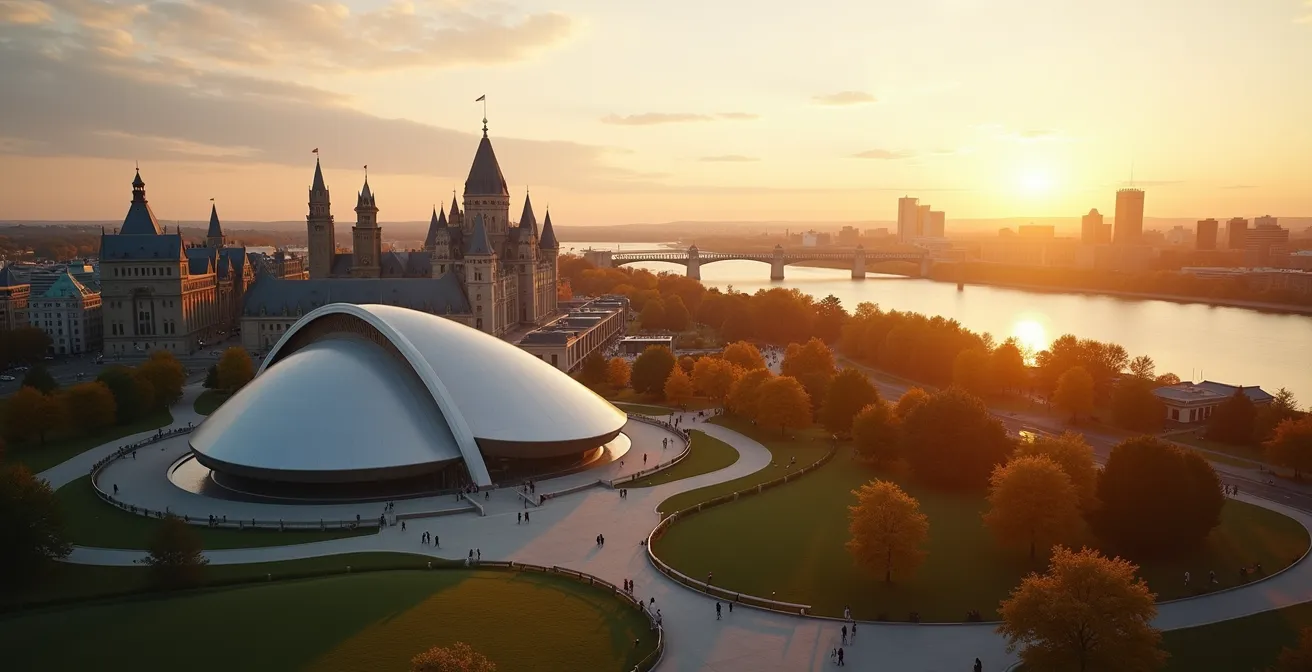
The key to a rewarding two-day museum tour in Ottawa is to abandon the checklist and embrace a curated narrative, focusing on how the city’s architecture and symbolic exhibits tell the story of Canada.
- Prioritize the dialogue between buildings, such as the Brutalism of the NAC versus Parliament’s Gothic Revival.
- Focus on “symbolic anchors”—key exhibits that unlock deeper cultural meaning, like the First Peoples Hall and the “Maman” sculpture.
- Integrate seasonal experiences like the Rideau Canal Skateway to connect indoor culture with the city’s living landscape.
Recommendation: Follow an itinerary that treats museums not as isolated attractions, but as sequential chapters in a story about Canadian identity, from its foundational myths to its modern artistic expressions.
Ottawa, as Canada’s capital, presents a delightful yet daunting challenge for the cultured traveler: a dense concentration of world-class national museums. Faced with the magnificent Canadian Museum of History, the National Gallery of Canada, the Canadian Museum of Nature, and more, the temptation is to create a frantic checklist. The common approach is to rush from one institution to the next, absorbing a blur of artifacts and information. This strategy, however, often leads to “museum fatigue” rather than genuine intellectual enrichment. It treats these cultural powerhouses as items to be ticked off a list, overlooking the deeper, interconnected story they collectively tell.
But what if the goal wasn’t to see the most, but to understand the most? The true secret to experiencing Ottawa’s cultural landscape lies not in quantity, but in curation. It requires shifting perspective from a tourist to a curator of your own experience. This means looking beyond the exhibits to the very structures that house them, understanding the symbolic dialogue happening across the Ottawa River, and connecting the art and history to the city’s living, breathing environment. This guide rejects the “see it all” mentality. Instead, it offers a two-day intellectual itinerary designed to reveal the narrative of Canada through a deliberate sequence of architectural encounters, symbolic anchors, and seasonal experiences.
For those who prefer a visual summary, the following video offers a sweeping look at the capital’s iconic landmarks, perfectly complementing the strategic advice in this guide.
This itinerary is structured as a journey. Each stop builds upon the last, weaving together themes of architecture, Indigenous heritage, governance, and modern art to create a cohesive and memorable cultural exploration of the Canadian capital region.
Summary: A Curated Journey Through Ottawa’s Cultural Narrative
- The Brutalist Architecture: Why the Building Design is as Important as the Exhibits?
- The Grand Hall: How to Understand the Totem Poles and First Peoples Hall?
- The House of Commons Tour: How to Secure Tickets During Renovation Periods?
- Crazy Kitchen: Why the Science and Tech Museum is the Best Choice for Kids?
- The Spider Sculpture: What is the Meaning Behind “Maman” Outside the Gallery?
- The Village Mistake: How a Misunderstanding Created the Name “Canada”?
- Rideau Canal Skateway: How to Check Ice Conditions Before You Travel?
- How to Enjoy the Quebec Winter Carnival at -20°C Without Freezing?
The Brutalist Architecture: Why the Building Design is as Important as the Exhibits?
Before stepping inside a single gallery, a curated tour of Ottawa begins with reading the city’s “architectural dialogue.” The capital’s story is written in stone and concrete, primarily through the dramatic contrast between 19th-century Gothic Revival and 20th-century Brutalism. Parliament Hill’s soaring spires speak of colonial ambition and ties to British tradition. Directly opposing this, the National Arts Centre (NAC) stands as a fortress of hexagonal, raw concrete forms—a powerful statement of mid-century Canadian nationalism and cultural self-reliance. This isn’t just a style choice; it’s a philosophical debate in built form.
Understanding this tension is key. Brutalism, often misunderstood as merely “brutal,” was about honesty of materials and creating monumental civic spaces. By observing these structures, you are engaging with Canada’s evolving identity. The experience is not just about appreciating aesthetics but understanding the historical context that shaped these imposing and often controversial buildings. It transforms a simple walk into an act of architectural interpretation.
Case Study: The NAC Renovation – From Fortress to Forum
The National Arts Centre’s 2017 renovation is a perfect example of this ongoing dialogue. A transparent glass tower and public atrium were added to the original 1960s Brutalist structure, transforming what critics often called a “bunker” into an inviting and open civic space. This $110 million project deliberately preserved the iconic hexagonal concrete forms while adding luminous “lantern” elements. This architectural move can be read as a metaphor for Canada’s own evolution: from a more insular identity to one that is transparent and globally engaged, all while respecting its foundational structures.
To truly grasp this, you can undertake a short, self-guided tour. Start at the NAC, walk towards Parliament Hill to feel the historical shift, and then look across the river to the organic curves of the Canadian Museum of History. This sequence reveals how different eras have envisioned Canada’s national identity through architecture.
The Grand Hall: How to Understand the Totem Poles and First Peoples Hall?
Crossing the bridge from Ontario to Gatineau, Quebec, the angular geometry of downtown Ottawa gives way to the sweeping, organic curves of the Canadian Museum of History. This building, designed by Indigenous architect Douglas Cardinal, is meant to evoke a landscape carved by wind, water, and glaciers. Its very form is a land acknowledgment, grounding the national narrative in the continent’s deep history before a single European ship arrived. The journey culminates in the Grand Hall, a space of breathtaking scale and meaning.
With its six-storey window wall facing Parliament Hill, the Hall stages a powerful encounter. It houses the world’s largest indoor collection of totem poles, representing the First Nations of the Pacific Coast. As architect Douglas Cardinal himself stated, “This is not a hall of relics, but a representation of living cultures.” To appreciate this, one must move beyond seeing them as static artifacts and learn to read their symbolic language. Unlike Western hierarchies, the most important figures are often at the base, and specific features like the shape of a beak or the position of wings convey complex stories of creation, power, and transformation.
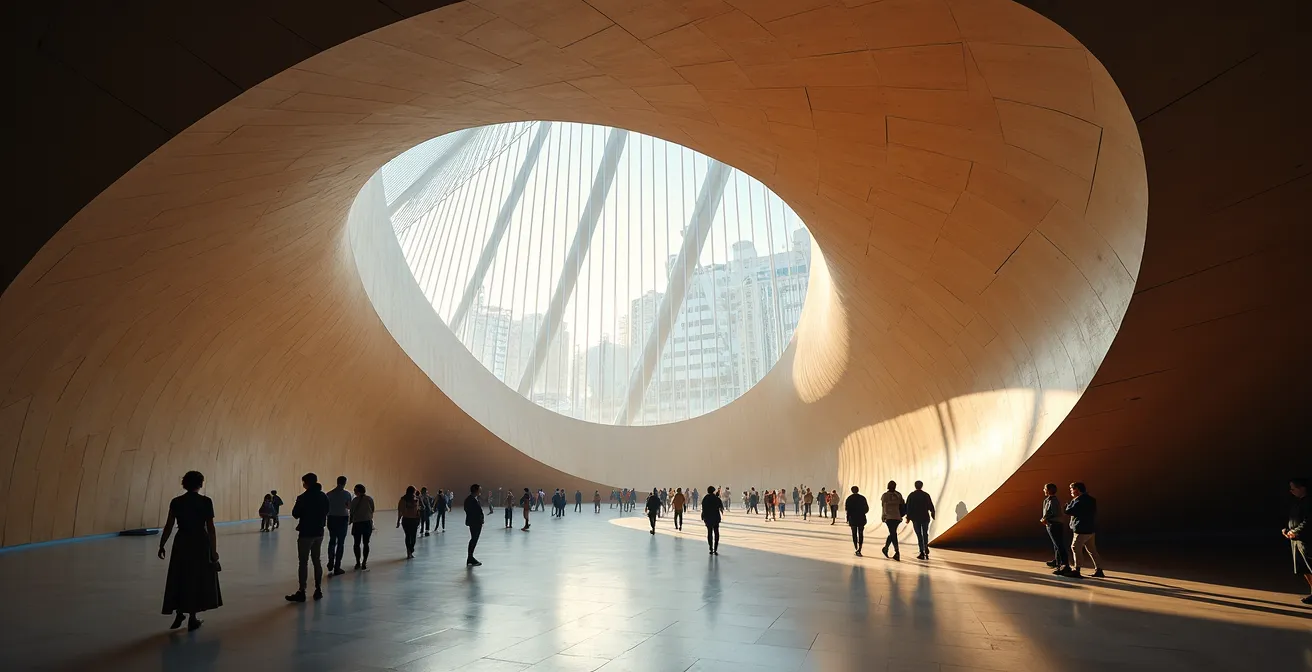
The architecture and the collection work in perfect harmony here. The soaring, curved walls create a space that feels both monumental and natural, a worthy home for these towering cultural statements. Standing in the Grand Hall is not just a museum visit; it is an immersive lesson in a worldview where culture, nature, and storytelling are inseparable. It’s the essential starting point for understanding the layers of Canadian identity.
The House of Commons Tour: How to Secure Tickets During Renovation Periods?
After immersing yourself in the deep time of Indigenous history, the itinerary shifts to the centre of contemporary Canadian governance: Parliament Hill. While the iconic Centre Block undergoes a decade-long renovation, the democratic process continues in a remarkable temporary home. The House of Commons now sits within the West Block, and the Senate resides in Ottawa’s former grand train station. Securing free, time-stamped tickets to tour these spaces is essential for understanding the country’s political machinery, and it requires some advance planning.
Booking should be done online via the official Parliament of Canada website, ideally several weeks in advance, especially for peak season travel between May and August. The process is straightforward but requires promptness, as time slots fill up quickly. Arriving well in advance of your tour time is non-negotiable due to airport-style security screening. This process, in itself, is a small reminder of the security considerations that shape modern governmental spaces.
Case Study: West Block’s Building-Within-a-Building Innovation
The temporary House of Commons in West Block is an architectural marvel and a lesson in adaptive reuse. Engineers constructed a stunning glass-roofed chamber *inside* the courtyard of the historic 1860s Gothic Revival building. This $863 million engineering feat preserves the original heritage stonework, which now forms the interior walls of the modern legislative space. It’s a powerful symbol of how Canada’s democracy is evolving: transparent, state-of-the-art, and accessible, yet nested firmly within its historical foundations. The tour provides a firsthand look at this brilliant fusion of old and new.
A visit here provides a crucial counterpoint to the Museum of History. It’s a journey from the deep cultural roots of the land to the formal structures of colonial and contemporary governance, demonstrating the complex layers that constitute the modern Canadian state.
Crazy Kitchen: Why the Science and Tech Museum is the Best Choice for Kids?
After a day steeped in history and political structures, a shift towards the experiential and playful is in order. For families, or simply the young at heart, the Canada Science and Technology Museum is an unmissable stop. It consciously moves away from static displays towards interactive learning, an approach that has been central to its identity. An internal analysis revealed that following the museum’s extensive modernization, interactive exhibits were featured in 80% of its display space. This commitment to hands-on engagement is what makes it so effective.
The crown jewel of this philosophy is the Crazy Kitchen. It is a simple, brilliant concept: a fully furnished kitchen tilted at a dramatic angle. As you walk through it, your brain struggles to reconcile the visual information (a level room) with the physical information from your inner ear (a slanted floor). The result is a powerful and memorable sensation of disorientation that teaches you about perception and sensory conflict more effectively than any textbook. It’s a perfect example of embodied cognition—learning through physical experience.
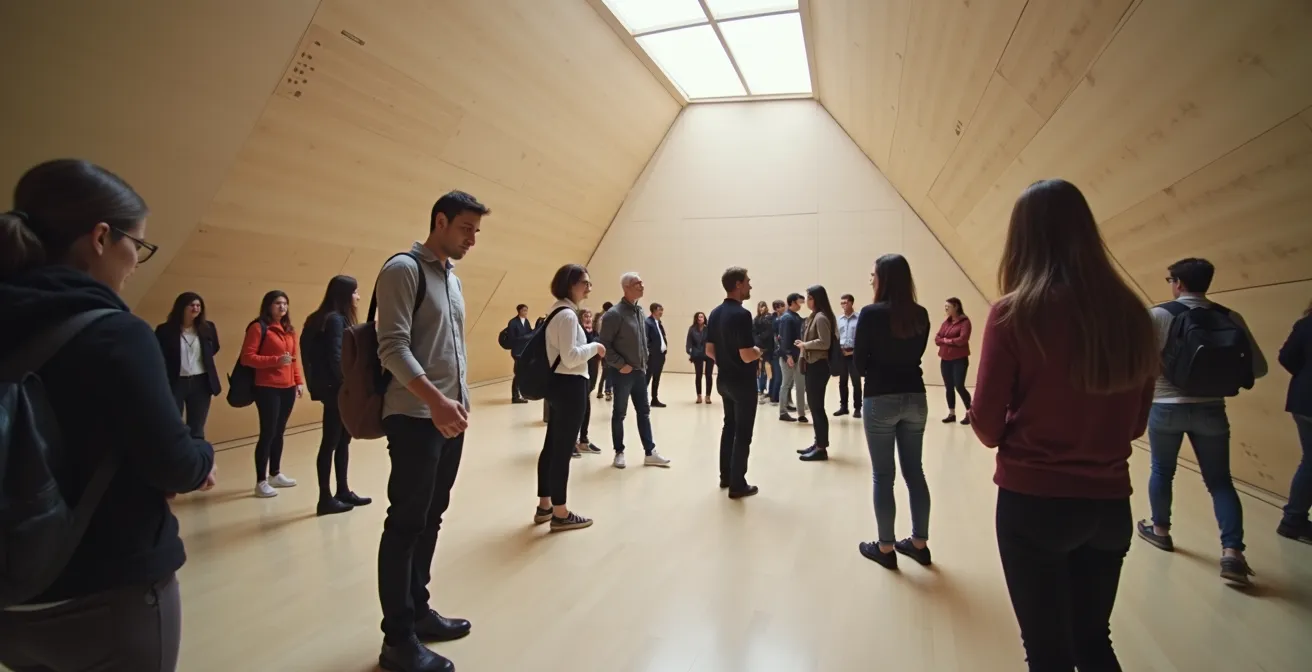
Beyond this famous exhibit, the museum offers vast halls filled with locomotives, early automobiles, and interactive displays on everything from sound to energy. It celebrates the story of Canadian innovation and ingenuity, providing a tangible, fun, and often noisy counterpoint to the more formal institutions. It serves as a reminder that a nation’s story is also told through its tools, its inventions, and its relentless drive to understand and shape the physical world.
The Spider Sculpture: What is the Meaning Behind “Maman” Outside the Gallery?
No cultural tour of Ottawa is complete without paying homage to “Maman,” the monumental spider sculpture standing guard outside the National Gallery of Canada. More than just a striking photo opportunity, this 30-foot bronze sculpture by Louise Bourgeois is a profound symbolic anchor. To understand it is to unlock a conversation about art, power, and memory. The artist herself provided the most poignant explanation, as noted in the National Gallery of Canada’s official statement.
The spider is an ode to my mother. She was my best friend. Like a spider, my mother was a weaver.
– Louise Bourgeois
This statement reframes the creature from an object of fear to a symbol of maternal strength, creativity, and protection. The spider, a weaver and repairer of webs, becomes a metaphor for the artist’s own mother, a tapestry restorer. The sculpture’s steel cage-like sac contains marble eggs, reinforcing this theme of fierce, protective maternity. It is both intimidating and tender, a complex duality that is central to its power.
Case Study: Maman’s Strategic Placement – Art Confronts Power
The sculpture’s location is no accident. Installed in 2005, “Maman” is positioned to create a direct and deliberate sightline to the Gothic spires of Parliament Hill. This placement establishes a fascinating dialogue between the creative, feminine, and maternal power embodied by the spider, and the patriarchal, political authority represented by the seat of government. Curators describe this as a “productive tension between domestic and state power.” The sculpture isn’t just in front of the gallery; it’s actively engaging in a silent, symbolic confrontation with the heart of Canadian politics across the street.
Viewing “Maman” with this context transforms it from a sculpture into a statement. It becomes a critical part of the city’s architectural and symbolic dialogue, asking potent questions about what kinds of power and what kinds of stories we choose to monumentalize.
The Village Mistake: How a Misunderstanding Created the Name “Canada”?
Our curated journey brings us back to the Canadian Museum of History, this time to explore a foundational story that is both humble and profound: the origin of the country’s name. The name “Canada” was born from a linguistic misunderstanding. The museum effectively tells this story, which is crucial for any deep understanding of the nation. It reminds us that Canada’s official history is inextricably linked with, and often misinterpreted from, its Indigenous origins.
The story, featured prominently in the Canadian History Hall, dates to 1535. When explorer Jacques Cartier encountered St. Lawrence Iroquoians and asked about the surrounding land, they gestured towards their settlement and said “kanata,” which simply meant “village” in their language. Cartier mistakenly applied this specific word to the entire vast territory. This simple error was codified on maps and in official documents, and a name for a country was born from the name for a village.
The museum’s exhibit on this topic is a powerful teaching moment. It uses interactive maps, artifacts, and audio recordings of Iroquoian languages to re-centre the narrative. It transforms what could be a simple historical footnote into a profound lesson about perspective, language, and the deep, pre-existing Indigenous presence across the land. Acknowledging this history is a vital part of modern reconciliation efforts in Canada, and institutions like the museum play a key role by officially recognizing that they operate on unceded territory. This context is not just supplementary; it’s fundamental.
Key Takeaways
- A curated itinerary focusing on narrative provides a richer experience than a simple museum checklist.
- Ottawa’s cultural story is told through an “architectural dialogue” between historic and modern buildings.
- Understanding key symbolic anchors, from totem poles to modern sculptures, is essential for deeper insight.
Rideau Canal Skateway: How to Check Ice Conditions Before You Travel?
A cultural trip to Ottawa in winter cannot be confined to indoor spaces. The city’s identity is deeply connected to its seasons, and the most iconic winter experience is the Rideau Canal Skateway—the world’s largest skating rink. Integrating this outdoor activity into your museum itinerary connects you to the city’s living culture. However, this experience is entirely dependent on weather, making it crucial to check ice conditions before you go. Safety and enjoyment depend on it.
The National Capital Commission (NCC) is the official body responsible for the Skateway and provides reliable, up-to-the-minute information. Ignoring their official channels in favour of anecdotal evidence is a common mistake. The ice thickness must be a minimum of 30 cm for skating to be permitted, and conditions can change rapidly. The nearly 8 km long Skateway is divided into several sections, which may open or close independently.
Your Action Plan: Official NCC Ice Monitoring Protocol
- Daily Checks: Visit the official source, ncc-ccn.gc.ca/skateway, where updates are posted daily at 8 AM and 4 PM.
- Understand Color Codes: Green means the section is open, Yellow indicates fair conditions (potential rough patches), and Red means it is closed.
- Note Specific Zones: The Canal is divided into multiple zones; check the status of the specific section you plan to visit, as they don’t all open at once.
- Monitor Ice Thickness: The daily report explicitly states the measured ice thickness, which must be at least 30cm for safe skating.
- Follow Social Media: For real-time alerts on sudden closures or changing conditions during the day, follow the official @NCC_Skateway account on social media platforms.
Strategically pairing a skate on the canal with a museum visit is the perfect way to structure a winter day. You can access different museums from various points along the canal, using the institutions as welcome warming huts and cultural top-ups.
This table from a local tourism authority provides a practical guide for combining skating with a museum stop, a strategy that beautifully merges outdoor activity with indoor cultural exploration.
| Access Point | Nearby Museum | Distance | Warming Strategy |
|---|---|---|---|
| NAC Stairs | National Gallery | 5 min walk | Gallery café + free Thursday evening entry |
| Fifth Avenue | Canadian Museum of Nature | 10 min walk | Castle-like building with hot chocolate |
| Ottawa Locks | Bytown Museum | At entrance | Historic building with Ottawa origin exhibits |
How to Enjoy the Quebec Winter Carnival at -20°C Without Freezing?
While the title mentions the famous Quebec Winter Carnival, it’s important to clarify that for a trip focused on Ottawa, the premier event is Winterlude. This vibrant festival is Ottawa’s own three-week-long celebration of winter, running every February. It transforms the city into a hub of activity, with international ice carving competitions in Confederation Park, the aforementioned Rideau Canal Skateway, and a massive family-oriented snow playground called Snowflake Kingdom. Unlike the Quebec City carnival, which is a five-hour drive away, Winterlude is woven directly into the fabric of the capital’s cultural circuit.
The key challenge for enjoying any Canadian winter festival is, of course, the cold. Temperatures of -20°C (-4°F) are common, and being improperly dressed can ruin the experience. The secret is not bulk, but layers. The proven Canadian three-layer system is designed to manage moisture, retain heat, and block wind.

This layering strategy is essential for comfort:
- Base Layer: A moisture-wicking fabric like merino wool or a synthetic blend is crucial. It pulls sweat away from your skin. Cotton should be avoided at all costs, as it holds moisture and makes you cold.
- Mid Layer: This is your insulation. A fleece or down-filled vest or jacket traps your body heat effectively.
- Outer Shell: A windproof and waterproof jacket, ideally with sealed seams, is your shield against the elements. It protects your insulating layers from wind and snow.
Special attention must be paid to your extremities. High-quality merino wool socks, boots rated for -30°C, and insulated mitt-style gloves (which keep fingers together for more warmth than traditional gloves) are non-negotiable. A balaclava or neck warmer is also vital to protect your face from windburn.
Winterlude vs. Quebec Carnaval: Ottawa’s Integrated Festival
A key advantage of Winterlude is its deep integration with Ottawa’s museums. During the festival, many institutions offer special exhibits, themed activities, and serve as official warming stations. This allows you to create a perfect indoor-outdoor circuit: marvel at the intricate ice sculptures in Confederation Park, then step into the warmth of the National Arts Centre or a nearby gallery for a dose of high culture before heading back out. This synergy makes Winterlude a uniquely comprehensive cultural experience, blending outdoor winter magic with the capital’s world-class indoor attractions.
Now that you have the framework for a deeply enriching cultural tour of Ottawa, the next step is to translate this curated approach into a personalized plan for your own two-day journey.