Predicting the aurora isn’t about luck or a single Kp number; it’s about layering three critical data sets for a complete picture.
- Solar wind data (especially the Bz value) is the fuel for the aurora.
- Local Canadian weather forecasts are the window of opportunity—clouds are the enemy.
- Your geographic position (geomagnetic latitude) determines the strength of the show you’ll see.
Recommendation: Always prioritize a strong, southward Bz signal from a real-time source over a high Kp index for predicting the most dynamic and colourful displays.
You’ve spent thousands on a trip to the Canadian North, a once-in-a-lifetime journey to witness the aurora borealis. The one fear that looms larger than the sub-zero temperatures is a sky that remains stubbornly dark and empty. Most guides offer simple advice: go as far north as possible, check the Kp index, and hope for the best. This turns your dream trip into a lottery, a game of chance against the vast, unpredictable Arctic sky.
But what if prediction wasn’t about hope, but about data? For seasoned aurora chasers and astro-photographers, luck has little to do with it. Success hinges on a systematic approach, moving beyond the simplistic Kp index to analyze the raw data of space weather. It involves understanding the intricate dance between solar wind particles and Earth’s magnetic field, and then layering that cosmic forecast onto a hyper-local Canadian weather report. The key isn’t just knowing if a solar storm is happening; it’s knowing if you’ll actually be able to see it from your specific spot on the ground.
This guide abandons luck in favour of methodology. We will deconstruct the process of an expert, showing you how to read the same data they do. We’ll explore why one city offers statistically clearer skies than another, how to interpret the crucial data points that signal an impending light show, and why your ski gear is woefully inadequate for the unique cold of standing still under the stars. Prepare to stop hoping and start forecasting.
To navigate this data-driven approach, we’ve broken down the essential components into a clear roadmap. This guide will walk you through everything from choosing the right location to decoding the complex language of solar wind charts.
Summary: How to Read Solar Forecasts to Predict Aurora Activity?
- Yellowknife vs. Whitehorse: Which City Has Better Clear Sky Stats for Aurora?
- Equinox Effect: Why March and September Are the Best Months for Aurora?
- Smartphone vs. DSLR: Can You Capture the Aurora with an iPhone?
- Standing Still at -30°C: Why Ski Gear is Not Enough for Aurora Watching?
- Kp 3 vs Kp 7:How to Buy Lobster Directly from the Wharf in Nova Scotia?
- Sunrise vs. Sunset: When is the Lighting Best for Lake Louise Photography?
- Rideau Canal Skateway: How to Check Ice Conditions Before You Travel?
- How to Obtain Permits for Visiting Inuit Lands in Nunavut?
Yellowknife vs. Whitehorse: Which City Has Better Clear Sky Stats for Aurora?
Your first decision is your most critical: location. While both Yellowknife, NWT, and Whitehorse, Yukon, are premier Canadian aurora destinations, they are not created equal. The choice goes beyond simple latitude; it’s a data-driven decision based on weather patterns and geomagnetic position. Yellowknife sits at a slightly higher geomagnetic latitude (approx. 68° N) compared to Whitehorse (approx. 65° N), placing it more directly under the heart of the auroral oval on an average night. This geographical advantage means the lights are more frequently visible directly overhead, rather than just on the horizon.
This prime positioning is reflected in the statistics. According to Destination Canada, travelers visiting Yellowknife during the peak season have an incredible 95% chance of spotting the northern lights over a three-night stay. This is largely due to its semi-arid climate, which results in more clear nights than many other northern locations. Whitehorse, situated on the leeward side of the coastal mountains, can experience more frequent cloud cover, which is the ultimate deal-breaker for aurora viewing, no matter how strong the solar storm.
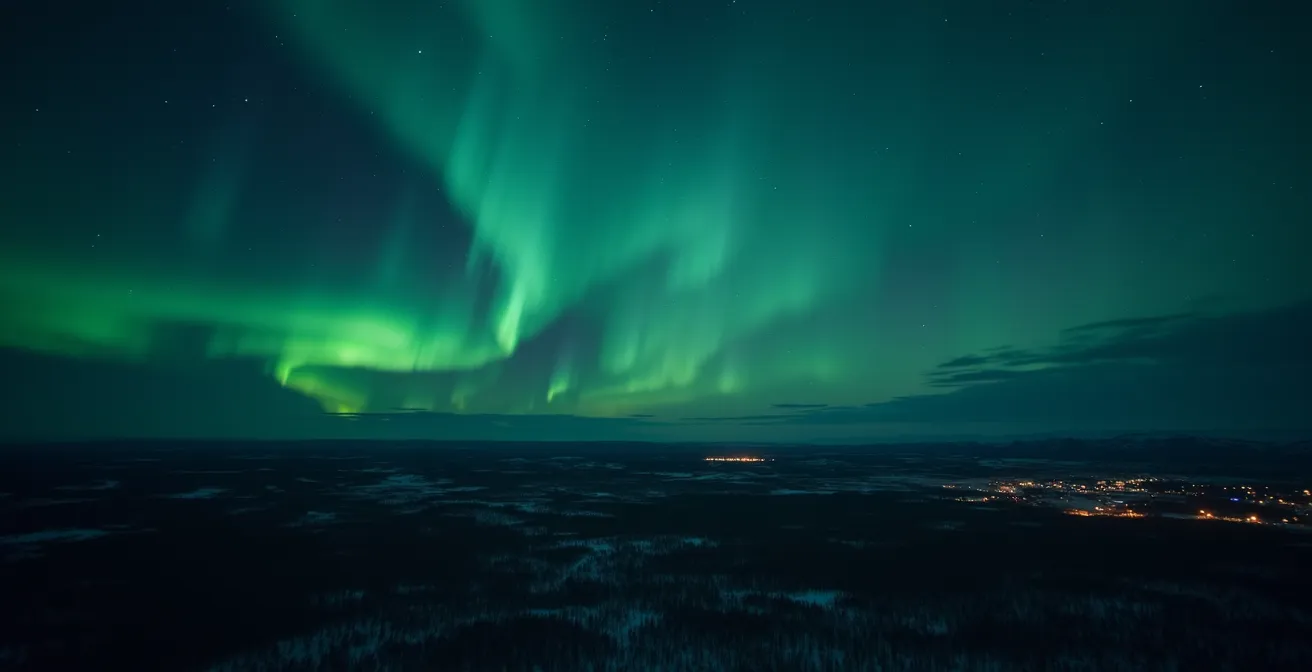
While Whitehorse offers stunning mountain scenery and milder winter temperatures, a purely data-driven choice for maximizing viewing probability points to Yellowknife. The combination of its ideal geomagnetic position and superior clear-sky statistics makes it the more reliable stage for the celestial performance. The table below, based on data from analysis of northern viewing conditions, breaks down the key differences.
| Factor | Yellowknife | Whitehorse |
|---|---|---|
| Geomagnetic Latitude | 68° N | 65° N |
| Peak Viewing Months | November to April | September to April |
| Average Viewing Nights | 240 nights/year | 200+ nights/year |
| Best Viewing Hours | 10 PM – 2 AM | 10 PM – 2 AM |
| Winter Temperature | -25°C to -40°C | -15°C to -25°C |
Equinox Effect: Why March and September Are the Best Months for Aurora?
After choosing your location, the next layer of planning is timing your trip. While aurora can be seen throughout the winter, not all months offer the same odds. The peak seasons are not centered around the darkest, coldest parts of winter as one might assume. Instead, science points directly to the periods around the spring and fall equinoxes—specifically March and September. This phenomenon is known as the Russell-McPherron effect, a key principle for any serious aurora chaser.
This effect demonstrates that during the equinoxes, the tilt of Earth’s axis aligns with the solar wind in an optimal way. This alignment creates cracks in our planet’s magnetosphere, allowing more solar particles to pour in and ignite the atmosphere. As noted in research from institutions like the University of Alaska’s Geophysical Institute, this alignment means that auroral activity is statistically twice as likely during the equinoxes compared to the solstices. For a traveler investing in a trip, this doubles your chances before you even leave home.
Choosing between March and September in Canada involves a trade-off in daytime activities and conditions:
- March: Offers the full winter wonderland experience. A reliable snowpack allows for activities like dog-sledding, and frozen lakes provide vast, unobstructed viewing platforms with unique reflection opportunities. Nights are long and dark, but temperatures are still deeply cold.
- September: Provides a more comfortable experience with milder temperatures, often hovering around freezing. The landscape is ablaze with fall colours, offering spectacular daytime scenery. Lakes are open, creating perfect mirror-like reflections of the aurora overhead.
For those looking for a balance of high odds and lower costs, the shoulder seasons of late August and early April can be strategic. You still benefit from the elevated equinox activity but with significantly fewer tourists and more daylight hours for other Canadian adventures.
Smartphone vs. DSLR: Can You Capture the Aurora with an iPhone?
Witnessing the aurora is one thing; capturing it is another. A common question is whether you need thousands of dollars in camera equipment. The surprising answer is: it depends on the strength of the storm. Thanks to computational photography, modern smartphones like the latest iPhone or Google Pixel can not only capture the aurora but can sometimes outperform a DSLR in specific situations.
The key is to match your gear to the forecast. For a low-level display (Kp 2-3), characterized by faint, slow-moving green arcs, a DSLR or mirrorless camera with manual controls is essential. You’ll need the ability to set a long exposure (15-25 seconds), a high ISO (1600-3200), and use a wide-aperture lens (f/2.8 or faster) to gather enough light. A smartphone’s Night Mode will struggle to resolve these subtle details.
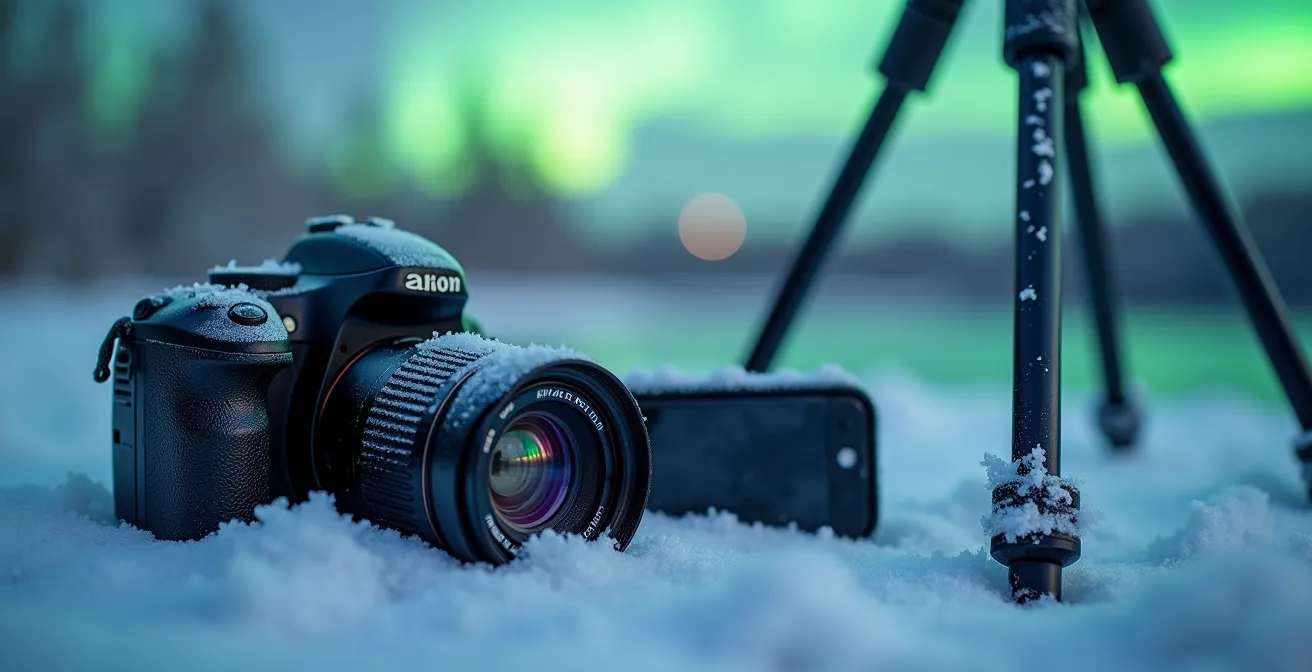
However, during a powerful aurora storm (Kp 6+), when the sky is filled with rapidly dancing curtains and coronas, a smartphone can be your best tool. Its automated HDR processing is brilliant at capturing the huge dynamic range between bright aurora sections and dark skies, all while keeping the exposure short enough to “freeze” the rapid movement. Fumbling with manual settings on a DSLR in the freezing dark during a fast-moving storm can mean missing the peak moment. A smartphone on a tripod allows you to simply point and shoot.
Regardless of your camera choice, cold weather battery management is non-negotiable. At -30°C, a battery’s life can be cut by more than half. The pro tip is to keep your phone and spare DSLR batteries inside your parka, in an insulated inner pocket, preferably with a chemical hand warmer. Essential accessories, available at Canadian retailers like Best Buy Canada or London Drugs, include a sturdy tripod and a Bluetooth shutter remote to avoid camera shake.
Standing Still at -30°C: Why Ski Gear is Not Enough for Aurora Watching?
One of the most underestimated challenges of aurora chasing is the cold. Not just any cold, but a specific, punishing type known as “static cold.” Many travelers assume their high-end ski or snowboarding gear will suffice, but this is a critical, and potentially trip-ruining, miscalculation. Active winter sports generate a significant amount of body heat, and performance apparel is designed to be breathable to release that heat and moisture. Aurora watching is the complete opposite.
You will be standing or sitting motionless for hours, generating almost no body heat, while the Arctic air relentlessly saps warmth from your body. This is where ski jackets and pants fail. They lack the sheer bulk of insulation required to trap your body’s minimal heat output. This is why Arctic clothing rental packages in Yellowknife and Whitehorse are so popular and essential. They provide gear specifically designed for static cold.
The key pieces of a proper Arctic clothing system include:
- An Insulated Parka: A high-loft down or synthetic parka with a windproof outer shell and a large, fur-lined hood to create a warm microclimate around your face.
- Insulated Overalls: “Bib” style pants are superior to regular ski pants as they provide an extra layer of insulation over your core.
- Extreme Cold Boots: This is the most critical item. Your feet are the first to suffer. Boots from brands like Baffin or Sorel, rated for -40°C or colder, are the standard. They feature thick, removable felt liners that are essential for insulation and moisture management.
- Layering System: A merino wool base layer to wick moisture, followed by a fleece or down mid-layer, are crucial components under your outer gear.
As the Canadian Arctic Photography Guide from the Northern Lights Canada Tourism Board notes, the cold impacts more than just your comfort. It’s a technical challenge for your equipment as well.
The -30°C Battery Drain Test is real – keeping phones and spare DSLR batteries in an insulated inner pocket with a chemical hand warmer is essential.
– Canadian Arctic Photography Guide, Northern Lights Canada Tourism Board
Kp 3 vs Kp 7:How to Buy Lobster Directly from the Wharf in Nova Scotia?
While some Canadian adventures involve chasing the freshest lobster on an East Coast wharf, aurora hunters in the North are chasing a different kind of number: the Kp index. This is the most commonly cited metric in aurora forecasts, a global index of geomagnetic activity on a scale from 0 to 9. However, a high Kp number is not a guarantee of a great show, and a low number doesn’t always mean a bust. Understanding what it truly represents is key to a data-driven hunt.
Think of the Kp index as a measure of the storm’s *geographic reach*. As the Kp level increases, the auroral oval expands southward from the poles. According to NOAA, the auroral oval expands approximately two degrees equatorward for each single-digit increase in the Kp index. This is why a Kp 7 storm can bring the aurora to southern Canada or the northern US, while a Kp 3 might be an incredible overhead spectacle in Yellowknife but completely invisible in Banff.
However, the Kp index only tells you the *potential* for aurora. The real key to a vibrant, dancing display is a factor many beginners overlook: the Bz component of the interplanetary magnetic field. Think of Kp as the amount of fuel in the tank, but a southward Bz is the key that turns on the engine. When the Bz is oriented southward (a negative value), it opens a direct channel for solar wind particles to flood into Earth’s upper atmosphere. A strong Kp 6 with a northward (positive) Bz can result in a disappointing, faint glow. Conversely, a modest Kp 4 with a strongly negative Bz (-10 nT or lower) can produce a breathtaking, dynamic storm. Real-time Bz data gives you a 20-60 minute heads-up—the most accurate short-term forecast you can get.
Sunrise vs. Sunset: When is the Lighting Best for Lake Louise Photography?
Just as a photographer at Lake Louise must master the golden hour of sunrise and sunset, an aurora chaser must master their own crucial window of time. The aurora is not an all-night affair. While it can technically appear anytime it’s dark, geomagnetic activity follows a distinct nightly pattern. The most active period is almost always centered around solar midnight, which for most Canadian aurora latitudes falls between 10:00 PM and 3:00 AM local time.
Planning your night around this window is far more effective than simply staying out from dusk until dawn. Solar energy, driven by the solar wind, accumulates on the day side of the Earth and is released on the night side. This release of energy peaks in the hours around midnight, leading to the brightest and most active displays. Arriving at your viewing spot around 9:30 PM allows your eyes to dark-adapt and ensures you’re in position for the most probable start of the main event.
Your nightly timing strategy must also be fluid and responsive to real-time data. This involves two key elements:
- Monitoring Short-Term Forecasts: Use an app or website like SpaceWeatherLive to watch for a sudden southward dip in the Bz value. When you see the Bz drop into negative territory, you know the “switch has been flipped,” and activity should ramp up within the next 20-60 minutes. This is your cue to get outside, no matter the time.
- Hourly Cloud Cover Check: A perfect solar storm is useless if your view is blocked. Use the hourly forecast from Environment Canada for your specific location. Look for a “sucker hole”—a clear one or two-hour window in the clouds between 10 PM and 3 AM. A successful night might involve waiting indoors until 1 AM for a predicted break in the clouds to materialize.
Forget all-night vigils. An expert approach involves targeted, data-informed strikes during the most probable windows of opportunity, both from a solar and a terrestrial weather perspective.
Key Takeaways
- Data Layering is Key: Successful aurora prediction combines solar wind data, local cloud forecasts, and geographic location.
- Prioritize the Bz Factor: A strong, southward Bz value is a more reliable indicator of an intense aurora display than a high Kp index alone.
- Dress for Static Cold: Standard ski gear is insufficient; you need extreme insulation designed for standing motionless in sub-zero temperatures.
- Timing is Everything: Focus your efforts around solar midnight (10 PM – 3 AM) and use equinox months (March, September) to maximize your statistical odds.
Rideau Canal Skateway: How to Check Ice Conditions Before You Travel?
Just as a skater must check the official ice condition report before venturing onto Ottawa’s Rideau Canal Skateway, a smart aurora chaser must become obsessive about checking atmospheric conditions. Your “ice” is the sky, and its most important condition is clarity. The most powerful solar storm in a decade is completely worthless if you’re standing under a thick blanket of clouds. Integrating Canadian weather data with solar forecasts is the final, crucial step in the prediction process.
This is not a one-time check. It’s a dynamic, nightly strategy that involves cross-referencing multiple sources to build a complete operational picture. A reliable protocol allows you to make informed go/no-go decisions, saving you from hours of fruitless waiting in the freezing cold. This process can be distilled into a nightly checklist.
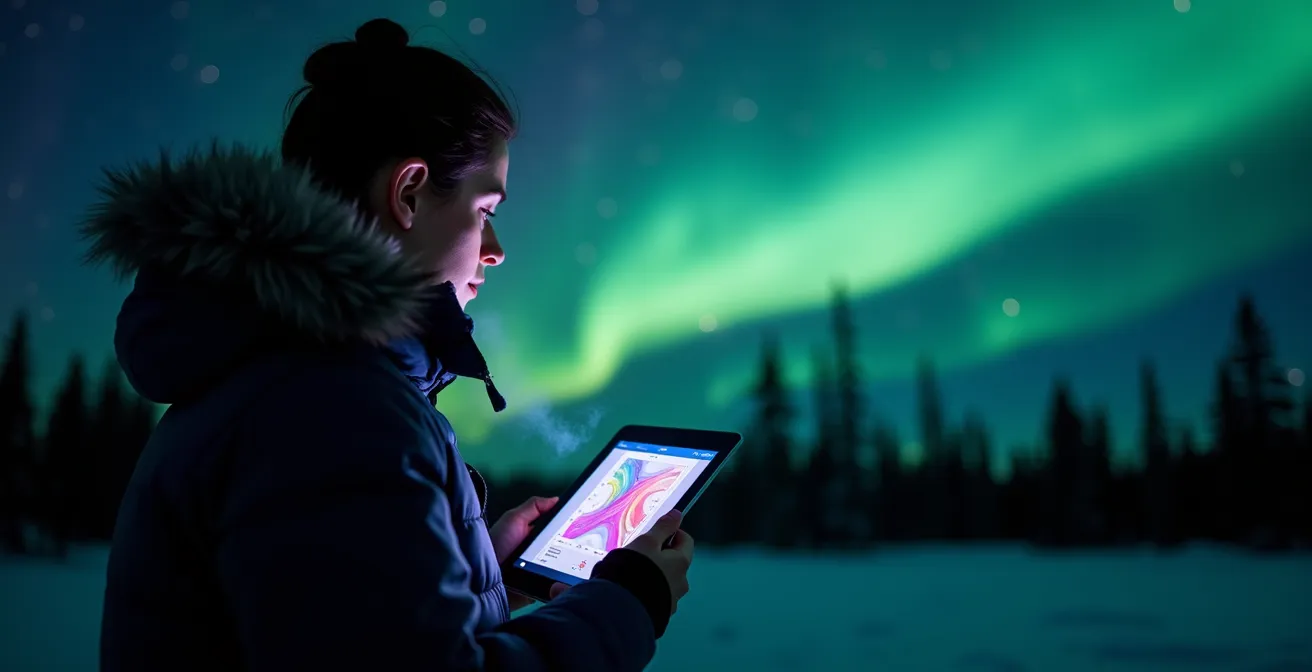
The Nightly 3-Step Aurora Prediction Protocol
- Check Solar Wind Vitals: Using a source like SpaceWeatherLive, check the three key indicators. The Bz value must be negative (southward). The solar wind speed should ideally be above 400 km/s. The density indicates the intensity of the particle stream. This gives you the baseline potential for the night.
- Cross-Reference Local Cloud Forecasts: Go to the Environment Canada hourly forecast for your exact location. Ignore the daily summary and focus on the hour-by-hour breakdown for “Cloudy periods” or “Clear” between 10 PM and 3 AM. This tells you if you’ll have a window to see the sky.
- Consult the OVATION Nowcast: Use the NOAA OVATION model. This provides a 30-90 minute visual forecast of the aurora’s location and intensity. Fast-forward the animation to the current time and see if your location falls within the red or green probability zones. This confirms if the activity is happening *right over your head*.
When all three of these data sources align—strong solar wind with negative Bz, a clear window in the clouds, and your location within the OVATION model’s auroral zone—your probability of a successful sighting skyrockets. This is how you move from hoping to knowing.
How to Obtain Permits for Visiting Inuit Lands in Nunavut?
Gaining access to restricted or sensitive areas, like certain Inuit lands in Nunavut, requires preparation, respect for protocols, and understanding the rules. In the same way, gaining “access” to the secrets of the aurora requires moving beyond surface-level forecasts and learning to read the raw data protocols of the sun. This is the final and most advanced step: long-range planning and decoding the charts yourself.
Long-range planning uses historical data to your advantage. The sun rotates on its axis approximately every 27-28 days. This means a coronal hole or active sunspot region that sends high-speed solar wind towards Earth will face us again in about four weeks. If you experience a great aurora show, you can mark your calendar for 27 days later for a heightened chance of a repeat performance. This is a powerful, though not guaranteed, long-range forecasting tool.
Furthermore, we are currently in a period of heightened activity. Scientists predicted the peak of Solar Cycle 25 for 2024-2025. This solar maximum means the sun is generally more active, producing more flares and coronal mass ejections (CMEs) that lead to aurora. Planning a trip during the years around the solar maximum, combined with the equinox effect, is the ultimate way to stack the statistical odds in your favour. It’s a strategic choice based on a decade-long cycle.
This data-driven methodology transforms you from a passive tourist into an active hunter. You are no longer at the mercy of a simple forecast; you are an interpreter of cosmic events, equipped with the knowledge to make strategic decisions. By layering geographical, seasonal, and real-time solar data, you replace the anxiety of the unknown with the confidence of a well-executed plan.
With this comprehensive methodology, your next step is to begin monitoring the real-time data sources for your chosen travel dates and location, turning theory into a successful and unforgettable aurora hunt.
Frequently Asked Questions About Reading Solar Forecasts
What do the three key solar wind indicators mean for aurora chasers?
Bz (direction) indicates magnetic field orientation – negative values allow solar particles to enter Earth’s magnetosphere. Speed (velocity) shows how fast particles are traveling – above 400 km/s increases aurora probability. Density (impact) measures particle concentration – higher density creates more intense displays.
How far in advance can we predict aurora from solar wind data?
Solar wind measurements from the DSCOVR satellite at the L1 point give a 20-60 minute warning before particles reach Earth, depending on solar wind speed. CME predictions can forecast activity 1-3 days ahead, but with significantly less precision regarding timing and intensity.
Why does negative Bz matter more than high Kp for aurora intensity?
Negative Bz allows magnetic reconnection, the process where the solar wind’s magnetic field latches onto Earth’s, opening a door for energy to pour in. Even with a low Kp index, a strong negative Bz (-10 nT or lower) can trigger brilliant, dynamic aurora displays, while a positive Bz can effectively block activity regardless of the Kp level.