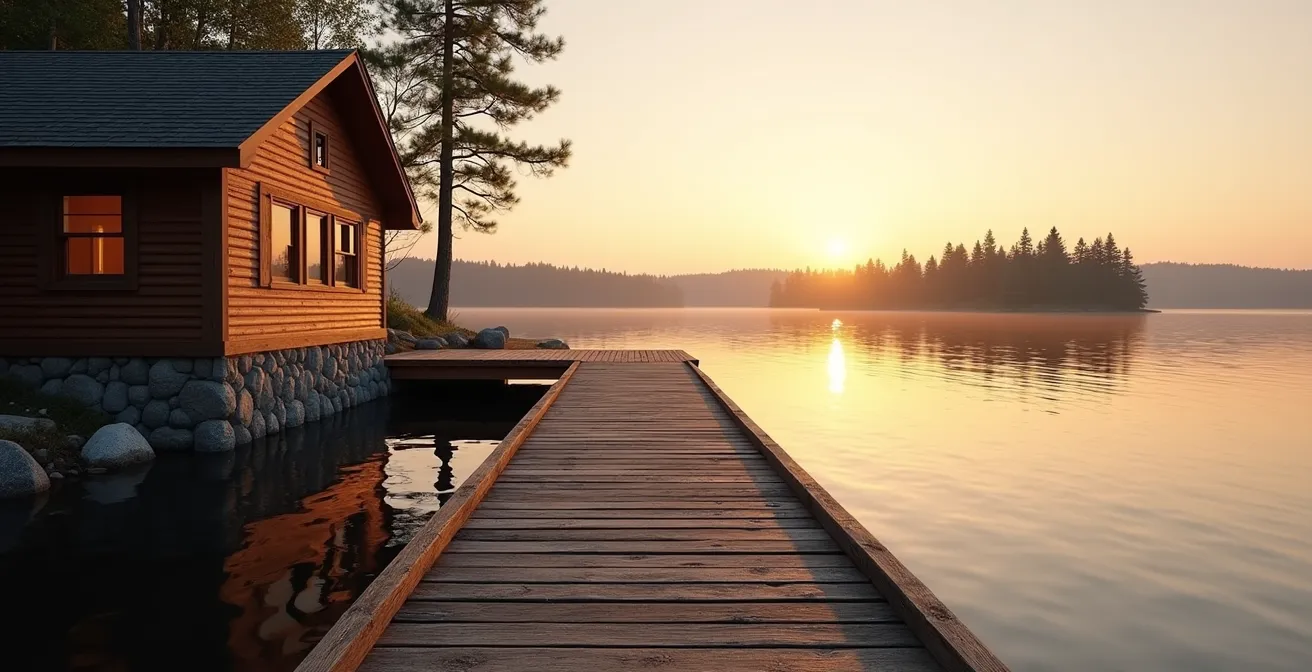
Renting a Muskoka cottage isn’t like booking a hotel; you’re temporarily in charge of a sensitive, off-grid ecosystem.
- City habits, like flushing “flushable” wipes or ignoring garbage rules, can lead to thousands of dollars in fines and damages.
- The pristine look of the lakes is deceptive, hiding parasites and specific boating regulations you are responsible for knowing.
Recommendation: Before you pack, understand the cottage’s “invisible infrastructure”—its septic, water, and waste systems—as your top priority.
The dream is always the same: a Toronto family escapes the city for a week of serene dock-sitting, sunny boat rides, and crackling campfires in Muskoka. The rental photos show a pristine lake, a charming cottage, and endless relaxation. But as a property manager in cottage country, I can tell you there’s an invisible world of rules and responsibilities those photos don’t show. The biggest mistake city dwellers make is assuming a cottage works like their home. It doesn’t.
Most guides will tell you to book early and pack bug spray. This isn’t that guide. We’re not talking about packing lists; we’re talking about the costly assumptions that can ruin your vacation and damage a fragile environment. These are the unwritten—and written—laws of cottage country that owners wish every renter knew. The key to a successful cottage vacation isn’t just about respecting the neighbours; it’s about respecting the delicate, hidden infrastructure you’re suddenly in charge of.
From the toilet you flush to the water you drink, everything operates on a different system. Thinking that “flushable” wipes are actually flushable or that a clear lake means clean water are mistakes that can lead to five-figure repair bills, hefty fines, and serious illness. This guide will walk you through the critical differences between city life and cottage reality, ensuring your vacation is memorable for the right reasons.
To help you navigate these cottage country essentials, this article breaks down the eight key areas where first-time renters often get into trouble. From understanding what goes down the drain to what to do with your trash, each section provides the insider knowledge you need for a safe and respectful stay.
Summary: How to Rent a Cottage in Muskoka Without Getting Scammed or Fined?
- The Toilet Paper Rule: Why You Cannot Flush Anything but TP in a Cottage Septic System?
- The PCOC Requirement: Do You Need a License to Drive a Rental Jet Ski?
- Docks and Trespassing: Where Does Private Property End and the Lake Begin?
- Duck Mites and Shallow Water: How to Prevent Swimmer’s Itch in Warm Lakes?
- Pack In, Pack Out: What to Do With Garbage When the Cottage Has No Curbside Pickup?
- Beaver Fever: Why You Must Filter Canadian Stream Water Despite It Looking Clear?
- The Yoke Flip: How to Get a 50lb Canoe onto Your Shoulders Alone?
- How to Portage a Canoe Solo in Algonquin Park Without Injury?
The Toilet Paper Rule: Why You Cannot Flush Anything but TP in a Cottage Septic System?
The single most expensive mistake a renter can make involves the toilet. Unlike city sewers that whisk waste away to a municipal treatment plant, most cottages rely on a private, underground septic system. This is a living ecosystem of bacteria in a tank that breaks down organic waste. If you kill those bacteria or clog the system, you’ve created a biohazard and a financial nightmare. A simple pumping can cost a few hundred dollars, but destroying the underground weeping bed can lead to repairs costing up to $25,000 for a leaching bed replacement.
The golden rule is simple: nothing but human waste and toilet paper goes down the drain. Your septic system is not a garbage can. “Flushable” wipes are the number one enemy; they do not break down and will clog the pipes and tank. The same goes for feminine hygiene products, dental floss, and even kitchen grease poured down the sink, which can solidify into massive “fatbergs.” Harsh chemicals like bleach kill the beneficial bacteria needed for the system to function. You are responsible for any damage, and “we didn’t know” is not an excuse.

As this visualization of the underground layers suggests, the septic system is an integral part of the property’s soil and groundwater environment. Contaminating it not only leads to costly personal repairs but also poses a significant threat to the lake’s water quality. Always treat the septic system with the respect it deserves.
The PCOC Requirement: Do You Need a License to Drive a Rental Jet Ski?
Once you’re on the water, a different set of rules applies. Many renters assume that driving a boat or a Personal Watercraft (PWC) like a Jet Ski is as simple as driving a car. This assumption can lead to a minimum $250 fine for operating without proof of competency, with maximums reaching into the thousands. All operators of a motorized pleasure craft in Canada must carry proof of competency, which is typically a Pleasure Craft Operator Card (PCOC).
However, there’s a critical exception for renters that you must understand. According to regulations, you are not required to have a full PCOC to operate a rental boat if you complete a specific process with the rental company. As made clear by tourism and transport guidelines, a completed boat rental safety checklist can serve as temporary proof of competency for the duration of the rental. The rental agency is legally required to walk you through this checklist, which covers boat operation, safety equipment, and local water hazards.
Do not treat this briefing as a formality. This is your crash course in boating safety. Pay close attention, ask questions, and keep that completed checklist on board at all times. If you are pulled over by the Ontario Provincial Police (OPP), this document is your only proof that you are operating the vessel legally. While the PCOC is recommended for anyone spending significant time on the water, the rental checklist is your legal lifeline for a short-term vacation.
Docks and Trespassing: Where Does Private Property End and the Lake Begin?
In the city, property lines are defined by fences and sidewalks. In cottage country, they are defined by trees, shorelines, and docks—and the rules are just as strict, if not more so. A common and disruptive mistake is treating every dock as a public stopping point. You must operate under the assumption that every dock is private property. As the Muskoka Lakes Association aptly puts it in their etiquette guides:
The dock is the cottage’s outdoor living room
– Muskoka Lakes Association, Cottage Country Etiquette Guide
You wouldn’t walk into a stranger’s living room, so do not tie up to or step onto their dock without explicit permission. For many water-access-only cottages, the dock is their sole point of entry and exit; blocking it is like parking your car across their driveway. When boating, maintain a respectful distance of at least 30 meters from occupied docks and slow down to minimize your wake. A large wake can swamp smaller boats, damage property, and erode the shoreline.
This respect for privacy is a cornerstone of the “Cottage Code.” This also includes noise. Sound travels incredibly far across water, especially at night. Adhere to the unwritten rule of quiet enjoyment between 10 PM and 8 AM. While the 66-foot shoreline road allowance is a legal public access area on paper, in practice, it runs directly through what cottage owners consider their private waterfront. Always prioritize the owner’s privacy and find a public beach or park for your landing spots.
Duck Mites and Shallow Water: How to Prevent Swimmer’s Itch in Warm Lakes?
One of the less-discussed joys of warm, beautiful lakes is the potential for swimmer’s itch, or cercarial dermatitis. This is an itchy, temporary rash caused by microscopic parasites released from snails that live in shallow, weedy areas. While it’s not dangerous, a bad case can certainly put a damper on your vacation. The parasites are most active on warm, sunny days, particularly in the afternoon. Prevention is all about knowing where and when the risk is highest.
This table breaks down the risk zones, helping you make smarter choices about your swimming spots.
| Lake Area Type | Risk Level | Peak Risk Time | Prevention Method |
|---|---|---|---|
| Shallow weedy bays | High | Late afternoon (2-6 PM) | Avoid swimming or towel dry immediately |
| Sandy beaches near marshes | High | Warm sunny days | Swim in deeper water beyond weed line |
| Rocky shores with deep drop-off | Low | Minimal risk | Standard precautions |
| Open water (center of lake) | Very Low | Minimal risk | Enjoy swimming freely |
| Docks in deep water | Low | Early morning best | Quick entry and exit |
The most effective prevention method, developed by seasoned cottage owners, is simple but requires discipline. The parasites burrow into your skin as the water evaporates. To stop them, you must towel dry vigorously the moment you get out of the water. Don’t air dry. If possible, a quick freshwater rinse within ten minutes is also highly effective. It’s wise to pack an anti-itch cream like hydrocortisone and an antihistamine just in case, but proper drying is your best defense.
Pack In, Pack Out: What to Do With Garbage When the Cottage Has No Curbside Pickup?
Welcome to self-reliance. Perhaps the biggest shock for city renters is the absence of municipal services like curbside garbage collection. In cottage country, you are solely responsible for your own waste. The rule is “Pack It In, Pack It Out.” You cannot leave bags of garbage behind for the owner or the next renter. Doing so will result in a significant deduction from your security deposit for disposal fees.
Managing your waste is a logistical task you must plan for. This means knowing the location and operating hours of the nearest district landfill or transfer station before your trip even begins. Be aware that many have limited hours, especially on weekends, and charge a fee per bag. A smart renter minimizes the waste they create in the first place by removing excess packaging from food before arriving. But for the garbage you do create, proper storage is a critical safety issue. All garbage must be stored in a secure location like a locked shed or a designated bear-proof container. Leaving garbage outside, even for one night, is an open invitation to bears, raccoons, and other wildlife, creating a dangerous situation for you and habituating the animals to human food.
Your Action Plan: Muskoka Waste Management for Renters
- Locate the nearest Muskoka District Landfill or transfer station on a map before you arrive. Note its hours.
- Purchase the required clear municipal garbage bags from a local hardware or grocery store upon arrival.
- Budget for disposal fees, which can be $5-10 per bag at the transfer station.
- Store all garbage in a locked shed or a certified bear-proof container. Never leave it on a deck or in a car overnight.
- Do a final “garbage run” to the landfill on your way out of town to leave the cottage clean.

The heavy-duty latches on cottage storage sheds aren’t for decoration; they are a necessary defense against wildlife. Respecting these garbage protocols is a non-negotiable part of being a responsible renter in Muskoka.
Beaver Fever: Why You Must Filter Canadian Stream Water Despite It Looking Clear?
The water in Muskoka’s lakes and streams looks incredibly pure, but this is a dangerous illusion. That crystal-clear water can be teeming with microscopic parasites, most notably Giardia lamblia, the cause of “Beaver Fever.” This intestinal illness can cause weeks of severe gastrointestinal distress. The Giardia parasite is invisible to the naked eye and can survive for months in cold, pristine-looking water, making any untreated lake or stream water a potential health risk.
Many cottages draw their water directly from the lake. It is absolutely crucial that you ask the owner about their water filtration system before you drink a single drop from the tap. A safe system will typically include a series of filters and, most importantly, a UV (ultraviolet) sterilizer. A UV light kills bacteria and parasites like Giardia. Standard carbon filters, like a Brita pitcher, are not sufficient; they improve taste but do NOT remove Giardia.
For maximum safety, follow a clear hierarchy. The gold standard is to bring your own bottled water for all drinking and cooking needs. If you’ve confirmed the cottage has a fully functional UV system, using the tap water is the silver standard. The bronze standard, and an absolute minimum for any unconfirmed water source, is to bring the water to a rolling boil for at least one full minute. Never assume clear water is clean water.
Key Takeaways
- Your rental cottage operates on a fragile, “invisible infrastructure”; treat its septic and water systems with extreme care.
- City rules do not apply. You are responsible for knowing local bylaws for noise, boating, and waste disposal.
- Self-reliance is paramount. There is no curbside pickup for garbage, and emergency services can be distant.
The Yoke Flip: How to Get a 50lb Canoe onto Your Shoulders Alone?
Part of the quintessential cottage experience is paddling a canoe. But first, you have to get it to the water. A 50-pound canoe can be an intimidatingly awkward object to lift, but it’s a task that relies on technique, not raw strength. The “Yoke Flip” is a classic method that uses leverage and balance to get the canoe onto your shoulders safely and without assistance.
The technique involves three distinct phases. First, stand beside the canoe’s center, squat with a straight back, and lift it to rest on your thighs. Second, shift your grip to the far edge (gunwale) and use a hip thrust to pivot the canoe up onto its side, resting against your body. The final and most crucial phase is the controlled drop: as the canoe becomes vertical, you step underneath the center yoke and gently guide it down to rest on your shoulders. The key is to keep your feet shoulder-width apart and use smooth, controlled movements, letting the canoe’s momentum do most of the work.
However, the technique is useless without the right foundation. As experienced Algonquin Park guides will tell you, the vast majority of portaging injuries come from slips and falls, not the lift itself. Attempting a yoke flip on uneven ground or while wearing flip-flops is a recipe for a twisted ankle or worse. Always scout your lifting location for level, stable ground and wear sturdy, closed-toe footwear with good grip. Safety and technique will always beat muscle and haste.
How to Portage a Canoe Solo in Algonquin Park Without Injury?
Lifting the canoe is only the first half of the challenge. Carrying it over a portage trail—the overland paths connecting lakes in places like Algonquin Park—is where safety and strategy become paramount. The most common mistake novices make is trying to do it all in one heroic trip, carrying both the canoe and a heavy pack. This leads to fatigue, poor balance, and injury.
Most portage injuries come from slips, trips, and falls – not from lifting the canoe itself.
– Ontario Parks Safety Division, 2024 Backcountry Safety Report
The safest and smartest approach for a solo portage is the two-trip strategy. Your first trip is a “scout run.” Carry only your gear pack and paddles, which are lighter and easier to manage. This allows you to assess the trail for hazards like fallen trees, muddy patches, or steep grades without being encumbered by the canoe. You can move quickly and safely, taking mental notes of any tricky spots.
On your second trip, you return for the canoe. Now, you have full knowledge of the trail ahead. You know where to watch your step and where you can safely take a break. This methodical approach may seem slower, but it dramatically reduces the risk of a fall, which is the number one cause of portaging injuries. Essential gear for any portage is non-negotiable: sturdy hiking boots (never sandals), bug spray, and a whistle for emergencies. By prioritizing safety over speed, you ensure your backcountry adventure ends with good memories, not a call to park rangers.
By understanding these hidden rules and responsibilities, you can ensure your Muskoka vacation is the relaxing escape you dreamed of. Plan ahead, respect the local environment, and you’ll be welcomed back year after year.
Frequently Asked Questions About Renting a Cottage in Muskoka
What are the noise rules for cottages in Ontario?
While specific bylaws vary by municipality, the universal “Cottage Code” dictates quiet hours are from 10 PM to 8 AM. Sound travels far across water, so music and loud conversations should be kept to a minimum during these times to respect your neighbours.
Can I drink the lake water in Muskoka if it looks clean?
No. Never drink untreated water from any lake or stream. Even the clearest water can contain invisible parasites like Giardia (“Beaver Fever”). Only drink tap water if you have confirmed the cottage has a functional UV filtration system. Otherwise, stick to bottled water or boil your water for at least one minute.
Do I really need a special license to drive a rental boat?
You need proof of competency. While a Pleasure Craft Operator Card (PCOC) is the standard, for a rental boat you can use a completed rental boat safety checklist as a temporary equivalent. The rental company must provide this and a safety briefing. You must have this completed checklist with you on the water at all times.