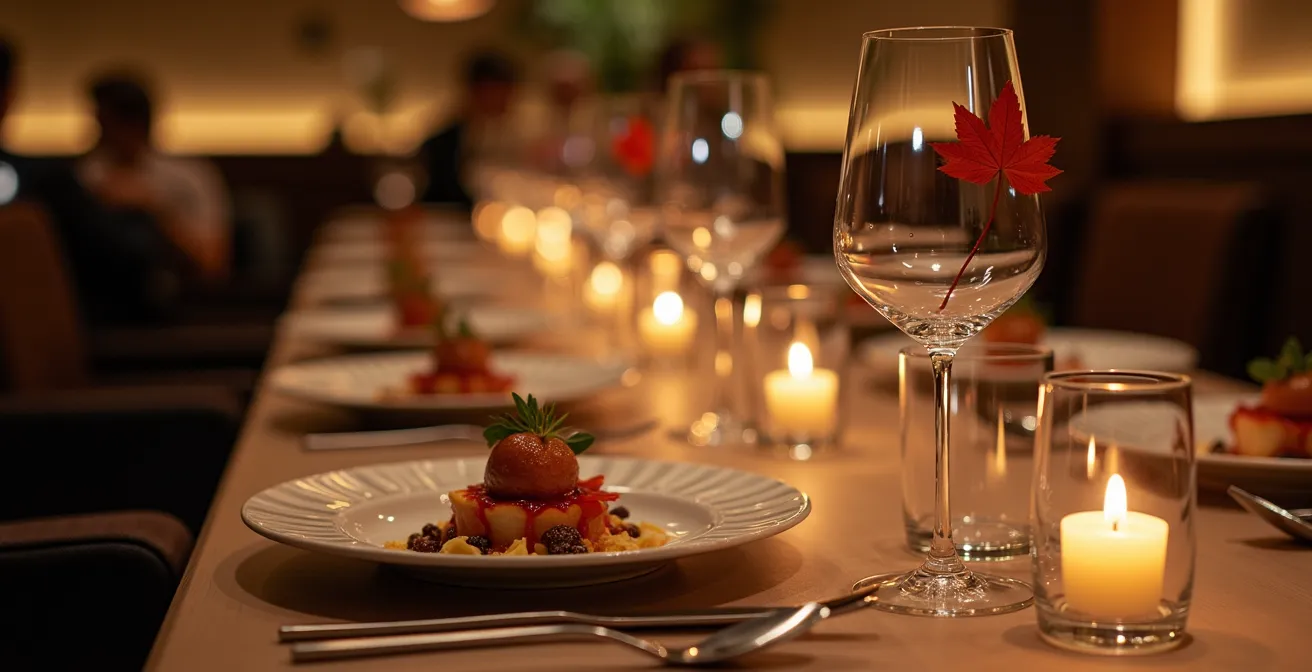
The true worth of a Toronto Michelin-starred dinner isn’t a simple yes or no; it’s a personal value equation you must solve yourself.
- The price tag extends far beyond the food, encompassing anticipatory service, ingredient storytelling, and a significant, non-negotiable “tipping tax” of 18-20%.
- Value is found not just in star ratings but in strategic choices: curated wine flights featuring local discoveries, Bib Gourmand gems, and city-specific advantages like Montreal’s BYOW scene.
Recommendation: Instead of asking “Is it worth it?”, ask “What am I paying for and does it align with my priorities?”. Use this framework to decide whether to splurge on a star or invest in a different, equally high-quality Canadian culinary experience.
The arrival of the Michelin Guide in Toronto has sent ripples through Canada’s culinary scene, crowning a select few with its coveted stars and, inevitably, cementing their status with formidable price tags. The question on every gourmet traveler’s mind is a simple one: is that $400 tasting menu genuinely worth the expense, or is it an exercise in hype? Many will offer the standard justifications—it’s a “once-in-a-lifetime experience,” or “you’re paying for artistry.” These platitudes, however, are unhelpful for the discerning diner weighing a splurge against the city’s other exceptional offerings.
To answer the question properly requires moving beyond sentiment and into analysis. The real issue is not the price itself, but the value proposition. This article proposes a different approach: deconstructing the Michelin-star value equation. We will break down exactly what your money buys, from the tangible differences in service and creativity to the less-visible costs embedded in Canadian dining culture, such as the significant tipping expectations. It’s not about declaring a verdict, but about providing a critical framework for you to make an informed decision.
By dissecting the components—service, reservations, etiquette, wine, and the mandatory tip—we will equip you to calculate the worth of a high-end tasting menu based on your own priorities. The goal is to transform you from a passive consumer into a strategic diner, capable of navigating Toronto’s exciting and expensive new culinary landscape with confidence.
This guide will walk you through the key factors that define the cost and value of a Michelin-starred meal in Canada. By understanding each component, you can build your own framework for deciding where your dining dollars are best spent.
Summary: Deconstructing the Michelin Value Equation in Toronto
- 1 Star vs. 2 Stars: What is the Difference in Service and Creativity?
- The Tock Drop: How to Snag a Reservation at a Sold-Out Starred Restaurant?
- Dress Code and Photos: What is the Etiquette for a 3-Hour Tasting Menu?
- The Wine Pairing: Is it Better Value to Order by the Glass or the Flight?
- Service Included: How to Handle Tipping on a $1000 Dinner Bill?
- Why You Need to Budget 18-20% for Tips in Toronto and Vancouver Restaurants
- Sushi and Pizza: Why These Two Foods are the Cheapest Staples in Vancouver?
- How to Experience Montreal and Toronto’s Fine Dining for Under $100 CAD?
1 Star vs. 2 Stars: What is the Difference in Service and Creativity?
The first variable in the value equation is the star itself. In Canada, the distinction is stark. As of the latest guide, Toronto’s landscape features 17 one-star and 1 two-star restaurants, making the two-star experience an exclusive proposition. While a one-star restaurant is defined by “high-quality cooking” that is “worth a stop,” a two-star signifies “excellent cooking, worth a detour.” The price difference often reflects this jump, but what does it mean in tangible terms?
Creativity at the two-star level often transcends mere technique. It’s about a profound connection to place. The elevation of Restaurant Pearl Morissette to two-star status is a prime example. Here, the tasting menu is a spontaneous expression of a 42-acre Niagara property, showcasing iconic Canadian ingredients like Fogo Island cod and Quebec foie gras with perfected, rather than purely avant-garde, methods. You are paying for a narrative of Canadian terroir that is difficult to replicate. A one-star, while excellent, may focus more on executing a specific cuisine to a high standard without the same overarching, farm-to-table philosophy.
Service is the other major differentiator. At a one-star, you can expect flawless, professional service. At a two-star, service becomes anticipatory and deeply personalized. The staff doesn’t just serve you; they curate your experience. This includes:
- Personalized Storytelling: Staff provide detailed narratives about each dish’s origin, from the farm it was sourced from to the inspiration behind its creation.
- Seamless Team Coordination: Multiple staff members interact with your table with such perfect handoffs that it feels like a choreographed performance.
- Proactive Customization: The team might adapt the menu on the fly based on a preference you casually mentioned earlier in the meal.
The question for your value equation is this: is the hyper-personalized theatre of a two-star experience worth the significant premium over the high-quality, but more straightforward, excellence of a one-star?
The Tock Drop: How to Snag a Reservation at a Sold-Out Starred Restaurant?
Part of the perceived value of a Michelin-starred meal is its exclusivity, a factor amplified by the near-impossibility of securing a table. In Toronto, top-tier restaurants like Alo, Edulis, and Aburi Hana primarily use the Tock platform, releasing reservations in monthly blocks that are devoured in seconds. This frantic event, known as the “Tock drop,” is a modern-day battle for culinary access. From a critic’s perspective, this manufactured scarcity is a double-edged sword: it heightens anticipation but can also add a layer of stress that detracts from the pleasure.
Successfully navigating this system requires strategy and preparation. It’s not enough to simply log on at the right time; you must have a plan. Being flexible with your dates can dramatically increase your chances, and following the restaurants on social media can alert you to rare last-minute cancellations. For the truly committed, technology is your ally.

As the image suggests, securing a booking is often a tense, focused moment. For those with the means, there is a way to bypass the digital rush. As Destination Toronto notes, an often-overlooked strategy is leveraging the power of a high-end hotel concierge. As they state in their guide:
Concierges at Toronto’s luxury hotels often have reserved tables or special access for their guests.
– Destination Toronto, 2025 MICHELIN Star Restaurants in Toronto Guide
This “insider access” is a hidden component of the luxury travel experience, turning a frustrating digital lottery into a seamless service. This convenience, of course, has its own price, factoring into the overall cost of your trip but adding immense value by saving time and stress.
Dress Code and Photos: What is the Etiquette for a 3-Hour Tasting Menu?
Once you’ve secured the reservation, the focus shifts to the experience itself. A three-hour tasting menu is as much a social performance as it is a meal, and understanding the unspoken rules is key to feeling comfortable and showing respect for the establishment. The dress code is the most visible signal of this. While Toronto’s fine dining scene is notably less formal than Paris or New York, effort is expected.
The term is “smart casual,” but its interpretation varies by neighbourhood. In Yorkville, a tailored blazer with dark, high-end jeans is perfectly acceptable. On West Queen West, the atmosphere might welcome a more creative, fashion-forward approach. The universal rule, however, is to avoid streetwear: no sneakers, no t-shirts, no baseball caps. As Don Alfonso 1890 explicitly requests, diners should also avoid strong perfumes or colognes, which can interfere with the subtle aromas of the food and wine for you and surrounding tables. Thoughtful presentation is a sign of respect for the immense effort invested in your meal.
The other major point of modern etiquette is photography. While restaurants understand the desire to capture a beautiful dish for social media, there are rules. Flash photography is always forbidden, as it is disruptive to the ambiance and other diners. The best practice is to be quick and discreet. Take one or two photos without flash when the dish arrives, then put your phone away. Spending the meal on your phone is disrespectful to the chefs, the service staff, and your dining companions. You are paying for an immersive experience, and being present is a prerequisite to enjoying it.
The Wine Pairing: Is it Better Value to Order by the Glass or the Flight?
The wine pairing is a significant component of the final bill and a major decision point in your value equation. A standard wine flight can add $150-$250 per person to the cost, so is it the best choice? The answer depends on your goal: are you seeking comfort and control, or are you paying for curated discovery?
For the connoisseur who knows their preferences, ordering by the glass or selecting a single bottle offers control. However, from a pure value-per-ounce perspective, it’s often the least economical option. A detailed look at the numbers shows where the value lies.
This is further supported by a comparative analysis of Toronto’s options, which breaks down the cost-benefit of each choice.
| Option | Average Cost (CAD) | Portions | Best For | Value Score |
|---|---|---|---|---|
| Full Wine Flight | $150-250 | 5-7 pours (3oz each) | Discovery & storytelling enthusiasts | 8/10 |
| Half-Pairing/Shared | $75-125 | 5-7 pours (1.5oz each) | Budget-conscious couples | 9/10 |
| By the Glass | $18-35/glass | 5oz standard | Wine connoisseurs with preferences | 6/10 |
| Bottle Service | $80-500+ | 750ml (5 glasses) | Groups of 2-3 with similar tastes | 7/10 |

The real, intangible value of the flight, however, lies in the sommelier’s expertise, especially in a Canadian context. As the team at Restaurant Pearl Morissette highlights, the pairings are an opportunity for unique, local discovery.
Toronto sommeliers leverage exceptional Niagara icewines and other varietals that are world-class but less known internationally. The flight’s value lies in this unique, local discovery.
– Restaurant Pearl Morissette, Michelin Guide Toronto & Region 2025
Opting for the flight means you are paying for a guided tour of Canada’s best-kept secrets—wines you would likely never discover on your own. The half-pairing offers a brilliant compromise, providing the full narrative arc of the tasting at a more accessible price point, making it the highest-value option for most discerning diners.
Service Included: How to Handle Tipping on a $1000 Dinner Bill?
For many international visitors, Canadian tipping culture can be the most jarring part of the fine dining experience. Unlike many European or Asian countries where service is included, tipping in Canada is not only expected but has reached new heights. A $1000 dinner bill is rarely just $1000. It is crucial to factor what I call the “Tipping Tax” into your budget from the outset. This isn’t an optional bonus for good service; it’s a quasi-mandatory part of the bill that constitutes a significant portion of the staff’s income.
The old 15% standard is largely a relic of the past. In major cities like Toronto and Vancouver, the baseline expectation for good service in a fine dining context now starts at 18% and frequently extends to 20% or more. This isn’t just anecdotal; a recent poll revealed that 21% of diners now tip 20% or higher, a significant jump from just a few years ago. On a $1000 bill, that’s an extra $200 you need to account for.
So, how should you handle it? The simple answer is to budget for 20% for excellent service. Tipping less than 18% at a Michelin-starred restaurant would likely be interpreted as a sign of dissatisfaction with the service. While “service included” models are being discussed in the Canadian restaurant industry, they are not yet the norm. For now, the Tipping Tax is a non-negotiable part of the value equation and must be anticipated.
Why You Need to Budget 18-20% for Tips in Toronto and Vancouver Restaurants
The escalation of tipping expectations in Canada isn’t arbitrary; it’s driven by a combination of technological prompts and the complex internal economics of a restaurant. Any visitor to Toronto or Vancouver will immediately notice that many point-of-sale machines now start with 18% or 20% preset options. This “tip-flation” subtly nudges diners toward a higher standard, making 18% the new floor.
More importantly, it’s crucial to understand that your server does not pocket the entire tip. Fine dining establishments operate on a “tip-out” or “tip pool” system. A significant portion of the gratuity is distributed among other staff who contribute to the experience but don’t directly interact with the guest. Understanding this structure helps contextualize why a generous tip is so integral to the restaurant’s ecosystem. The breakdown is typically as follows:
- The server keeps approximately 45-60% of the tip.
- Kitchen staff, including the chefs who prepared your meal, receive 20-30%.
- Bartenders are tipped out 5-10% of beverage sales.
- Bussers and food runners, who ensure seamless service, share 10-15%.
- In some upscale venues, hosts may receive 2-5%.
From a critical perspective, this system effectively outsources a portion of staff wages to the customer. While one can debate the merits of this model, a visitor must operate within its reality. Your 20% tip is not just a reward for your server; it’s a contribution to the entire team’s compensation. Failing to tip appropriately has a direct financial impact on the kitchen brigade, the sommelier, and the support staff who all worked to create your meal.
Sushi and Pizza: Why These Two Foods are the Cheapest Staples in Vancouver?
The article’s title poses a question about Vancouver, and it highlights a fascinating duality in Canadian food scenes that provides a strategic alternative to the $400 tasting menu. While Toronto’s food scene is more centralized, Vancouver’s culinary identity is famously “high-low.” Due to its Pacific proximity and generations of Japanese culinary heritage, the city offers an abundance of world-class, yet affordable, sushi. Simultaneously, as a city with numerous universities, pizza remains a cheap, student-friendly staple. This creates a culture where a diner can have an exceptional, budget-friendly meal for lunch and a Michelin-starred splurge for dinner.
This high-low dynamic is the key to strategic dining for the value-conscious traveler. Instead of feeling pressured into a single, expensive tasting menu, one can experience the pinnacle of a city’s food scene through its more accessible, yet equally high-quality, staples. The Michelin Guide itself recognizes this with its Bib Gourmand category, which highlights restaurants offering great food at a great value.
However, as a critic, it’s essential to add a word of caution. The “Bib Gourmand Effect” can be a double-edged sword. As the Michelin Guide itself has observed, this recognition can paradoxically lead to price increases.
Michelin’s recognition of value-for-money spots can paradoxically put upward price pressure on formerly cheap eats as they gain international fame.
– MICHELIN Guide Canada, Bib Gourmand Effect Analysis
This means the window for “value” can be fleeting. The lesson from Vancouver’s sushi and pizza culture is not just that cheap eats can be great, but that the savvy traveler should seek out these local treasures—be it sushi in Vancouver or perhaps Toronto’s diverse offerings in Scarborough or Kensington Market—as a core part of their culinary journey, providing a delicious and economical counterpoint to a potential fine-dining splurge.
Key Takeaways
- The “worth” of a Michelin meal is a personal value equation, not a universal truth; you must weigh tangible costs against intangible benefits like storytelling and unique Canadian ingredients.
- The final bill is significantly higher than the menu price; always budget for 13% HST and a mandatory-feeling 18-20% tip, the “Tipping Tax” of Canadian fine dining.
- Strategic value can be found in alternatives like Bib Gourmand restaurants, prix-fixe lunch menus, and taking advantage of regional policies like Montreal’s BYOW scene.
How to Experience Montreal and Toronto’s Fine Dining for Under $100 CAD?
For the traveler who solves their value equation and concludes that a $400-plus tasting menu isn’t the right fit, the Canadian fine dining scene is far from inaccessible. With a strategic approach, it is entirely possible to experience exceptional food in cities like Toronto and Montreal for under $100 per person. The key is to look beyond the stars and leverage local knowledge.
In Toronto, the most effective tool is the Michelin Bib Gourmand list. These are restaurants selected by the guide for offering high-quality food at a reasonable price. By targeting winners like Alma or Bar Raval and ordering strategically (one appetizer, one main, and a non-alcoholic drink), a full experience can be had for approximately $75-95 after tax and a generous tip. Furthermore, timing your visit to coincide with the city’s Summerlicious or Winterlicious events opens the door to prix-fixe menus at normally expensive restaurants for a fraction of the cost.
Montreal, however, offers a unique structural advantage that dramatically alters the dining equation: its “Apportez Votre Vin” (BYOW) policy. This Quebec-specific law allows diners to bring their own retail-priced wine to licensed restaurants, completely eliminating the typical 200-300% restaurant markup on alcohol. This single policy can cut the cost of a fine dining meal by 60-70% compared to Toronto, making sub-$100 experiences that include excellent wine not just possible, but common. It’s a powerful reminder that value is often dictated by local policy as much as by culinary skill.
Your Action Plan: The Sub-$100 Fine Dining Strategy
- Target Bib Gourmand winners in your chosen city, such as Campechano or Bar Raval in Toronto.
- Order strategically: focus on one appetizer ($12-18) and one main course ($25-35) to manage costs.
- Factor in the essentials: account for 13% HST and an 18% tip, bringing your total to a manageable $75-95.
- Plan your visit during Toronto’s Summerlicious (July) or Winterlicious (January-February) for access to incredible prix-fixe deals.
- If in Montreal, prioritize “Apportez Votre Vin” (BYOW) restaurants to save significantly on alcohol costs.
By employing these strategies, you can enjoy the creativity and quality of Canada’s top culinary talents without succumbing to the financial pressure of the Michelin stars.
The decision to splurge is a personal one, but it should now be an informed one. By deconstructing the price and understanding all the components, from service choreography to the non-negotiable tip, you can now solve the value equation for yourself and dine in Canada with critical confidence.