
The Discovery Pass is a financially sound investment for most trips of a week or more, but its true return on investment (ROI) is revealed by looking beyond the simple 7-day break-even point.
- For a family of five, the pass pays for itself in just three days, saving significant money on a single trip.
- Its value is amplified by including access to over 80 National Historic Sites, which carry separate admission fees.
Recommendation: Treat the pass as a financial asset for your trip. Analyze your itinerary against its full scope of inclusions—not just park access—to calculate its true, and often much higher, value.
The classic dilemma for any traveler planning a Canadian road trip: staring at the Parks Canada website, a calculator in hand, trying to determine if the annual Discovery Pass is a smart purchase or an unnecessary expense. The common wisdom dictates a simple break-even point, but this superficial calculation often misses the bigger picture. Viewing the Discovery Pass not as a simple ticket, but as a financial travel product, changes the entire equation. It has terms, conditions, hidden bonuses, and significant limitations that can dramatically affect its return on investment.
For a traveler meticulously planning a 10-day itinerary, the decision isn’t just about dividing the annual fee by the daily rate. It’s about a strategic analysis. Does your route cross through provincial parks where the pass is useless? Are you traveling with a group? Could you extract an extra month of value simply by timing your purchase? This guide moves beyond the generic advice. We will dissect the Discovery Pass like a travel finance blogger, analyzing its clauses, uncovering its hidden value-stacking opportunities, and identifying the potential financial pitfalls to create a comprehensive ROI analysis for your specific trip.
This analysis will equip you with a framework to make a decision based not on a rule of thumb, but on a clear-eyed assessment of your personal travel style and itinerary. We will explore the granular details that turn a good-value purchase into a high-performance travel asset.
To help you determine the true return on investment of this pass for your vacation, this article breaks down all the key financial and logistical factors to consider. From detailed cost comparisons to understanding the crucial differences between park jurisdictions, you’ll have all the data needed to make an informed choice.
Summary: Analyzing the True ROI of the Parks Canada Discovery Pass
- Daily vs. Discovery Pass: Which Parks Canada Option is Cheaper for a 6-Day Trip?
- Family/Group Pass: How Many People Can Actually Fit in One Car on One Pass?
- Expiry Dates: Why Buying Your Pass in December Gives You 13 Months of Value?
- Forts and Canals: Which Non-Park Sites Are Included in the Discovery Pass?
- National vs. Provincial: Why Your Discovery Pass Won’t Work in Algonquin Park?
- Do You Need a Parks Canada Pass Just to Drive Through Banff National Park?
- The Rearview Mirror Hang tag: How to Avoid a Ticket When Parked at a Trailhead?
- How to Visit Banff and Jasper in July Without Being Stuck in Traffic?
Daily vs. Discovery Pass: Which Parks Canada Option is Cheaper for a 6-Day Trip?
The core of the Discovery Pass analysis begins with a simple break-even calculation. For a solo traveler, the math seems straightforward. With a daily admission fee of $11.00 for an adult in the iconic Rocky Mountain parks and an annual Discovery Pass costing $75.25, the investment becomes profitable on the seventh day. This is the widely cited break-even point of 7 days of national park visits for a single adult. For a 6-day trip, paying daily fees ($66.00) appears cheaper by about $9. However, this simplistic view is the first mistake in a proper ROI analysis.
The calculation dramatically shifts for couples, families, or groups. A daily pass for a family or group is approximately $22.00, while the Family/Group Discovery Pass, covering up to seven people in one vehicle, is priced at $151.25. In this scenario, the break-even point is also reached on the seventh day. But the potential for savings is far greater. Let’s analyze a real-world scenario to see how this plays out.
Case Study: The 6-Day Rocky Mountain Road Trip
Consider a family of five on a 6-day tour of Banff, Jasper, and Yoho National Parks. Paying daily fees would cost them $132.00 (6 days x $22.00 family rate). In stark contrast, the annual Family Discovery Pass is just $151.25. For an additional $19.25, the family secures access to all national parks and historic sites for a full year. If their trip was just one day longer (7 days), they would have spent $154.00 on daily fees, making the annual pass the cheaper option outright. This demonstrates that for families, the pass becomes a powerful savings tool even on trips shorter than a week, especially when considering the potential for future weekend getaways within the year.
Therefore, while a solo traveler on a 6-day trip might save a few dollars with daily passes, they are forfeiting a full year of access for a nominal amount. For any group of two or more, the Discovery Pass almost always presents a superior financial value, even on trips slightly shorter than the technical 7-day break-even point. The key is to see the pass not just as a cost for one trip, but as an asset for 365 days of travel potential.
Family/Group Pass: How Many People Can Actually Fit in One Car on One Pass?
The Family/Group Discovery Pass is a significant value proposition, covering up to seven individuals arriving in a single vehicle. Currently priced at $151.25 CAD for a Family/Group Pass, it offers substantial savings over individual passes. However, its value is contingent on understanding the strict “terms and conditions” of this financial travel product. The most critical rule is that the pass is tied to a person, not a vehicle.
The pass must be signed by one of the individuals in the group, who becomes the designated pass holder. This person must be present whenever the pass is used for entry. This means you cannot simply lend your pass to friends or other family members if you are not with them. It is non-transferable and will be rendered void if resold. This is a crucial point for groups coordinating travel in multiple vehicles or with different arrival times. While the pass covers up to seven people, they must all be in the pass holder’s vehicle at the moment of entry.
One common misconception is that the group of seven people must be the same for every visit. This is incorrect. The pass holder can be accompanied by any group of up to six other people on any given day. This flexibility is a key feature, making it ideal for residents who might host different friends or family members on various trips to a park throughout the year. It’s also important to note that these passes are intended for personal recreational use and are not valid for commercial groups, such as tour operators.
Action Plan: Maximizing Your Family Pass Value
- Designate and Sign: Before your trip, decide who the primary pass holder will be. That person must sign the back of the physical pass for it to be valid.
- Ensure Presence: The designated pass holder must be in the vehicle at every park entry gate or checkpoint. Plan your carpooling and meeting points accordingly.
- Safeguard the Asset: Remember the pass is non-refundable and non-transferable. Treat it like cash; if it’s lost or stolen, it cannot be replaced.
- Verify Group Type: Confirm your group is non-commercial. If you are part of an organized tour, the operator is responsible for park entry fees.
- Leverage Flexibility: Take advantage of the fact that the pass holder can bring a different group of friends or family on each visit throughout the year.
Expiry Dates: Why Buying Your Pass in December Gives You 13 Months of Value?
A Parks Canada Discovery Pass is a time-based asset, and optimizing its lifespan is a key strategy for maximizing its ROI. Officially, the pass is valid for 12 full months from the date of purchase. More specifically, it expires on the last day of the month it was purchased in, one year later. For example, a pass bought on October 10, 2024, will be valid until October 31, 2025. This nuance is where the opportunity for “timing optimization” arises.
p>
By purchasing a pass at the beginning of a month, you receive nearly 13 months of value. A pass bought on December 1, 2024, is valid for the entire month of December 2024 plus the full 12 months of 2025, expiring on December 31, 2025. This “13th-month hack” is especially valuable for Canadian residents living near national parks, such as those in Calgary or Vancouver. For them, a strategic December purchase can cover holiday season activities, a full year of winter and summer excursions, and the following year’s holiday season as well.
This timing strategy transforms the pass from a single-vacation expense into a year-long recreational investment. For a Calgary resident who makes frequent weekend trips to Banff, which is just a 90-minute drive away, this is a significant financial win. Considering a single adult’s daily admission is $11.00, a December purchase covering both winter skiing and the following summer’s hiking trips can deliver a massive return on the initial $75.25 investment. It turns a simple purchase into a calculated move that pays dividends across multiple seasons and two calendar years.
For international tourists, this may seem less relevant, but it can still be a factor. If you are planning a trip in early summer (e.g., June), but know you might return the following year in late spring (e.g., May), purchasing the pass in May of the first year could potentially cover both trips, doubling its value for the price of one.
Forts and Canals: Which Non-Park Sites Are Included in the Discovery Pass?
A common oversight in calculating the Discovery Pass’s ROI is focusing solely on national parks. This approach ignores a significant source of “value-stacking”: the pass also grants admission to over 80 National Historic Sites across Canada. Many of these sites have their own substantial entry fees, and visiting just one or two can tip the financial scales firmly in favour of the annual pass. These sites range from iconic forts and museums to unique cultural and natural landmarks.
For instance, a traveler on an East Coast road trip might visit the Fortress of Louisbourg in Nova Scotia, where adult admission is nearly $20. On the same trip, they might stop at the Halifax Citadel National Historic Site. In Alberta, a visit to Banff National Park can be supplemented with stops at the Cave and Basin National Historic Site or the Banff Park Museum. The entrance fees for these sites, which are all covered by the Discovery Pass, can add up quickly.
This bundled value is where the Discovery Pass truly outperforms daily park-only fees. A family planning a 10-day trip to Alberta might initially focus on the $22/day fee for Banff and Jasper. However, if their itinerary includes a rainy-day visit to the Cave and Basin ($9.00/adult), the financial equation changes. The pass is not just a park pass; it’s a comprehensive Canadian heritage pass. The following table illustrates the individual admission costs at some of these popular sites, all of which are covered by the Discovery Pass.
| Historic Site | Adult Admission | Location |
|---|---|---|
| Fortress of Louisbourg | $19.75 | Nova Scotia |
| Cave and Basin | $9.00 | Banff, Alberta |
| Banff Park Museum | $4.50 | Banff, Alberta |
| Halifax Citadel | Varies | Halifax, Nova Scotia |
When you factor in these additional sites, the 7-day break-even rule becomes conservative. A family could find the pass pays for itself in just 4 or 5 days if they mix major park visits with stops at these valuable historic locations.
National vs. Provincial: Why Your Discovery Pass Won’t Work in Algonquin Park?
The single most significant financial risk when purchasing a Discovery Pass is failing to understand its jurisdictional boundaries. The pass is exclusively for federal properties: National Parks, National Historic Sites, and National Marine Conservation Areas managed by Parks Canada. It is completely invalid at provincial or territorial parks, which are managed by individual provincial or territorial governments and have their own separate fee and pass systems. This is a critical distinction that trips up countless travelers, especially in provinces with iconic parks of both types.
For example, a tourist planning a trip to Ontario might assume the Discovery Pass covers the famous Algonquin Provincial Park or Killarney Provincial Park. It does not. Similarly, in British Columbia, the pass won’t work for popular spots like Joffre Lakes or Garibaldi Provincial Park. In Alberta, while Banff and Jasper are covered, the beautiful Kananaskis Country, a massive park system adjacent to Banff, requires its own $90 annual Kananaskis Conservation Pass. As Parks Canada states, the revenues from fees are a vital part of their operating budget, and this financial separation is mirrored at the provincial level.
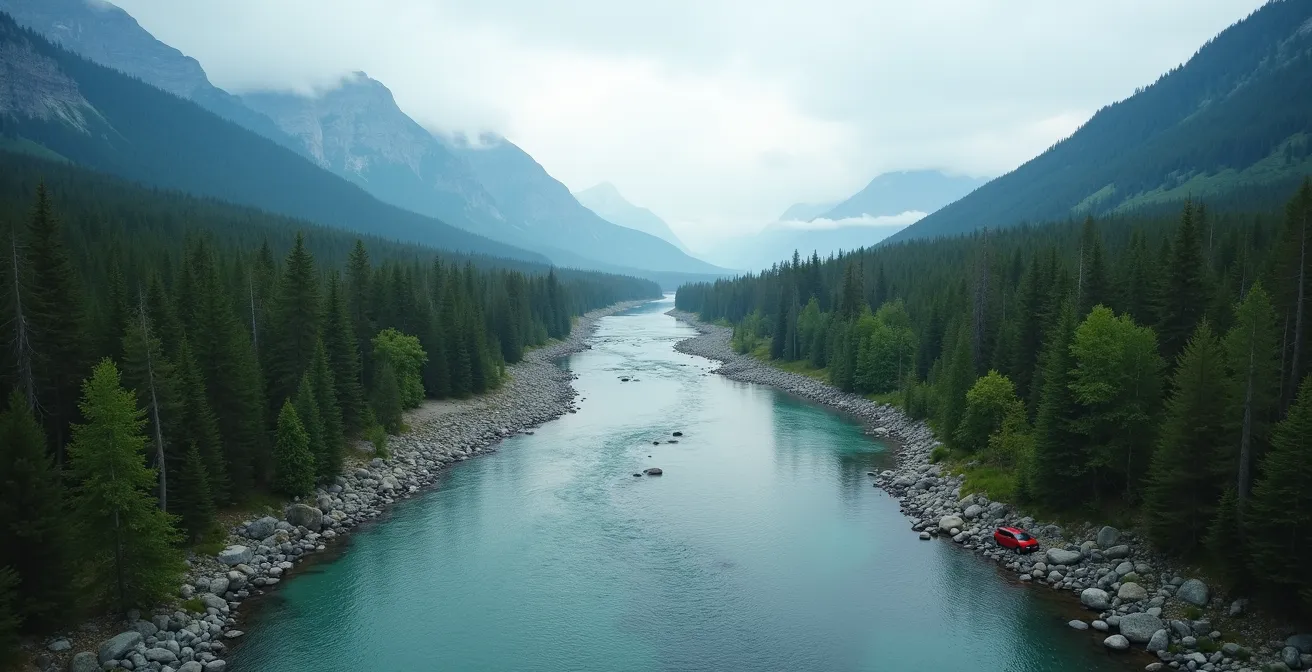
This jurisdictional divide can lead to unexpected costs. A traveler might budget for the Discovery Pass, only to find they need to spend an additional $20 for a day pass in an Ontario Park or purchase an entirely separate annual pass for Kananaskis. Before buying a Discovery Pass, you must meticulously map your itinerary and identify which parks are national and which are provincial. This “jurisdictional arbitrage” is a non-negotiable step in your ROI calculation.
The table below highlights the fragmented nature of park pass systems across Canada, underscoring why the Discovery Pass is not a one-size-fits-all solution.
| Province | Pass Name | Annual Cost | Coverage |
|---|---|---|---|
| Alberta | Kananaskis Conservation Pass | $90 CAD | Kananaskis Country & Bow Valley only |
| Ontario | Ontario Parks Pass | Varies by park | Provincial parks in Ontario |
| British Columbia | BC Parks Pass | No annual pass system | Day-use fees vary by park |
| Manitoba | Manitoba Parks Pass | $44 CAD | All provincial parks |
Do You Need a Parks Canada Pass Just to Drive Through Banff National Park?
A frequent and important question for travelers is whether a pass is required simply to transit through a national park without stopping. The answer is nuanced and depends on the specific road you are on. If you are driving on the Trans-Canada Highway (#1) through a park like Banff or Yoho, you are not required to have a pass, provided you do not stop.
This exemption exists because the Trans-Canada is a primary national transportation corridor. You can legally drive from Calgary, through Banff National Park, and into British Columbia without purchasing a pass if your journey is purely for transit. This also applies to emergency situations; if you have a vehicle breakdown or a medical emergency, you are exempt from pass requirements. However, the moment you pull over to use a park facility, the exemption ends. As defined by Banff National Park’s official requirements, you are considered to be “spending time in a national park” if you are taking part in activities like “road trips, camping, backcountry adventures, visits to picnic sites and viewpoints, stops in towns and villages” like Banff or Lake Louise.
This is where it gets tricky. The transit exemption does not apply to scenic parkways. Routes like the iconic Icefields Parkway (Highway 93 North) between Lake Louise and Jasper, or the Bow Valley Parkway (Highway 1A), are considered park activities in and of themselves. Driving these routes, even without stopping, absolutely requires a valid Parks Canada Discovery Pass or a daily admission pass. Mistaking these scenic drives for transit corridors is a common and costly error for uninformed tourists.
In essence, if your vehicle’s tires leave the pavement of the Trans-Canada Highway for anything other than a genuine emergency, you are officially a park visitor and must have a valid pass displayed. This includes stopping at a viewpoint, having a picnic, or even just pulling into a townsite to get gas or coffee.
The Rearview Mirror Hang tag: How to Avoid a Ticket When Parked at a Trailhead?
Purchasing the Discovery Pass is only half the battle; correctly displaying it is crucial to avoid a fine, which would instantly negate any savings. This is a matter of compliance, and failure to comply carries a financial risk. Whether you receive a physical hang tag or a printable e-pass, the rules for display are specific and strictly enforced by park wardens, especially in busy parking lots at trailheads and popular viewpoints.
If you purchase your pass online, you will receive a printable version. Before your arrival, you must print it and fold it as instructed, ensuring the expiry date is facing up and clearly visible. This printed pass should be placed on the driver’s side of the dashboard. If you are unable to print it, you must be prepared to show the pass on your mobile device at the first Parks Canada location you visit (like an entry gate or visitor centre) to exchange it for a physical hang tag. This tag should then be hung from your vehicle’s rearview mirror.

The visibility of the pass is paramount. A pass tucked away in the glove compartment or a wallet is invalid for parking purposes. Wardens must be able to see the expiry date without having to search. This simple act of compliance protects your investment. For other types of entry, the rules differ slightly. At National Historic Sites, or if you are arriving on foot, by motorcycle, or by boat, you are required to present your pass in person to staff upon arrival. Forgetting to display the pass is not a valid excuse and can result in an unwelcome ticket on your windshield, an easily avoidable expense.
Think of the hang tag or dashboard pass as the proof of your “share” in the Parks Canada system. It must be prominently displayed to claim your benefits. A clear, visible pass ensures a stress-free experience, allowing you to focus on the scenery instead of worrying about a potential fine.
Key Takeaways
- The Discovery Pass financial break-even point is typically 7 days for a solo traveler, but can be as few as 3-4 days for a family.
- The pass is for FEDERAL sites only; it is not valid at provincial parks like Algonquin or in Alberta’s Kananaskis Country.
- Strategic purchase timing (e.g., early in the month) can extend the pass’s validity to nearly 13 months, significantly increasing its ROI.
How to Visit Banff and Jasper in July Without Being Stuck in Traffic?
The final, and often overlooked, component of the Discovery Pass’s value is not financial, but logistical: time. Visiting Canada’s flagship parks like Banff and Jasper in peak season (July and August) can be a battle against congestion. Banff, the most visited national park in Canada, saw over 4 million visitors in 2022/23. This popularity translates into long lineups at the park entry gates, especially on weekend mornings.
This is where the Discovery Pass becomes a time-saving asset. With a valid pass displayed, you can use the dedicated pass-holder lanes or, in many cases, bypass the gatehouses entirely. As Off Track Travel highlights, “At road entrances into Banff National Park, there is no need to stop at the Parks Canada gatehouse if you have a valid Discovery Pass displayed”. This can save you anywhere from 15 minutes to over an hour of sitting in traffic, a significant benefit when you have a packed itinerary of hikes and sightseeing. This saved time is a tangible, albeit non-monetary, return on your investment.
By eliminating the need to stop, pay daily fees, and interact with staff at the gate, you get to your destination faster and with less stress. For a traveler on a tight 10-day schedule, an extra hour of daylight at Moraine Lake or on a trail in Jasper is incredibly valuable. This convenience factor should absolutely be weighed in your decision. The pass transforms your park entry from a potential bottleneck into a seamless experience. In the high-stakes environment of a peak-season road trip, the Discovery Pass is not just a key to the parks; it’s a key to a more efficient and enjoyable vacation.
Ultimately, the decision to buy a Discovery Pass is a calculation of ROI that includes money, time, and convenience. By analyzing your itinerary, group size, and travel dates through the financial lens we’ve provided, you can move beyond the simple 7-day rule and make a truly informed investment in your Canadian adventure.
Having analyzed all the variables, the next logical step is to map your intended route against the list of included national parks and historic sites to finalize your personal cost-benefit analysis.
Frequently Asked Questions About the Parks Canada Discovery Pass
Can I drive Highway 1 through Banff National Park without paying?
Yes, if you don’t plan to stop anywhere along the way. The Trans-Canada Highway has right-of-way status through the park.
What about emergency stops like vehicle breakdown?
Emergency situations are exempt from requiring a pass, including vehicle breakdowns or medical emergencies.
Does this exemption apply to scenic routes like the Icefields Parkway?
No, scenic parkways like the Icefields Parkway and Bow Valley Parkway are considered park activities and always require a pass.