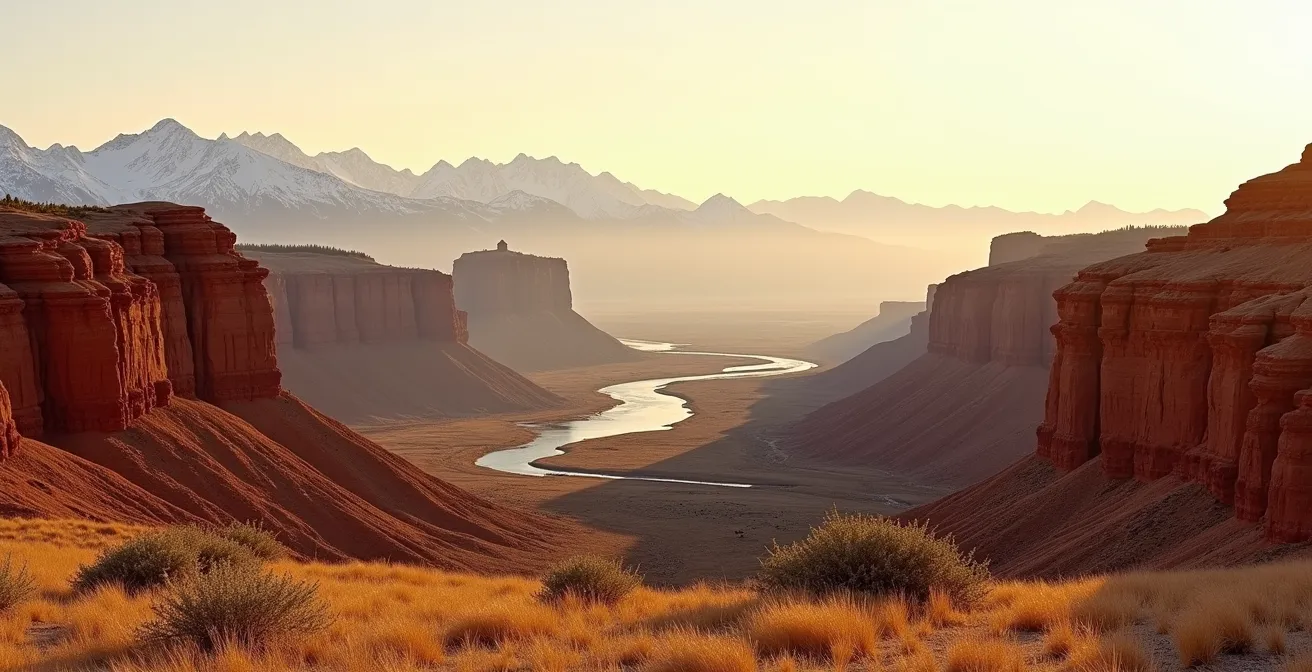
The true Alberta experience isn’t found in the Rockies’ most crowded spots, but in the deliberate choices you make to explore the vast, story-rich Badlands.
- This means choosing the scenic Cowboy Trail over the fast highway, understanding the difference between a curated dude ranch and an authentic working ranch, and preparing for the unique challenges of the prairie climate.
- Exploring this landscape reveals a deeper story of the province, from sacred Indigenous sites to a resilient ranching culture.
Recommendation: Embrace the contrast. Pair a mountain trip with a Badlands journey to understand the full, diverse soul of Alberta.
When you picture Alberta, a specific image likely comes to mind: the turquoise lakes and jagged, snow-dusted peaks of Banff and Jasper. It’s an image plastered on postcards and endlessly shared on social media. Many travelers arrive, tick off Lake Louise and the Icefields Parkway, and leave believing they’ve seen the province. But as a geographer who has walked, driven, and studied this land, I can tell you they’ve only read the first chapter. They’ve missed the geological and cultural counterpoint that truly defines Alberta’s character: the Badlands.
The common advice is to “go see the dinosaurs” in Drumheller, a worthy but incomplete suggestion. This reduces a vast, complex region to a single museum. The real story of Alberta is one of geological duality—the dramatic uplift of the Rocky Mountains juxtaposed with the patient, relentless erosion that carved the Badlands. To truly understand this province is to experience both.
But what if the key to unlocking this deeper experience wasn’t about where you go, but about the choices you make to get there? This guide is not a simple itinerary. It is a framework for making informed choices that contrast the familiar mountain vacation with the profound, authentic adventure of the Badlands. We will explore how choosing a different highway, a different kind of accommodation, and even a different style of “fitness” reveals the soul of a land that is far more than just its mountains.
This article guides you through the crucial decisions that will transform your trip from a typical tourist outing into a genuine exploration. From understanding the real risks of the prairie heat to choosing an authentic Western experience, you’ll learn to see Alberta not as a single destination, but as a land of fascinating and rewarding contrasts.
Summary: A Geographer’s Guide to Alberta’s Contrasting Landscapes
- Heat Stroke Risk: Why You Must Hike Drumheller Canyons Before 11 AM in July
- Calgary Stampede: How to Dress Western Without Looking Like a Costume?
- The River Valley: How to Explore North America’s Largest Urban Park System?
- Highway 22 vs. Highway 2:How to Prepare Your Vehicle for the 7,800 km Trans-Canada Highway Crossing?
- Head-Smashed-In Buffalo Jump: Why This UNESCO Site is Worth the Detour?
- Writing-on-Stone: Why You Must Follow Rules at Sacred Petroglyph Sites?
- The Cattle Drive: Are You Fit Enough for 8 Hours in the Saddle?
- Dude Ranch vs. Working Ranch: Which Alberta Horse Experience fits Your Skills?
Heat Stroke Risk: Why You Must Hike Drumheller Canyons Before 11 AM in July
The sun-baked coulees and hoodoos of the Drumheller Valley offer an otherworldly landscape that feels a million miles from the alpine meadows of the Rockies. This is Alberta’s desert, and its stark beauty is seductive. However, under the intense July sun, that beauty hides a significant danger: extreme heat. The canyons that are so fascinating to explore can become dangerous heat traps, with temperatures soaring far above the forecast.
Many visitors, accustomed to cooler mountain air, underestimate this risk. The danger is not hypothetical; a report from the neighboring province of British Columbia documented 619 heat-related deaths during a single heat event in 2021, highlighting how severe this threat can be in Western Canada. In the Badlands, the dry air and reflective soil can accelerate dehydration and lead to heat stroke with surprising speed. The key is not to avoid the canyons, but to respect their rhythm.
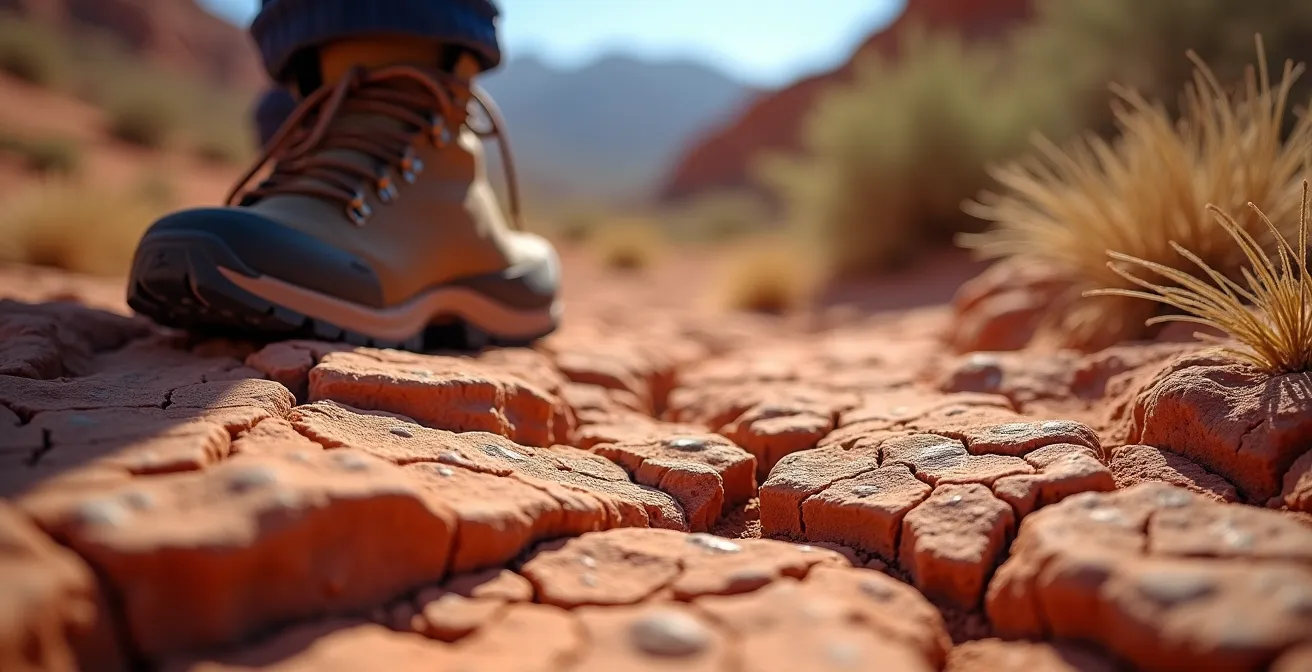
As the photo suggests, the golden hours of the early morning are the secret. This means starting your hikes before 7 AM, when temperatures can be 10-15°C cooler than at midday. This is the pace of the prairie: a deliberate approach that works with the environment, not against it. A proper kit is non-negotiable: carry a minimum of three litres of water per person, wear light-coloured and moisture-wicking clothing, and pack electrolyte supplements, available at stores like Canadian Tire or MEC. Taking mandatory shade breaks every 30 minutes during peak hours isn’t a sign of weakness; it’s a vital survival strategy in a landscape that commands respect.
Calgary Stampede: How to Dress Western Without Looking Like a Costume?
Every July, Calgary transforms. The glass towers of the corporate hub give way to a city-wide celebration of its western roots during the Calgary Stampede. For a visitor, it’s a spectacle of rodeo, music, and prairie culture. It’s also a sartorial minefield. There’s a fine line between paying homage to authentic western wear and looking like you’re wearing a cheap Halloween costume. The secret isn’t in buying the flashiest gear, but in understanding the functional origins of the style.
The authentic West is about practicality, not performance. Skip the novelty fringe and oversized rhinestone buckles. Instead, think about the context. A local’s attire subtly changes throughout the day. For a morning visit to the agricultural barns or a pancake breakfast, worn denim, a simple plaid shirt, and practical boots are standard. When heading to the afternoon rodeo, adding a single quality piece, like a felt hat from a venerable local maker like the Alberta Boot Company, signals respect for the tradition.
For the evening Grandstand Show or a night out at a music venue like the Nashville North tent, a switch to dark-wash jeans, perhaps with a leather vest, elevates the look. Accessorizing is key but should be subtle—a simple silver buckle has more impact than a giant, flashy one. The goal is to look like you belong in the environment, not like you’re trying to stand out. True western style is earned through wear and function; it’s an understated confidence, not a loud declaration.
The River Valley: How to Explore North America’s Largest Urban Park System?
While the Badlands offer a wild, untamed canyon experience, Alberta provides another, strikingly different version right in the heart of its capital. Edmonton’s North Saskatchewan River Valley is the largest expanse of urban parkland in North America, a 7,400-hectare green canyon that carves through the city. For the traveler exploring Alberta’s contrasts, it presents a fascinating counterpoint to the desert-like coulees of Drumheller.
Unlike the remote, vehicle-dependent Badlands, the River Valley is a fully integrated part of urban life, accessible by public transit and crisscrossed by over 160 kilometers of maintained trails. Here, the challenge isn’t navigating rough terrain or extreme heat, but choosing how to engage with a vast, multi-use space. Will you rent a bike and follow the paved paths for kilometers, rent a canoe to see the city skyline from the water, or join locals at a winter festival on the frozen river? The choice defines your experience.
The contrast between these two Albertan “canyons” is a perfect illustration of the province’s diversity. One is a testament to raw, geological time, while the other showcases a harmonious blend of nature and urban design. The following table breaks down these differences, helping you make an informed choice about which canyon experience fits your travel style.
| Feature | Edmonton River Valley | Alberta Badlands |
|---|---|---|
| Landscape Type | Urban forest canyon | Desert-like canyons |
| Trail Network | 160 km paved/groomed | Remote hiking paths |
| Best Season | Year-round access | May-October ideal |
| Unique Activities | Winter festivals on ice | Fossil hunting |
| Accessibility | Public transit connected | Vehicle required |
Highway 22 vs. Highway 2:How to Prepare Your Vehicle for the 7,800 km Trans-Canada Highway Crossing?
The journey from Calgary towards the Badlands presents a traveler’s first and most fundamental choice, one that perfectly encapsulates the theme of this guide: efficiency versus experience. You can take the fast, four-lane Highway 2, a direct artery designed to get you from A to B as quickly as possible. Or, you can choose Highway 22, the legendary “Cowboy Trail,” a two-lane road that meanders through the foothills and ranching country. This decision is not about logistics; it’s about philosophy.
Highway 2 is predictable and functional. Highway 22 is a story. It winds past historic ranches, offers stunning views of the Rocky Mountain front ranges, and demands a slower, more observant pace. As one of the most scenic drives in the country, it’s an experience in itself. However, this choice comes with practical considerations. Services are more spread out, cell coverage can be spotty, and the risk of encountering wildlife—or a stray cow—on the road is significantly higher, especially at dawn and dusk. A study of prairie drives on routes like the Cowboy Trail underscores these differences.
This table highlights the trade-offs, making it clear that your choice of road is a choice of travel style.
| Route Feature | Highway 22 (Cowboy Trail) | Highway 2 (Queen Elizabeth II) |
|---|---|---|
| Distance Calgary to Drumheller | 280 km via scenic route | 135 km direct |
| Drive Time | 4-5 hours with stops | 1.5 hours non-stop |
| Scenery | Ranching country, foothills | Prairie farmland |
| Gas Stations | Every 50-80 km | Every 20-30 km |
| Wildlife Risk | High at dawn/dusk | Moderate |
Opting for the Cowboy Trail or any rural Alberta road requires a different level of vehicle preparedness. It’s not just about a full tank of gas; it’s a mindset of self-reliance.
Your Action Plan: Rural Alberta Vehicle Preparation Checklist
- Gas Policy: Never pass a gas station with less than half a tank in prairie regions.
- Emergency Supplies: Carry a minimum of 4L of emergency water and basic, non-perishable food supplies.
- Tire Check: Verify spare tire pressure and the functionality of your jack before departing from a major city.
- Offline Navigation: Download offline maps for your entire route, as cell coverage is unreliable between towns.
- Windshield Kit: Pack a gravel windshield repair kit; small chips from passing trucks are common on rural roads.
- Wildlife Safety: Install deer whistles (a common local precaution) and drive with extreme caution at dawn and dusk.
Head-Smashed-In Buffalo Jump: Why This UNESCO Site is Worth the Detour?
Just looking at a map, Head-Smashed-In Buffalo Jump can seem like an out-of-the-way detour. It’s not directly on the main tourist track between Calgary and Banff. This is precisely why it’s so essential. The site, a UNESCO World Heritage treasure, is one of the world’s oldest, largest, and best-preserved buffalo jumps. For over 6,000 years, the Blackfoot people skillfully drove bison over these cliffs in a sophisticated, communal hunt. Visiting is not just a history lesson; it’s a profound connection to the living history of the Plains Indigenous peoples.
Unlike a static museum display, the award-winning interpretive centre is built directly into the cliffside, allowing you to experience the landscape from the same perspective as the hunters. You stand at the top, feeling the relentless prairie wind, and look down at the processing fields below. You are not just learning about history; you are standing within it. This is where the abstract stories of the plains become tangible. It is a place that powerfully demonstrates the deep ingenuity and spiritual connection the Blackfoot have with this land.
But the experience extends beyond the archaeology. It’s about immersing yourself in the vastness of the prairie landscape itself. As local expert Linda Miller shared with National Geographic, the site offers more than just history. Her advice captures the soul of the place perfectly:
People should come for the skies. The sunsets are just gorgeous. The stars and the sky at night are so full and vast.
– Linda Miller, National Geographic – Canadian Badlands
That is why it’s worth the detour. You go for the history, but you stay for the sky. You arrive to see a cliff, but you leave with a sense of the immense scale of both the landscape and the human story embedded within it.
Writing-on-Stone: Why You Must Follow Rules at Sacred Petroglyph Sites?
Deep in southern Alberta, along the Milk River, lies Áísínai’pi, or Writing-on-Stone Provincial Park. This stunning landscape of sandstone hoodoos and coulees is another of Alberta’s UNESCO World Heritage Sites. But its primary significance is not geological; it is spiritual. This is the largest concentration of First Nation petroglyphs (rock carvings) and pictographs (rock paintings) on the Great Plains, a sacred place where the Blackfoot (Niitsítapi) people have come for millennia to record stories, prophecies, and spiritual visions.
When you visit, it is crucial to understand that you are not in a typical park or museum. You are in an open-air cathedral. The rock art here is not just “art”; it is a library of sacred texts, a living connection to ancestors, and an active part of contemporary Indigenous spirituality. This context transforms a tourist’s responsibility. The rules here aren’t about crowd control; they are about profound respect for a living culture.
The single most important rule is to never, ever touch the rock art. The oils from human skin are incredibly damaging, accelerating the erosion of the delicate sandstone and fading the images. Similarly, staying on marked trails is not just for your safety, but because the surrounding area contains countless undocumented and fragile archaeological sites. The best way to experience Áísínai’pi is to book a guided tour with a park interpreter or a local Blackfoot guide. They can share the stories behind the carvings, explain their significance, and provide a layer of understanding that is impossible to achieve on your own. It is an act of respect to listen and learn from the culture you are visiting, and supporting the Indigenous-owned businesses at the interpretive centre is a tangible way to give back.
Key Takeaways
- The Badlands demand a different mindset: respect the climate, prepare for self-reliance, and embrace a slower pace of travel.
- A true Alberta adventure is defined by informed choices, whether it’s the road you take, the history you engage with, or the type of ranch you visit.
- The province’s character lies in its contrasts—the mountains vs. the prairie, the urban vs. the wild, and the ancient vs. the modern.
The Cattle Drive: Are You Fit Enough for 8 Hours in the Saddle?
For many, the ultimate western fantasy is a real cattle drive. The idea of spending a day in the saddle, moving a herd across the vast prairie, is a powerful draw. But here lies another critical contrast between the mountains and the plains: the type of fitness required. A traveler who can conquer a 10-kilometer mountain summit hike might assume they are more than ready for a day on horseback. This is a common and painful miscalculation.
Summit-fit is not saddle-fit. The physical demands are completely different. Hiking is a cardiovascular challenge that primarily uses the large muscles in your legs. An eight-hour cattle drive, however, is a test of sustained, low-impact strain on a completely different set of muscles. It’s an endurance challenge for your core, inner thighs, and lower back—muscles that are often neglected in typical fitness routines. The mental challenge also differs: a summit push is about powering through intense bursts of effort, while a cattle drive requires immense patience through hours of monotony, punctuated by brief moments of focused work.
A recent analysis in a men’s travel guide confirmed that the recovery time is also deceptive; while leg soreness from a hike might last a day or two, the unique muscle pain from your first long ride can last for three to five days. Understanding this difference is key to enjoying the experience rather than just enduring it. The following table clarifies the distinction.
| Fitness Aspect | Mountain Summit | 8-Hour Cattle Drive |
|---|---|---|
| Primary Muscles | Legs, cardiovascular | Core, inner thighs, lower back |
| Endurance Type | Intense bursts, recovery | Sustained low-impact strain |
| Mental Challenge | Push through breathlessness | Patience through monotony |
| Weather Exposure | Can retreat if needed | No escape for 8 hours |
| Recovery Time | 1-2 days soreness | 3-5 days unique muscle pain |
This doesn’t mean you should avoid the experience. It means you should prepare for it specifically. A few weeks of pre-ride conditioning, focusing on wall-sits to build riding-position endurance, hip flexor stretches, and core exercises like planks, can make all the difference between a trip of a lifetime and a week of agony.
Dude Ranch vs. Working Ranch: Which Alberta Horse Experience fits Your Skills?
The final, crucial choice for any traveler seeking a western horse experience in Alberta is deciding between a “dude ranch” and a “working ranch.” The terms are often used interchangeably by visitors, but for locals, they represent two vastly different worlds. Your choice will fundamentally define your vacation, and aligning it with your expectations and skill level is paramount. A dude ranch is designed for tourism; a working ranch is designed for cattle.
A dude ranch is a hospitality experience centered around horses. The schedule is built for guest enjoyment: gourmet meals, guided scenic trail rides that match your (often beginner) skill level, and afternoon activities like swimming or spa treatments. It’s a curated, comfortable, and often luxurious way to experience the western lifestyle. A working ranch, on the other hand, is a business. Guests are often invited to participate in the real, unglamorous work of the ranch. Your day is dictated by the needs of the animals and the land, not a guest services manager.
This means waking up at 5:00 AM to feed horses, spending the day mending fences or moving cattle to a new pasture, and eating a packed lunch in the field. The reward is not luxury, but unfiltered authenticity. A detailed comparison from a local tourism guide illustrates the stark daily differences.
| Time | Dude Ranch | Working Ranch |
|---|---|---|
| 5:00 AM | Guest sleeping | Feed horses, check fences |
| 7:00 AM | Gourmet breakfast buffet | Quick ranch breakfast |
| 9:00 AM | Guided scenic trail ride | Move cattle to new pasture |
| 12:00 PM | Three-course lunch | Packed lunch in field |
| 3:00 PM | Pool time or spa | Fence repair work |
| 6:00 PM | Wine and appetizers | Family-style dinner |
| 8:00 PM | Campfire entertainment | Planning next day’s work |
Neither experience is “better”—they simply serve different purposes. The question is, what do you truly want? Do you want to be pampered in a western setting, or do you want to feel the exhaustion and satisfaction of a day’s real work? This choice is the ultimate expression of the informed travel this guide advocates for.
Ultimately, choosing your Alberta adventure is about looking beyond the postcard. It’s about seeing the province as a land of dynamic contrasts and making deliberate choices that lead to a richer, more authentic experience. To truly understand this place, you must be willing to trade the crowded viewpoint for the open road, the curated tour for the real work, and the easy answer for the informed choice.